 Birch Bay
 Exterior Work Built for Custer's Climate
Custer sits in the northwest corner of Whatcom County, close enough to Birch Bay and the Strait of Georgia that homes here deal with the same maritime weather pattern as the coastline: salt-tinged air on windy days, long stretches of driving rain off and on from fall through spring, and the kind of persistent shade and dampness that keeps moss and algae established on roofs, siding, and decking almost year-round. Add in the wide temperature swings between damp winters and warm, dry summers, and you have a climate that is genuinely hard on exterior building materials over a 20- or 30-year timeline.
We work throughout this part of Whatcom County, and Custer's mix of rural properties, wooded lots, and closer-in neighborhoods near Birch Bay all share the same underlying problem: whatever is on the outside of the house needs to shed water fast, resist moisture intrusion at every seam, and hold up to repeated wet-dry cycling without swelling, cracking, or feeding mold and moss growth. That's the lens we bring to siding, roofing, windows, and decks on every Custer project.
What Salt Air, Rain, and Moss Actually Do to a House
Salt Air and Coastal Moisture
Custer isn't beachfront, but it's close enough to Birch Bay and the Strait that airborne salt and marine moisture reach homes here, especially on west- and northwest-facing walls that catch weather coming off the water. Salt-laden moisture accelerates corrosion on exposed metal fasteners, flashing, and hardware, and it speeds up the breakdown of materials that weren't engineered with coastal exposure in mind.
Driving Rain
Whatcom County doesn't get the heaviest rainfall totals in Western Washington, but what it does get often arrives sideways, driven by wind off the water. Driving rain finds every gap in a siding system, every under-flashed window, and every roof valley that wasn't detailed correctly. Once water gets behind siding or under roofing, it doesn't dry out quickly in this climate — it sits, and that's when rot, mold, and structural damage start.
Moss and Algae
Between the shade from mature trees on many Custer lots and the sheer number of damp days per year, moss and algae get a long runway to establish themselves on north-facing walls, roof shadows, and anywhere water lingers. Moss holds moisture against the surface it's growing on, which is a slow, steady threat to wood-based siding, cedar trim, and asphalt shingles alike.
Siding: Why We Only Install James Hardie
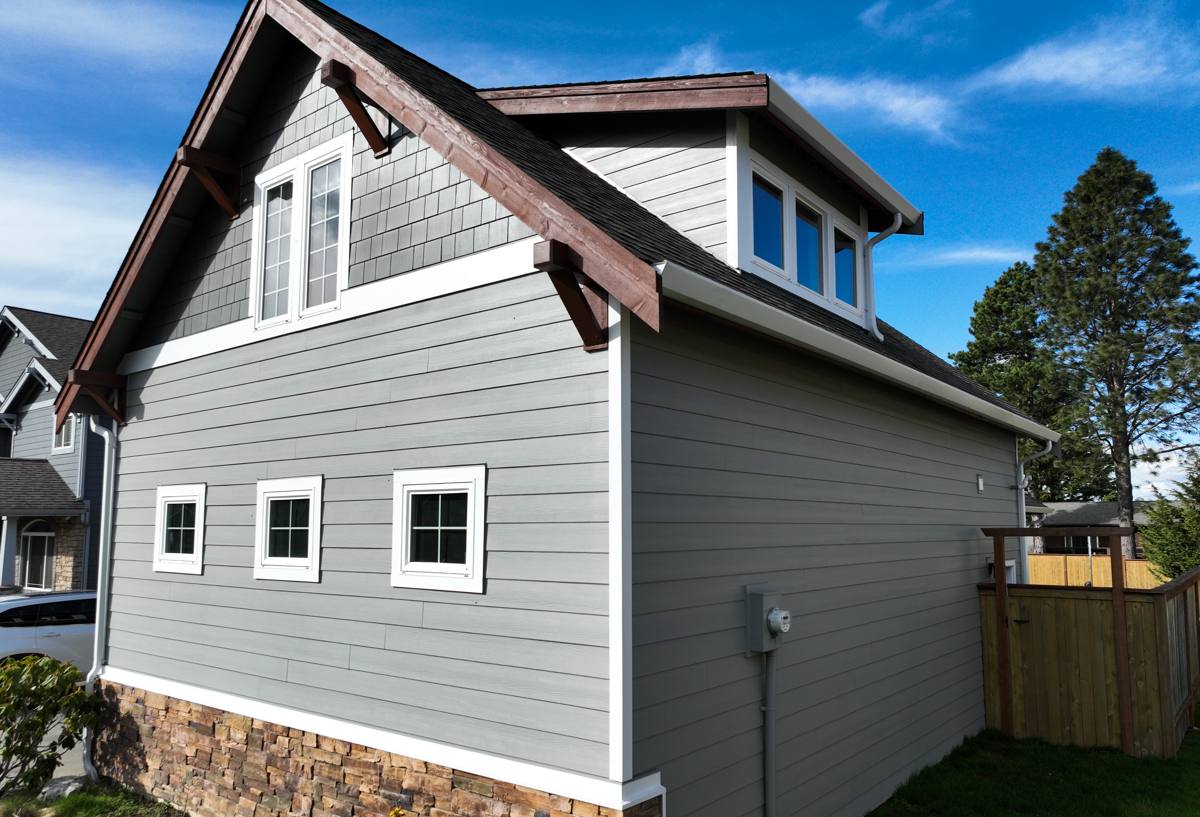
We install James Hardie fiber cement siding exclusively — we don't do vinyl, LP SmartSide, Cemplank, Allura, primed spruce, or cedar. That's not a marketing position, it's a standard we hold because of what we've seen these materials do in exactly the kind of climate Custer sits in.
- Vinyl can warp or become brittle with the temperature swings this area sees, and its seams and J-channels give wind-driven rain more opportunities to get behind the panels.
- Wood-based products (LP SmartSide, primed spruce, cedar) are organic materials at their core. Even with engineered treatments or careful priming, sustained damp exposure and moss contact are the exact conditions that break down wood fiber over time — swelling, edge softening, and eventually rot at seams and butt joints.
- Other fiber cement brands (Cemplank, Allura) use the same basic material science as Hardie, but we've standardized on Hardie specifically for its ColorPlus factory-baked finish, its HZ5 product line engineered for the Pacific Northwest's moisture cycle, and the strength of its transferable warranty when the installation is done to spec.
James Hardie fiber cement is non-combustible, dimensionally stable across our wet-dry seasonal swing, and doesn't feed mold or moss the way organic siding can. The ColorPlus finish is baked on at the factory under controlled conditions, which matters here specifically because field-applied paint on any siding product is the first thing to fail under repeated rain and UV exposure — ColorPlus is built to outlast that cycle by years.
Hardie Product Lines We Install
| Product | Best Use | Why It Fits This Climate |
|---|---|---|
| HardiePlank Lap Siding | Most common full-house application | Available in HZ5 zone engineering; sheds driving rain well when lapped and flashed correctly |
| HardieShingle | Accent gables, dormers, feature walls | Gives a cedar-shake look without the moisture vulnerability of real wood shakes |
| HardiePanel | Modern vertical siding, accent sections | Clean lines for contemporary Custer builds; needs correct joint detailing to perform |
| HardieTrim | Corners, fascia, window and door trim | Won't rot or attract moss the way wood trim does in shaded, damp areas |
Roofing for a Wet, Moss-Prone Climate
Roofing in Custer has to deal with the same driving rain and moss pressure as siding, but with the added stakes of a fully exposed, horizontal-ish surface that catches everything the sky delivers. Underlayment quality, valley flashing, and proper ventilation matter as much as the shingle or roofing material itself — a roof that traps moisture in the attic space will fail from the inside long before the shingles wear out on top.
We pay particular attention to:
- Valley and flashing details, since that's where the majority of leaks in this region actually start
- Ventilation balance, so moisture from inside the house doesn't condense against the roof deck
- Roof and gutter transitions that keep water moving off the house instead of pooling near siding and trim
Moss treatment and prevention (zinc or copper strips, proper tree clearance where possible, and periodic cleaning) extend roof life significantly in a climate where moss is a near-constant presence rather than an occasional nuisance.
Windows: Keeping Driving Rain Out
Window failures in this part of Whatcom County are rarely about the glass — they're about flashing and installation. A window that isn't properly flashed and sealed will let wind-driven rain track behind the frame and into the wall cavity, where it can sit unnoticed for a long time before it shows up as a soft spot, staining, or a musty smell. When we replace windows as part of a siding or exterior project, we integrate the window flashing with the new siding's water management plan rather than treating them as separate jobs — that continuity is what actually keeps water out over the long run.
Energy performance matters too. Modern dual-pane or triple-pane windows with a good low-E coating help even out the temperature swings between our damp winters and warmer summer days, and they cut down on the condensation that can form on older, single-pane glass during cold, wet stretches.
Decks: Built to Handle Standing Water and Moss
Decks take a beating in this climate because they're horizontal, often partially shaded, and directly exposed to standing water after rain. Composite decking has largely replaced wood for good reason here — it doesn't absorb moisture the way wood does, and it resists the moss and algae growth that makes wood decks slick and slowly degrades the boards. For homeowners who prefer real wood, proper spacing, drainage, and a realistic maintenance schedule (cleaning, sealing) are non-negotiable in a climate this damp.
Ledger board flashing — where the deck attaches to the house — is one of the most common failure points we see on older decks in this area. Water intrusion at that connection point can damage both the deck framing and the house's wall structure behind it, so it's worth having that connection inspected even if the deck surface itself still looks fine.
What Homeowners in Custer Should Watch For
- Dark streaking or green growth on north-facing or shaded siding sections
- Soft or spongy spots when pressing on wood trim, fascia, or siding near ground level
- Paint that's peeling, bubbling, or chalking faster than expected between repaints
- Gaps or separation at siding seams, window trim, or corner boards
- Granule loss or moss buildup on roof valleys and north-facing roof slopes
- Musty odors near windows or exterior walls after heavy rain
- Standing water on deck boards that doesn't drain within a few hours
Why a Local Crew Matters Here
Exterior work in Custer isn't the same as exterior work in a drier inland climate, and it's not identical to work right on the Birch Bay waterfront either — it's its own mix of salt-air exposure, tree-shaded moisture retention, and driving rain off the Strait. A crew that works this specific stretch of Whatcom County regularly knows which wall orientations need extra attention, how far moss pressure extends inland from the water, and how to sequence a siding, roofing, window, or deck project around the wet-weather windows that define our build season here. That local knowledge shows up in the small decisions — flashing details, ventilation choices, product line selection — that determine whether an exterior holds up for 10 years or for 30.
If you're weighing a siding, roofing, window, or deck project on a Custer home, we're happy to take a look and talk through what your house is actually dealing with. Reach out for a free, no-pressure estimate using the form below.