 Birch Bay
 Custer's Weather Puts Vertical Siding to the Test
Custer sits close enough to the water that homes here deal with salt-laden air, wind-driven rain, and the kind of persistent damp that keeps moss growing on roofs and north-facing walls most of the year. Board and batten siding — with its raised vertical battens and exposed seams — is a beautiful look, but it's also a profile with more edges, more joints, and more places for water to find a way in than flat lap siding. In a drier climate that's a minor detail. In Whatcom County, it's the difference between siding that lasts decades and siding that needs paint, caulk, or board replacement within a few years.
We've installed and repaired enough vertical siding around Birch Bay and Custer to know exactly where board and batten fails first: batten fastening that wasn't sealed correctly, board ends left exposed to standing water, and material that simply wasn't built to handle constant moisture cycling. Getting board and batten right here isn't about the look — that part's easy. It's about the details underneath it, and about choosing a material that doesn't fight the climate from day one.
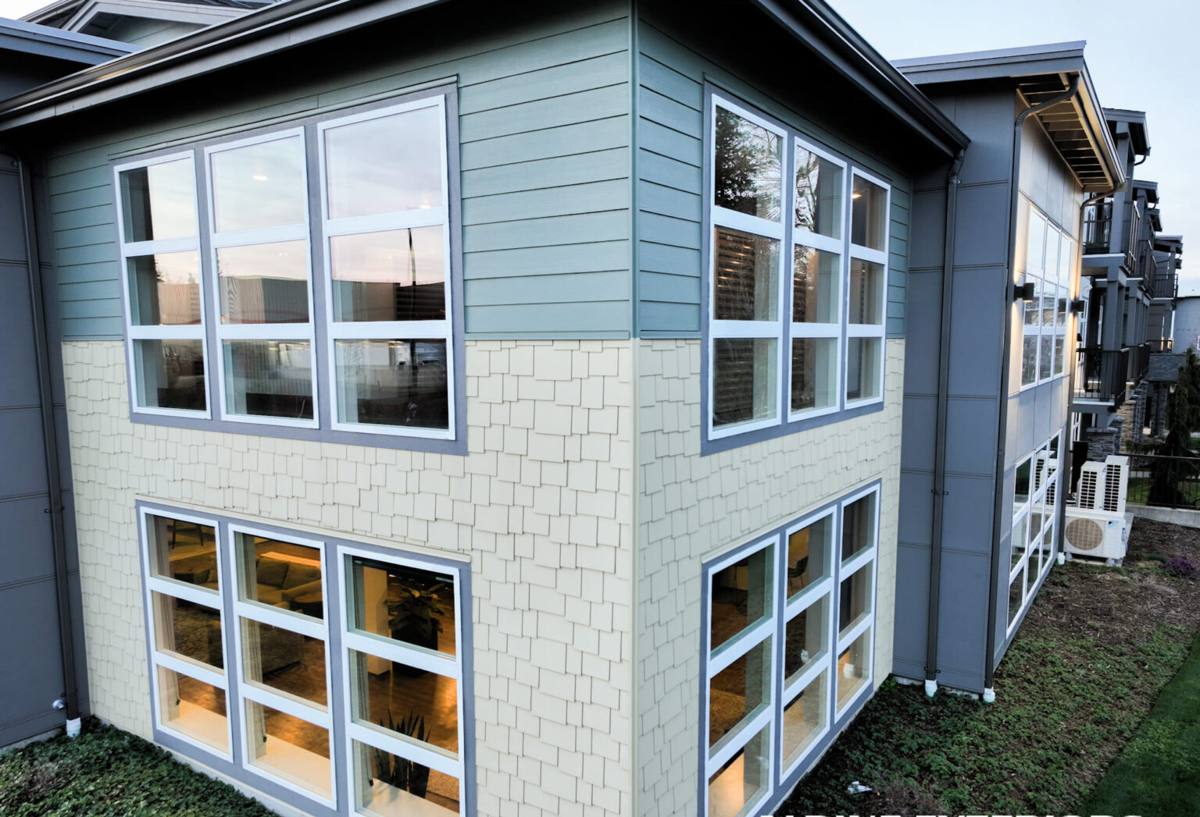
What Board & Batten Siding Actually Is
Board and batten is a siding profile built from wide vertical panels with narrower strips — battens — installed over the seams between them. The result is a clean, evenly spaced vertical line pattern that reads as farmhouse, craftsman, or modern coastal depending on the trim and color choices around it. It's popular around Custer as a full siding system on new builds and additions, and just as often as an accent — gables, entry surrounds, or a single feature wall — paired with lap siding on the rest of the house.
Why Homeowners in This Area Like It
Vertical board and batten breaks up the boxy look of a standard lap-sided home, works well with the mix of farmhouse and coastal cottage styles common around Birch Bay, and holds up visually against the region's overcast, gray-sky months better than some horizontal profiles — the strong vertical shadow lines still read clearly even in flat light.
Board & Batten vs. Lap Siding for a Custer Home
Lap siding is still the more forgiving choice for a full house in a wet climate — fewer vertical seams, simpler flashing details, and a longer track record on every wall orientation. Board and batten earns its place when the look matters as much as the performance: an accent gable, a porch or entry feature, or a full-house farmhouse look the homeowner specifically wants. We'll say so plainly if a wall's exposure makes board and batten a harder sell than lap siding in that spot — the right call depends on the specific wall, not a blanket rule either way.
Why Material Choice Matters More Here Than the Style Does
The board and batten look can be built out of several different materials, and in a marine climate like Custer's, the material matters far more than the profile itself. Here's how the common options actually perform under the salt air, driving rain, and moss pressure this area sees every year:
| Material | How It Holds Up in Custer's Climate | Long-Term Concern |
|---|---|---|
| Solid wood board & batten | Traditional look, but absorbs moisture at every seam and board edge | Rot, cupping, and repainting cycles every few years |
| Vinyl board & batten | Low up-front cost, but panels expand and contract with temperature swings | Fading, cracking in cold snaps, seams that let wind-driven rain behind the panel |
| Engineered wood (OSB-based) | Better dimensional stability than solid wood, still wood-based at the core | Edge swelling if the factory seal is ever compromised by moisture |
| James Hardie fiber cement | Dense, cement-based board that doesn't absorb water the way wood products do | None specific to the material — performance depends on correct installation |
This is exactly why our company installs only James Hardie fiber cement siding. We've made the call that in a climate like this, wood-based and vinyl board and batten products create ongoing maintenance and moisture problems fiber cement doesn't have — not because those products are poorly made, but because most of them weren't engineered for constant marine moisture exposure the way Hardie's Pacific Northwest product line is.
The James Hardie Board & Batten System We Install
For vertical siding, we install James Hardie's board and batten profile using HardiePanel vertical siding with separate Hardie trim boards as battens over the seams, finished in ColorPlus Technology factory-applied color. A few things about this system matter specifically for homes in this area:
Climate-Engineered for This Region
James Hardie manufactures its siding in different formulations engineered for specific climate zones, and the line specified for the Pacific Northwest is built to handle sustained moisture exposure and repeated wet-dry cycling without the fiber breakdown that can affect fiber cement not engineered for wet regions.
Factory Finish, Not Field Paint
ColorPlus finish is baked on at the factory under controlled conditions, which gives it better adhesion and fade resistance than field-applied paint — a real advantage in an area that sees this much rain and UV cycling through the year. It also means touch-up, when it's ever needed, uses matched ColorPlus product rather than repainting the whole wall.
Non-Combustible Core
Fiber cement doesn't burn, which is a straightforward advantage over wood-based and vinyl siding regardless of climate, and one more reason it's the only material we put on homes.
What Correct Installation Actually Involves
Board and batten is unforgiving of shortcuts, and most of the failures we get called out to look at in this area trace back to installation, not material. Because moss and algae need standing moisture and still air to take hold, a wall that can't drain and dry properly behind the siding is a wall that grows problems long before anyone notices from the outside. A correct install includes:
- A drainage gap (rainscreen) behind the panel so any moisture that gets past the surface has somewhere to go besides the sheathing
- Correct flashing at every horizontal transition — window heads, roof-to-wall intersections, and the base of the wall
- Fastener placement and spacing that follows the manufacturer's specification, not a generalized "close enough" pattern
- Battens fastened independently of the panel edge seam, not relied on to seal the joint by themselves
- Proper gapping and sealant at panel butt joints, sized for the temperature at time of install
- Starter strips and corner treatments that keep the bottom edge of the siding off standing water
Skip any one of these and the siding can still look right for the first year or two — the problems show up later, as trapped moisture works behind the panel where nobody sees it until there's a soft spot or paint failure. This is the main reason we don't treat board and batten as an easier version of lap siding. If anything, it demands more attention to flashing and drainage detail, not less.
Our Process for a Custer Project
Because we already work in and around Birch Bay and Custer, our process for a board and batten job here follows the same sequence every time:
- On-site assessment — we look at existing wall condition, moisture exposure (especially north and west-facing walls, which take the brunt of driving rain here), and whether this is a tear-off or a new install
- Material and layout plan — panel and batten spacing laid out to the specific wall, including how it meets existing trim, windows, and rooflines
- Weather barrier and drainage plane installation — this step is where most of the long-term moisture performance is decided
- Panel and batten installation — to manufacturer fastening spec, with flashing integrated at every penetration and transition
- Caulking, touch-up, and final inspection — checked against the same standard we'd want on our own homes
- Warranty registration — James Hardie's product warranty is registered to the homeowner, and our workmanship is covered separately
Maintenance in a Moss-Prone, Salt-Air Environment
Even with the right material and a correct install, board and batten siding in this area benefits from some basic seasonal attention. None of it is heavy work, but skipping it lets small issues turn into bigger ones over a few seasons:
- Rinse salt residue and grime off the siding once or twice a year, especially on walls facing open water or prevailing wind
- Keep gutters clear so overflow doesn't run down the face of the siding and feed moss growth at the top courses
- Trim back vegetation and tree cover that keeps a wall shaded and damp longer than the rest of the house
- Check caulking at trim and batten joints every year or two and have any cracked sealant redone before winter rains set in
- Watch for moss or algae staining at board and batten seams specifically — it tends to collect there before it shows up on flat siding
Cost Factors for a Custer Board & Batten Project
Board and batten pricing depends on more variables than a straightforward lap-siding job, mostly because of the trim and batten work involved. The broad factors that move the number:
| Factor | Why It Matters |
|---|---|
| Full house vs. accent application | An accent gable or entry feature costs far less than siding an entire home |
| Tear-off vs. new construction | Removing and disposing of old siding, and repairing sheathing underneath, adds labor |
| Wall condition | Rot or water damage found once old siding comes off needs to be addressed before new siding goes on |
| Trim and batten density | Narrower batten spacing means more material and more labor per square foot than wide spacing |
| Wall height and access | Two-story walls and steep or tight-access sites take longer and require more equipment |
We'll walk any Custer property and give a specific number based on these factors rather than a generic per-square-foot estimate — board and batten pricing varies too much house to house to be useful any other way.
Why a Crew That Already Works This Area Matters
Whatcom County's permitting and inspection expectations aren't identical everywhere, and a crew that already does work around Birch Bay and Custer isn't learning those requirements on your project. Local experience here also means knowing which walls on a given lot are going to take the worst of the driving rain and salt air based on orientation and tree cover, and building the flashing and drainage detail accordingly rather than treating every wall the same. That local knowledge doesn't show up as a line item on an estimate, but it shows up years later in which houses still look right and which ones don't.
It also means being available for the follow-up questions that come months or years after installation — a caulking check, a warranty question, or a second opinion on a wall that looks like it might need attention. A crew based near the job is easier to get back out for those small things than one that only shows up for the original bid.
If you're weighing board and batten siding for a home in Custer or anywhere around Birch Bay, we're happy to take a look and put together a straightforward, no-pressure estimate — what your specific walls need, what it involves, and what it costs, with no obligation attached.