 Birch Bay
 Siding Replacement in Custer, From a Crew Based Right Down the Road
Custer sits on flat, open Whatcom County land close enough to the Salish Sea that salt-laden air reaches most properties here, not just the handful closest to the water. Add driving rain that comes at walls sideways during winter storms and a moss season that runs long on shaded, north-facing exposures, and you get a climate that's genuinely hard on siding — harder than it looks from a dry summer curb appeal photo. When a Custer home's siding is due for replacement, the material choice and installation details matter more here than they would in a milder, drier market.
We're based in Birch Bay, a few minutes from Custer, and we work this stretch of Whatcom County on a regular basis rather than treating it as a stop between bigger jobs somewhere else. That matters for a siding replacement project specifically, because a lot of what makes an installation last thirty years instead of ten comes down to details a crew only gets right once they've seen how this exact climate treats a wall over multiple wet seasons.
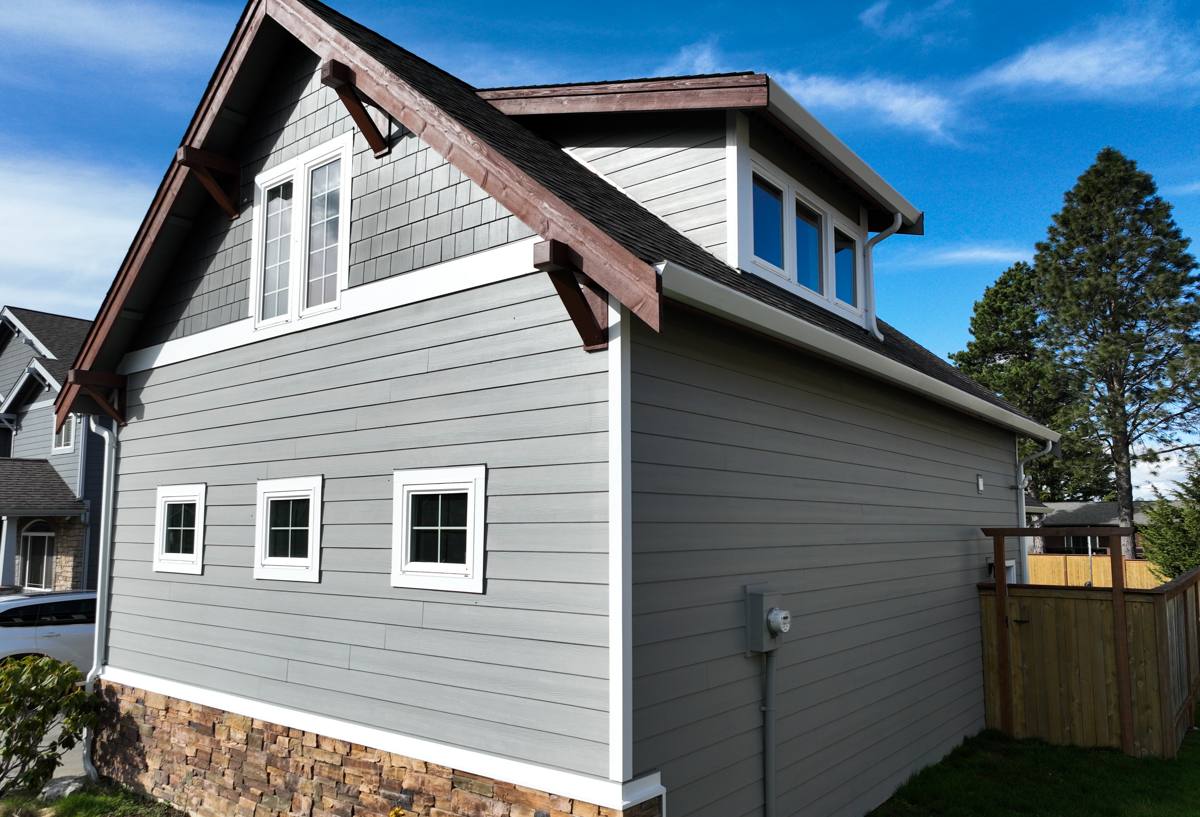
Why Siding Replacement Comes Up Sooner in Custer Than Inland Markets
Salt Air Off the Sound
Salt-laden air moving in off the water accelerates corrosion in fasteners, flashing, and trim hardware, and it breaks down lower-grade paints and finishes faster than a drier inland site would see. A siding system that's rated fine on a spec sheet written for a national market doesn't always get the same service life once it's actually hanging on a Custer wall for a couple of decades.
Wind-Driven Rain
Flat, open terrain around Custer gives storms very little to slow them down, so rain regularly arrives sideways instead of straight down. That pushes water into lap joints, trim seams, and anywhere the water management detailing behind the siding isn't right. It's a harder test on caulked joints and painted surfaces than the region's annual rainfall total suggests on its own.
A Long Moss and Mildew Season
Mild temperatures and steady moisture keep moss and mildew active across most of the calendar year, especially on shaded or tree-lined lots, which describes a lot of Custer properties. Organic growth on a siding surface holds moisture against the wall behind it, and that trapped moisture is where a lot of long-term siding failures actually start — quietly, over years, rather than as one obvious event.
Signs a Custer Home's Siding Has Reached the End of Its Service Life
- Moss or dark staining that returns quickly after cleaning, especially on shaded or north-facing walls
- Soft, spongy, or visibly bowed siding, particularly low on the wall or around window and door trim
- Peeling paint, chalking, or visible warping on older wood-based or engineered wood siding
- Cracked, buckled, or missing panels after a windy winter storm
- Rust streaking running down from fasteners or metal trim
- Musty smells or staining on interior walls that back up to an exterior wall
- Siding older than 20-25 years with no documented replacement or major repair history
None of these automatically means a full tear-off is the answer, but each one is worth a professional look before another wet season adds to whatever damage is already there.
What a Correct Siding Replacement Actually Involves
Replacing siding is more than swapping old panels for new ones. The sequence matters, and skipping steps to save a day or two of labor is exactly how a new-looking exterior ends up with the same moisture problems within a few years.
Full Tear-Off and Sheathing Inspection
Once the old siding comes off, we check the sheathing underneath for rot, soft spots, or hidden water damage before anything new goes up. Covering damaged sheathing with new siding just hides a problem that keeps getting worse behind the wall — we'd rather find it now, while it's still visible and fixable.
Weather Barrier and Flashing
Because so much siding failure in this climate comes from water getting behind the cladding rather than through it, the house wrap, window and door flashing, and every wall penetration get careful attention during a replacement. This step is easy to rush and nearly impossible to inspect once the new siding is up, so we treat it as a non-negotiable part of the job, not an upsell.
Installation to Manufacturer Spec
James Hardie's warranty depends on installation following their published specifications: correct fastener type and spacing, proper clearance above grade and roofline, and factory-cut edges used wherever possible, with field cuts sealed to spec. We install to that standard as the baseline on every job.
Final Walkthrough
We walk the finished job with the homeowner, cover realistic maintenance expectations for this climate, and confirm the work matches what was estimated before calling it done.
Why We Replace Old Siding With James Hardie, Not a Cheaper Alternative
We install James Hardie fiber cement exclusively — not vinyl, not LP SmartSide or other engineered wood products, not Cemplank or Allura, not primed spruce or cedar. That's a professional standard, not a sales angle, and it came from years of seeing what actually holds up on Whatcom County walls versus what looks fine on a spec sheet and starts showing problems a few winters in.
- Non-combustible core: fiber cement doesn't feed a fire the way wood-based siding can.
- Factory-applied ColorPlus finish: baked on under controlled conditions rather than field-painted, so it holds color and adhesion longer against salt air and UV.
- Climate-engineered HZ product lines: Hardie's HZ5 formulation targets regions with heavy moisture exposure and freeze-thaw cycling, a good match for this part of Whatcom County.
- Dimensional stability: fiber cement doesn't swell, cup, or warp the way wood-based sidings can after repeated wetting cycles.
- A strong transferable warranty: real coverage that follows the home if it sells, provided installation follows Hardie's spec.
Other products aren't defective, and plenty of homeowners elsewhere are satisfied with them. We've simply made a professional call that we'd rather stand fully behind one system than offer a cheaper option that quietly shifts long-term maintenance risk onto the homeowner a few years down the road.
Comparing Siding Options for a Custer Replacement Project
| Material | Moisture Behavior Here | Ongoing Maintenance | Typical Longevity |
|---|---|---|---|
| James Hardie fiber cement | Dimensionally stable; resists swelling and warping | Low; factory finish resists fading and chalking | 30+ years with correct install |
| Vinyl siding | Can warp or become brittle with heat and age; seams are entry points for wind-driven rain | Low upfront, but limited repair options once damaged | Variable; often shorter in wind-exposed spots |
| LP SmartSide / engineered wood | Wood-strand core absorbs moisture at cut edges and joints | Moderate to high; edge sealing and caulk upkeep matter | Depends heavily on installation and upkeep |
| Cedar / primed spruce | Absorbs and releases moisture readily; organic surface | High; regular refinishing needed in a wet, mossy climate | Shorter without consistent maintenance |
What Affects the Cost of a Siding Replacement
Every estimate is specific to the house, but a few factors consistently move the number for Custer properties: total square footage and number of stories, how much trim and detail work surrounds windows and rooflines, the condition of the sheathing once the old siding comes off, how exposed the property is to open wind and salt air, and which James Hardie product line and color best fit the home. We walk through each of these directly during the estimate instead of handing over a number with no explanation behind it.
Our Process for a Custer Siding Replacement
- On-site assessment: we look at current siding condition, sheathing risk, and how exposure varies across the walls of the house.
- Written scope and estimate: a clear plan and price before any work starts, not a verbal ballpark.
- Tear-off and sheathing check: old siding comes off, and anything damaged underneath gets addressed before new siding goes up.
- Weather barrier and flashing: house wrap and flashing at every penetration, done right the first time since it's hidden once the job's finished.
- Installation to spec: James Hardie installed to manufacturer clearances, fastening, and sealing requirements.
- Final walkthrough: a direct conversation about what was done and what to expect from the new siding going forward.
Why a Local Crew Matters for This Specific Job
A siding replacement is only as good as the judgment calls made on install day — how much clearance to leave above a deck ledger, which wall gets extra flashing attention because it stays wet longest, how a fastener schedule should adjust for a more exposed elevation. Those calls come easier to a crew that's worked Custer and the surrounding Birch Bay area across multiple seasons, not one seeing this specific combination of wind, salt, and moisture for the first time. It also means that if a warranty question comes up years down the line, it's a call to a crew still working in the same area, not one that's moved on somewhere else entirely.
If your Custer home is due for a siding replacement, we're glad to come take a look, walk you through what we find, and give you a straightforward, no-pressure estimate. Reach out using the form below to get started.