 Birch Bay
 Ferndale sits in the part of Whatcom County where marine air off the Salish Sea, low winter sun, and months of steady rain all combine to work on a house year-round. Homeowners here already know the drill: moss on the north roof slope by December, gutters that never seem to stay clear, and siding that looks fine from the street but tells a different story up close. We work throughout this part of Whatcom County, and Ferndale's mix of older farmhouses, established in-town neighborhoods, and newer construction near the edges of town gives us a good cross-section of what this climate does to exteriors over time.
This page covers how we approach siding, roofing, windows, and decks for homes in the Ferndale area, and why we think the products we choose to install — starting with James Hardie fiber cement siding — hold up better against what this region throws at a house.
What the Ferndale Climate Actually Does to a House
Ferndale isn't right on the open coast, but it's close enough to the Salish Sea and Puget Sound that salt-laden air is a real factor, especially on homes closer to the water or exposed to prevailing westerly winds. Add in Whatcom County's long, wet fall-through-spring stretch, and you get a combination that's hard on building materials in a few specific ways:
- Driving rain — wind-driven rain doesn't just wet a wall surface, it pushes moisture into seams, laps, and fastener points that aren't detailed correctly.
- Extended dampness — long stretches without a real drying window mean anything that absorbs moisture (wood trim, some composite products, unsealed cut edges) stays wet longer than it should.
- Moss and algae growth — shaded roof slopes and north-facing siding in this region grow moss and green staining faster than drier climates, and moss holds moisture against roofing and trim.
- Salt air exposure — accelerates corrosion on fasteners, flashing, and hardware that isn't rated for it.
- Freeze-thaw swings — not extreme here, but frequent enough that trapped moisture behind siding or under roofing can cause slow, repeated damage over a decade.
None of this is unique to Ferndale — it's the Pacific Northwest in general — but the specific combination of salt air and long moss season is worth planning around when you're choosing exterior materials, not just picking whatever's cheapest at the yard.
Siding: Why We Only Install James Hardie
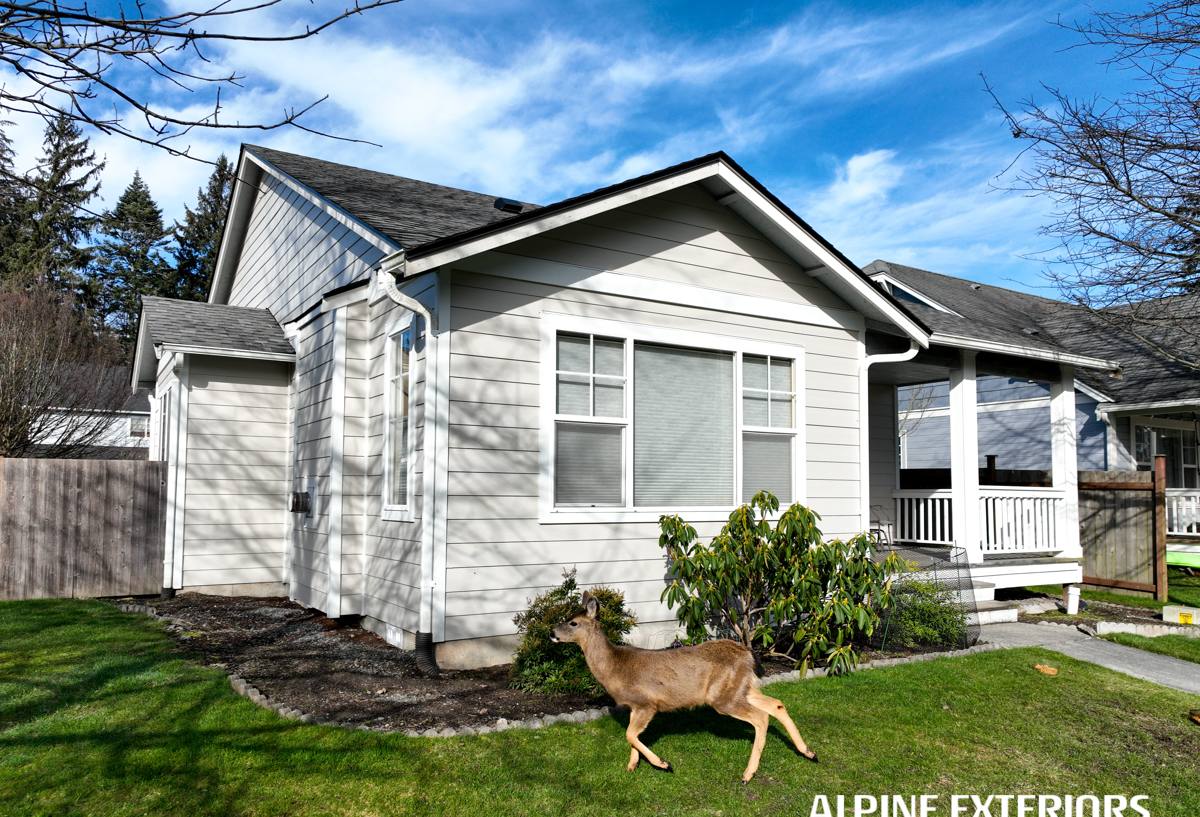
We install James Hardie fiber cement siding exclusively. We don't install vinyl, LP SmartSide, Cemplank, Allura, primed spruce, or cedar siding. That's a deliberate standard, not a limitation of what we're capable of doing, and it comes down to how each of those products actually performs over 15-20 years in a climate like this one — not on day one, when almost anything looks good.
What Hardie Gets Right for This Region
James Hardie fiber cement is non-combustible, which matters more every year as wildfire smoke and ember risk becomes a bigger part of Pacific Northwest summers. It doesn't rot, and it doesn't feed moisture-loving organisms the way wood-based products can. The ColorPlus factory finish is baked on under controlled conditions, which gives a more consistent, durable color layer than field-applied paint — important in a climate where repainting siding is a multi-day job you'd rather not repeat every 7-8 years.
Hardie also engineers specific product lines for different climate zones (their HZ5 line is built for regions like ours, with wetter, milder conditions), which means the product itself is formulated with places like Whatcom County in mind, not just the desert Southwest or the humid Southeast.
Why We Passed on the Alternatives
Vinyl siding is inexpensive and low-maintenance in the sense that it doesn't need painting, but it's a thin plastic product that expands and contracts with temperature, can crack in impacts, and doesn't offer the same fire performance or resale perception as fiber cement. LP SmartSide and Cemplank/Allura are both reasonable products in their own right — we're not here to trash them — but they come with trade-offs in moisture sensitivity at cut edges, warranty structure, or long-term color retention that we didn't want to build our reputation on installing. Primed spruce and cedar are traditional, attractive choices, but they demand ongoing maintenance — recaulking, repainting, watching for rot at end grain — that most homeowners underestimate when they're pricing a project, and that maintenance burden only gets worse in a climate with this much sustained moisture.
We'd rather install one product exceptionally well, understand its installation requirements inside and out, and stand behind it, than offer five options and hope each crew details them correctly.
| Factor | James Hardie Fiber Cement | Vinyl | Wood (Cedar/Primed Spruce) |
|---|---|---|---|
| Fire performance | Non-combustible | Melts/burns | Combustible |
| Moisture/rot risk | Very low when installed to spec | Low (but can trap moisture behind it) | High without diligent upkeep |
| Repainting needed | Rare — factory finish holds color for years | Never repainted, but fades/chalks | Every 5-8 years typically |
| Impact resistance | Good | Can crack in cold/impact | Dents, splits over time |
| Typical lifespan installed correctly | 30+ years | 20-30 years | Highly variable with maintenance |
Roofing in a Long Moss Season
Whatcom County's moss season is a real, recurring maintenance issue, not an occasional annoyance. Shaded, north-facing, and low-slope roof sections in and around Ferndale tend to hold moisture longer, and moss that's allowed to establish itself lifts shingle edges, holds water against the roof deck, and shortens the useful life of the roof covering. A roof that would otherwise last two decades can lose years off that lifespan if moss and debris aren't managed.
When we replace or repair a roof, we pay attention to a few things that matter specifically in this climate:
- Proper underlayment and flashing detailing at valleys, penetrations, and eaves — where driving rain finds weaknesses first
- Ventilation that lets the attic and roof deck actually dry out between wet stretches
- Material choices suited to shaded, moss-prone sections
- Gutter and drip-edge details that move water away from siding and fascia instead of letting it run down the wall
We're not selling moss-prevention treatments as a substitute for good roofing work — the underlying materials and installation quality matter far more than any spray-on product.
Windows: Sealing Out Driving Rain
Older windows in this area often show their age through fogged double-pane glass, drafts, and — more seriously — water staining or soft trim around the frame, which usually points to a flashing or sealant failure letting driving rain in behind the window rather than a problem with the glass itself. Replacement windows only perform as well as their installation: correct flashing integration with the wall's water-resistive barrier, proper shimming, and quality sealant work matter as much as the window unit itself in a climate that gets this much wind-driven rain.
When we replace windows, we're not just swapping glass — we're re-establishing the water management detail around each opening, which is often where the original problem started.
Decks: Built for Wet Wood Contact
A deck in Ferndale spends a lot of its life wet — from rain directly, from morning dew that takes hours to burn off under tree cover, and from splash-back off the ground. That reality drives a lot of our decisions on deck framing, fastener selection, and decking material: hardware needs to resist corrosion, ledger connections need proper flashing to keep water from tracking into the house framing, and decking materials need to handle repeated wet-dry cycling without cupping, splintering, or holding rot at fastener points.
We build and repair decks with those realities in mind rather than treating them as a warm-climate project transplanted into a wet one.
Why a Local Crew Matters Here
A lot of exterior problems in this region aren't caused by bad materials — they're caused by installation details that work fine in a drier climate but fail here. Flashing laps that are technically "close enough" in Arizona let water in over a Whatcom County winter. A crew that mostly works drier regions, or a big national outfit rotating crews through the area, doesn't always carry that judgment. Working this area regularly means we see the same failure patterns repeat — moss-driven roof damage, water intrusion at window and door flashing, siding failures at grade level and around trim — and we build our installation practices around preventing them, not just responding after the fact.
What to Check Before Hiring a Contractor
- Washington contractor license, verifiable through the state Department of Labor & Industries
- Liability insurance and, for roofing crews, workers' compensation coverage
- Manufacturer certification if the product (like James Hardie) has an installer certification program
- A written scope of work — not just a price — that spells out flashing, underlayment, and trim details
- Willingness to explain why they use the materials they use, not just what it costs
- Local references or a physical presence in the region, not just a phone number and a truck from out of town
Getting Started
Whether you're dealing with a roof that's carrying more moss than it should, siding that's showing its age, windows that let in more draft than daylight, or a deck that needs attention before it becomes a safety issue, we're happy to take a look and give you a straight, no-pressure assessment of what's actually going on and what it would take to fix it right. Reach out for a free estimate — there's no obligation, and we'll tell you honestly what we see.