 Birch Bay
 Why Semiahmoo Is a Different Kind of Siding Job
Semiahmoo sits right up against the water, out on the spit and along the shoreline near Blaine and Birch Bay in Whatcom County. That waterfront position is exactly why homes here take a different kind of beating than a house ten miles inland. Salt-laden air moves off the water and settles on everything — siding, trim, fasteners, window frames — day after day, all year. Add in driving rain that comes sideways off the Strait during winter storms, and a moss season that can run from October through May in the shaded, damp corners of a lot, and you've got a building envelope that's under near-constant pressure.
We've worked on enough homes in this stretch of Whatcom County to know that what works twenty minutes inland doesn't always hold up out here. Wind exposure is higher on waterfront and near-waterfront lots. Humidity stays elevated longer into the day because the water moderates temperature swings, which means siding surfaces stay damp longer than a homeowner might expect just looking at the forecast. None of this is exotic weather — it's normal Pacific Northwest coastal conditions — but it adds up faster on siding than most people realize until they're dealing with the consequences.
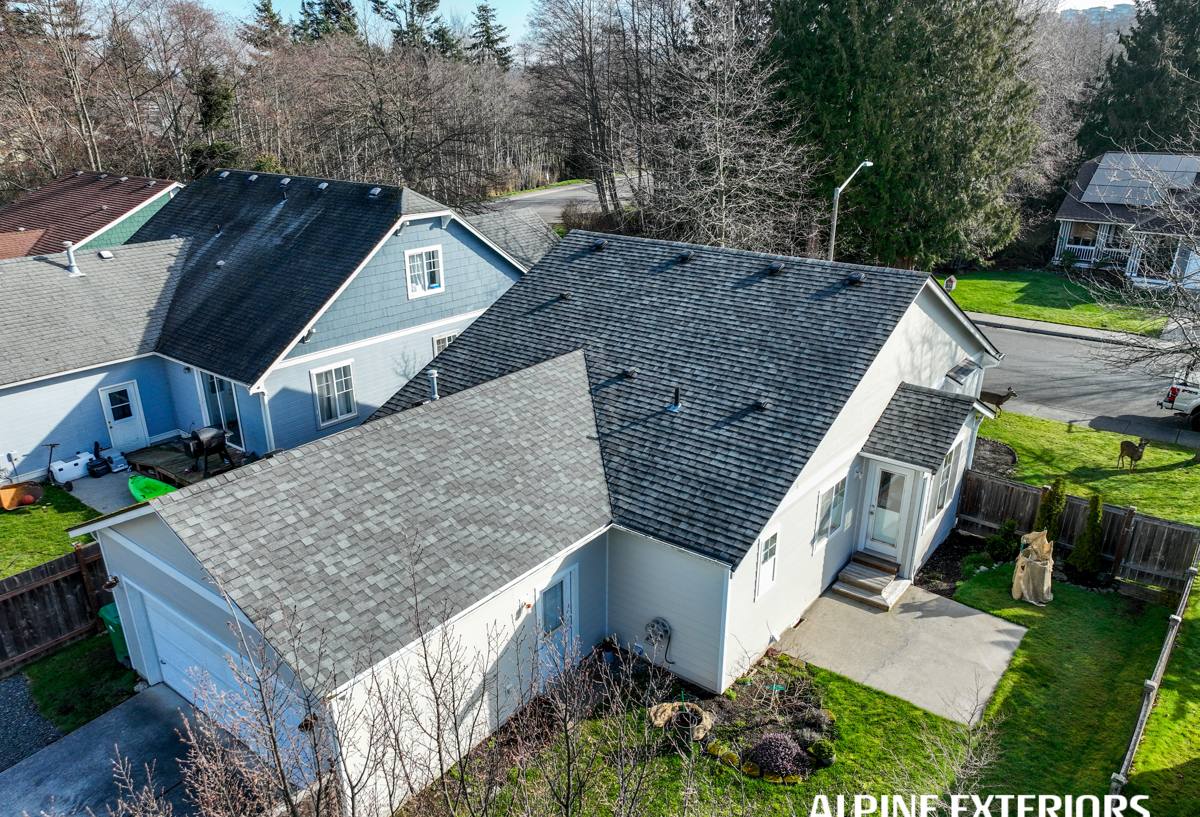
What Salt Air and Moisture Actually Do to a House
Salt Air and Metal Components
Salt air is corrosive to exposed metal — nail heads, flashing, fasteners, and hardware all take a hit over time if they're not rated for the exposure or properly protected. On a siding job, this shows up as staining, rust streaks, and eventually compromised fastening if the wrong materials were used. It's one of the reasons material choice and installation detail matter more here than in a lot of other parts of the county.
Driving Rain and Wall Assemblies
Wind-driven rain doesn't just fall on a house, it gets pushed sideways into seams, laps, and butt joints. A siding system that isn't installed with the right overlaps, flashing, and water-managed drainage plane behind it will eventually let moisture behind the cladding. Once water gets behind siding on a coastal lot, it doesn't dry out quickly — the ambient humidity is working against you.
Moss, Algae, and Prolonged Dampness
Shaded north and west-facing walls near mature trees or close to the water hold moisture longer through the fall and winter. That's prime territory for moss and algae growth on siding surfaces, especially textured or absorbent materials. Moss holds moisture against the substrate, which accelerates whatever decay process is already at work underneath.
Why We Only Install James Hardie Fiber Cement
We made a decision a long time ago to standardize on James Hardie fiber cement siding for every job we take on, and coastal work like Semiahmoo is a big part of why. Fiber cement is non-combustible, dimensionally stable, and doesn't feed moss and algae the way some wood-based or wood-alternative products do. It holds paint and factory finish far more consistently than wood, and it doesn't swell, rot, or delaminate the way products with wood fiber content can when they take on repeated moisture exposure.
James Hardie also builds region-specific product lines engineered for climate zones, which matters on the water. Their HZ5 formulation is built for the kind of freeze-thaw and moisture cycling the Pacific Northwest coast produces, and it's what we specify on Whatcom County homes. Combined with a ColorPlus factory finish — a baked-on finish applied under controlled conditions rather than field-painted — you get color and coating consistency that holds up to UV and salt exposure far longer than a site-applied paint job.
What We Don't Install, and Why
| Material | Why It's a Concern on This Coastline |
|---|---|
| Vinyl siding | Can warp or distort under heat and wind load; seams and laps are more vulnerable to wind-driven rain intrusion over time |
| LP SmartSide | Engineered wood product — wood fiber content is more susceptible to prolonged moisture exposure than fiber cement if edges or cuts aren't fully sealed and maintained |
| Primed spruce / cedar | Natural wood needs consistent recoating and sealing to resist moisture; salt air and shaded dampness shorten the maintenance interval considerably |
| Cemplank / Allura (other fiber cement brands) | Similar base material to Hardie, but we standardize on one manufacturer for consistent warranty terms, finish quality control, and installation specs across every job |
None of these are bad products in every application — they just aren't what we're willing to stand behind on homes facing this kind of sustained coastal exposure. We'd rather install one system well and back it with a real warranty than juggle multiple product lines with different failure modes.
How We Approach a Semiahmoo Siding Job
Assessment Before Anything Else
Every job starts with a look at the wall assembly, not just the visible siding. We check for signs of moisture intrusion behind existing cladding, evaluate flashing at windows, doors, and roof-to-wall transitions, and look at how the house is oriented relative to prevailing wind and rain. A house facing open water gets treated differently than one tucked behind a windbreak of trees, even if they're a quarter mile apart.
Installation Details That Matter Here
- Correct fastener type and spacing rated for coastal exposure, following James Hardie's published fastening schedules
- Proper weather-resistive barrier and rainscreen or drainage plane behind the siding to let any incidental moisture escape
- Flashing details at every penetration — windows, doors, vents, and hose bibs — sealed to shed water outward, not trap it
- Correct joint treatment at butt seams and corners, caulked and finished per manufacturer spec rather than left to weather naturally
- Ventilation and moisture management at the base of walls and near grade, where splash-back and standing water are more common near the water
None of this is unique to Hardie installation — good installation practice matters regardless of material — but fiber cement gives us a substrate that tolerates minor installation variance far better over the long run than wood-based alternatives do.
Roofing, Windows, and Decks in the Same Environment
Siding isn't the only part of a Semiahmoo home dealing with salt air and driving rain. Roofing takes direct wind and rain exposure and needs flashing and underlayment detail that accounts for wind-driven water working its way under shingles at edges and valleys. Windows on waterfront-facing walls need weatherstripping and flashing that holds up to repeated wetting, since a window that's marginal inland can become a real leak point out here. Decks facing the water deal with UV, salt spray, and standing moisture on fasteners and structural connections, which is why material and hardware choice on an exterior deck matters as much as the boards themselves.
We handle all four — siding, roofing, windows, and decks — because they're not separate systems on a house like this. Water that gets past a bad flashing detail at a window doesn't stay contained to the window; it tracks down into the wall assembly and shows up as a siding or framing problem later. Treating the exterior as one connected system, rather than four unrelated trades, is how you actually keep a coastal house dry.
Why a Local Crew Matters Out Here
A crew that works Whatcom County regularly knows the difference between a standard inland install and what a Semiahmoo or Birch Bay waterfront lot actually needs. That's not a marketing point — it's the difference between a crew that defaults to generic fastening schedules and one that adjusts for wind exposure, orientation, and the realities of a long wet season. We've seen what happens when siding is installed to a minimum spec on a coastal lot, and we've seen what holds up. That experience shapes every job we bid in this area, not just the big ones.
It also means we're around after the job is done. A warranty is only as good as the contractor standing behind it, and we're not driving in from out of the area for a one-time job. If something needs a look five years down the road, we're still local.
What This Means for Your Budget and Timeline
| Factor | What Affects It on a Semiahmoo Property |
|---|---|
| Wall complexity | Corners, dormers, and multiple wall heights near the water add cutting and flashing time |
| Existing damage | Moisture intrusion found during tear-off can extend scope if sheathing or framing needs repair |
| Access | Waterfront lots with limited driveway or staging space can affect scheduling and equipment use |
| Weather windows | Coastal wind and rain patterns can shift install scheduling more than inland jobs |
| Product selection | HZ5-rated Hardie products and ColorPlus finish options affect material cost versus standard lines |
Getting Started
If you're weighing a siding, roofing, window, or deck project on a Semiahmoo or Birch Bay property, we're glad to come take a look and give you a straightforward read on what your home's exterior is actually dealing with. We'll walk the property, talk through what we're seeing, and give you a free, no-pressure estimate — no obligation, just a clear picture of your options.