 Birch Bay
 Semiahmoo Sits Right at the Edge of the Weather
Homes in Semiahmoo take on a version of Whatcom County's marine climate that's more concentrated than what you'd find a few miles inland. Being close to the water means more direct exposure to salt-laden air, steady wind off the bay, and rain that doesn't just fall straight down — it drives sideways into south and west-facing walls for months at a stretch. Add in the shade from mature evergreens that many Semiahmoo lots have, and you get long stretches where siding simply doesn't dry out between storms.
That combination is hard on building materials that weren't engineered for it. Wood-based siding swells, and where it's cut or drilled it starts absorbing moisture at the exposed fibers. Vinyl gets brittle and can distort under repeated wind-driven flexing. Anything with a paint film that isn't fully cured or properly primed on cut edges becomes a spot where water gets in behind the finish. Over a few winters in a spot like Semiahmoo, those weak points turn into real problems — not because the homeowner did anything wrong, but because the product wasn't matched to the exposure.
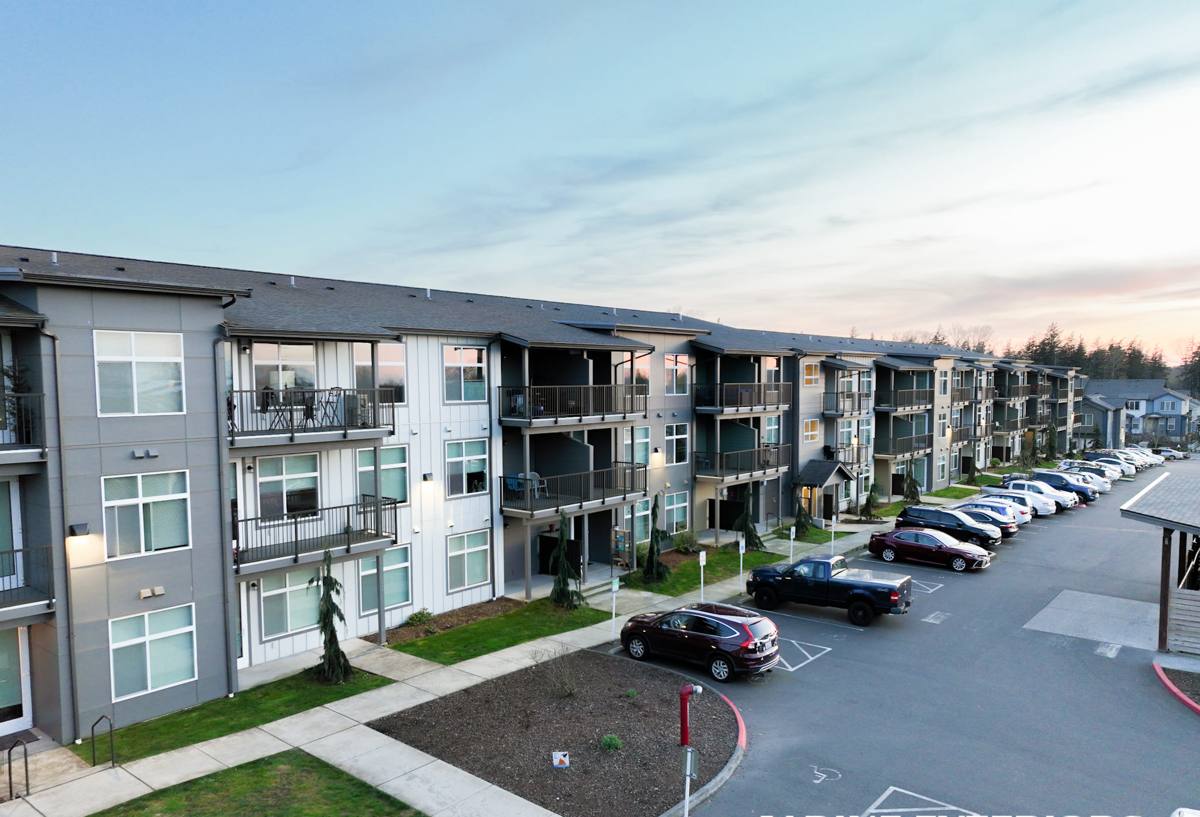
Why We Only Install James Hardie Here
We don't install LP SmartSide, vinyl, Cemplank, Allura, primed spruce, or cedar — not because those products have no merit anywhere, but because we've made a professional call about what holds up correctly on the homes we work on in this specific climate. Engineered wood siding relies on a resin-treated substrate and careful field sealing of every cut edge; miss one spot near the water and moisture finds it. Vinyl is inexpensive and low-maintenance in mild, dry climates, but it's a thin, flexible material that can warp, fade unevenly, and never fully seals a wall the way a rigid panel does. Cedar is a beautiful, honest material, but it's also a wood product that needs ongoing staining or sealing to survive salt air and shade — skip a maintenance cycle or two and it shows.
James Hardie fiber cement is cement, sand, and cellulose fiber — non-combustible, dimensionally stable, and manufactured with a factory-applied ColorPlus finish that's baked on before the boards ever reach a Semiahmoo jobsite. It doesn't feed pests, it doesn't rot, and it holds paint the way cement holds paint: because the color is part of the board, not a coating fighting to stay attached to wood grain. For a waterfront-adjacent property, that's the difference between siding you touch up every few years and siding you mostly leave alone.
The HZ5 Product Line: Built for This Exact Exposure
James Hardie manufactures its siding in climate-specific formulations called HZ (HardieZone) products, and the Pacific Northwest — including Whatcom County and the Semiahmoo area — falls into the HZ5 zone, engineered for regions with significant moisture exposure and freeze-thaw cycling. HZ5 boards are formulated to resist moisture-related damage better than the general-market version of the same products, which matters when a wall assembly is going to spend a good chunk of the year damp.
We spec HZ5 product on every Semiahmoo job because there's no cost advantage to using the wrong zone product, and every reason not to. The formulation is baked into the board at the factory — it's not something a contractor can compensate for later with extra caulk or paint.
Product Lines We Install
| Product | Best Use | Why It Fits Semiahmoo |
|---|---|---|
| HardiePlank lap siding | Primary wall cladding, most home styles | Classic horizontal look, wide range of exposure widths, holds a straight clean line in wind-driven rain |
| HardiePanel vertical siding | Modern facades, accent walls, gable ends | Fewer horizontal laps means fewer potential water-entry seams on exposed elevations |
| HardieShingle siding | Accent gables, cottage and craftsman styles | Gives a shingle look without the maintenance burden of real cedar shingles in a damp, shaded lot |
| HardieTrim boards | Corners, window and door casing, fascia | Matches the siding's stability so trim and field siding move together instead of separating over time |
What a Correct Installation Actually Involves
James Hardie siding is only as good as the wall assembly behind it. In a wind- and rain-exposed spot like Semiahmoo, the details most homeowners never see are the ones that decide whether the siding performs for its full service life or starts showing problems in year five.
What we make sure happens on every job
- A drainage plane (weather-resistive barrier) installed correctly, lapped shingle-style so water sheds outward rather than behind the siding
- A rainscreen gap or furring where the wall design calls for it, so any moisture that does get behind the cladding has somewhere to drain and dry instead of sitting against the sheathing
- Correct flashing at every window, door, and horizontal trim transition — the single most common failure point on siding jobs done without attention to detail
- Factory-primed and painted cut edges sealed per Hardie's published instructions before boards go up, not caulked over afterward
- Fasteners placed at the manufacturer's specified pattern and depth, not overdriven, which keeps the board's structural integrity intact
- Minimal reliance on caulk as a primary water barrier — caulk is a backup, not the plan
Any one of those steps done wrong won't necessarily show up right away. It shows up two, five, or ten winters later, after enough freeze-thaw cycles and enough wind-driven rain have found the gap. That's why the installation matters as much as the product choice.
Our Process on a Semiahmoo Home
We start with a walk-around of the existing exterior — looking at the current siding's condition, the state of the sheathing underneath where it's exposed, existing flashing at penetrations, and how each elevation is actually exposed to wind and rain given the lot's orientation and tree cover. That assessment shapes the estimate; a shaded, west-facing wall near open water gets treated differently than a sheltered, south-facing wall behind a windbreak of trees.
From there we cover the practical steps: removal of the old cladding, a check of the sheathing for any hidden moisture damage that needs addressing before new siding goes on, correct installation of the water-resistive barrier and flashing details, and installation of the Hardie product line and ColorPlus color you've chosen. We walk the finished job with you before we call it done, and we're straightforward about timeline — a full re-side takes longer than a quick trim job, and we'd rather tell you that up front than rush the flashing details to hit a date.
Living With Hardie Siding in a Salt Air, Moss-Prone Climate
One of the practical benefits of switching to James Hardie in this area is how little ongoing attention it needs compared to wood or repainted surfaces. The ColorPlus finish is designed to resist fading and doesn't need repainting on the same cycle a field-painted wood surface would. That said, no siding in Semiahmoo is completely maintenance-free — the same climate that's hard on the boards is hard on everything else on the exterior too.
What we recommend homeowners still keep an eye on
- Rinsing off accumulated salt spray and grime once or twice a year, especially on walls facing open water or prevailing wind
- Keeping gutters clear so overflow doesn't run down the face of the siding and feed moss growth at the base of walls
- Trimming back vegetation that's shading a wall and keeping it perpetually damp
- Checking caulk joints at trim and penetrations periodically — caulk is a maintenance item on any siding system, Hardie included
- Addressing any moss or algae on the siding surface promptly with a gentle wash rather than pressure that can drive water behind boards
What Affects the Cost of a Semiahmoo Siding Job
We don't quote a price without seeing the house, but the factors that move a job up or down in scope are consistent enough to lay out honestly.
| Factor | Why It Matters |
|---|---|
| Tear-off vs. building over existing siding | Full removal lets us inspect and repair sheathing and flashing — often necessary on older homes with hidden moisture damage |
| Wall complexity | Dormers, multiple gables, and cut-up elevations mean more trim, more flashing details, and more labor time than a simple rectangular wall |
| Product line selection | Lap, panel, and shingle styles carry different material and install labor costs |
| Site access | Waterfront lots with limited staging area, steep grades, or tight setbacks can add time for material handling and scaffolding |
| Existing damage | Rotten sheathing or framing found during tear-off needs repair before new siding goes on, which is a real cost but one you want caught, not covered up |
Why a Crew That Already Works Semiahmoo Matters
Siding installation isn't one-size-fits-all, and a crew that's used to working on homes a few miles inland doesn't automatically know how differently a wall performs when it's facing open water and taking wind-driven rain most of the winter. Knowing to spec HZ5 product without being asked, knowing which elevations on a given lot need extra attention to flashing and drainage, and knowing what moss and salt exposure actually do to a wall over a few seasons — that's the kind of judgment that comes from doing this work in this specific area, not from a general siding checklist.
If your Semiahmoo home needs new siding, or you're planning ahead before the next wet season, we're glad to take a look and give you a straightforward, no-pressure estimate — just fill out the form below.