 Birch Bay
 Semiahmoo's Siding Challenge: Salt, Rain, and Moss
Homes along the Semiahmoo shoreline deal with a combination of weather stresses that inland Whatcom County properties simply don't face. Wind coming off the water carries a fine mist of salt that settles on exterior surfaces, accelerating corrosion on fasteners, trim, and anything with exposed metal. Add in Western Washington's long stretch of driving rain — often blown sideways by coastal wind rather than falling straight down — and siding takes on moisture from angles it was never designed to shed. Then there's moss. The mild, wet winters that make this part of Washington so green also make it one of the better environments for moss and algae growth anywhere in the state, and siding is one of the first surfaces where it takes hold.
None of this means siding repair in Semiahmoo is dramatically different in principle from repair anywhere else. But it does mean the failures show up faster, the details matter more, and a repair that ignores the local climate tends to fail again within a few seasons. A patch job that would hold up fine on a sheltered inland lot can come apart quickly on an exposed waterfront wall here.
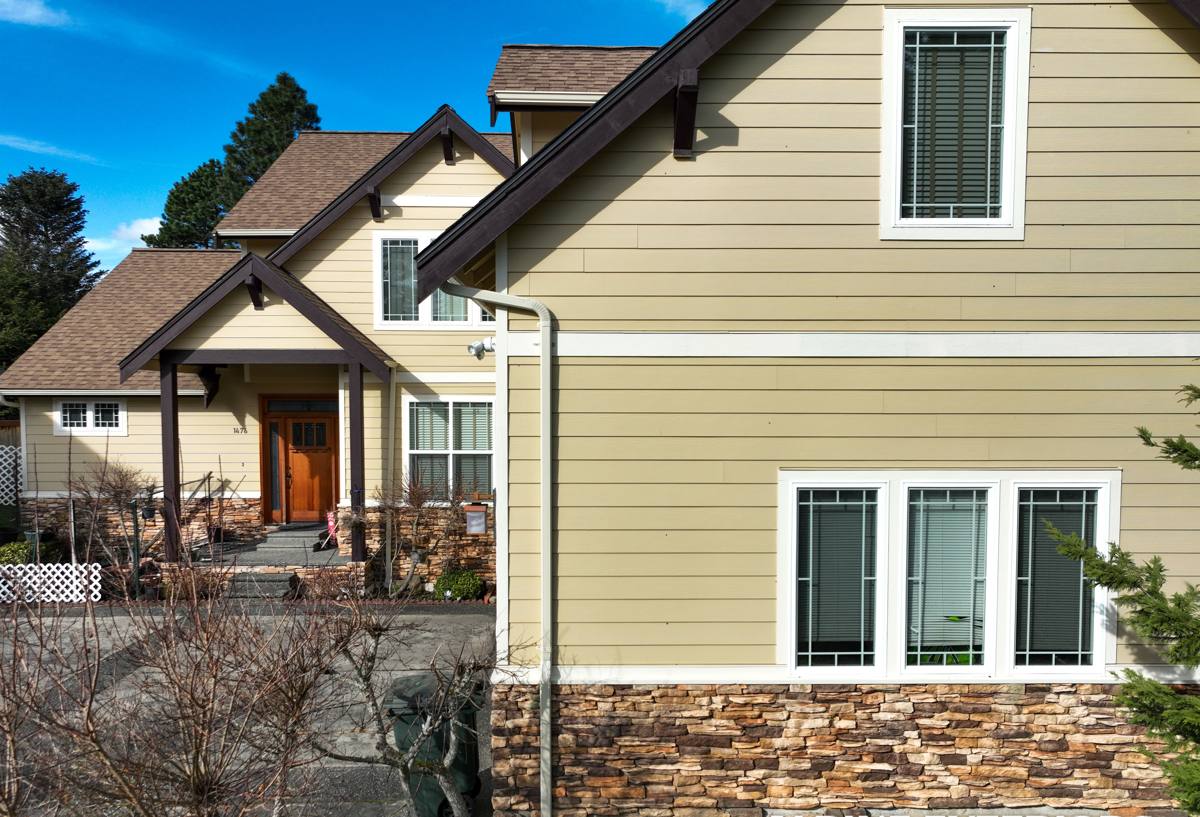
Signs Your Semiahmoo Home Needs Siding Repair
Most siding problems don't announce themselves with a dramatic failure — they start small and get worse every wet season they're left alone. Walking your home's exterior once or twice a year, especially after winter storms, is the cheapest maintenance you can do.
- Soft or spongy spots when you press on a siding panel, especially near the bottom courses and around window and door trim
- Visible cracking, splitting, or buckling in individual boards or panels
- Persistent moss, algae, or dark streaking that comes back even after cleaning
- Paint that's bubbling, peeling, or failing faster than it should — often a sign moisture is getting behind the surface
- Gaps opening up at seams, corners, or where siding meets trim, flashing, or the foundation
- Rust staining running down from nail heads or metal flashing
- Visible warping or waviness when you sight down a wall from the corner of the house
- Interior clues: musty smells, peeling interior paint, or soft drywall on an exterior wall
Any one of these on its own might be minor. Several showing up in the same area of the house — particularly a wall facing the water or prevailing wind — usually means moisture has been getting in for a while and the damage goes beyond what's visible from the outside.
What a Correct Siding Repair Actually Involves
A siding repair that just covers up a bad spot with new material is a temporary fix, not a real repair. Done correctly, repair work follows the same standards as new installation, just applied to a smaller section of wall.
Diagnosing Before Cutting
Before any siding comes off, the damaged area needs to be understood, not just patched. That means checking how far moisture has traveled behind the surface, whether the sheathing or framing underneath has been affected, and whether the underlying cause is a siding defect, a flashing failure, a caulking gap, or a drainage problem that has nothing to do with the siding itself. Fixing the siding without fixing the cause just buys time before the same spot fails again.
Matching Existing Siding
Repair work should be close to invisible when it's done. That means matching board profile, exposure, and reveal, not just color. On homes with factory-finished siding, matching the finish exactly is far easier when the replacement material comes from the same manufacturer's current product line — one more reason mixing siding brands over the years tends to create a patchwork look that's hard to undo.
Moisture Barrier and Flashing
Whatever is behind the siding matters as much as the siding itself. A proper repair means checking and, where needed, replacing the water-resistive barrier, correcting flashing at windows, doors, and horizontal trim, and making sure water has a way to drain out rather than pooling behind the wall. On a coastal wall taking direct wind-driven rain, this step is not optional — it's the difference between a repair that lasts and one you'll be paying for again in a few years.
Fasteners and Attachment
Given the salt exposure around Semiahmoo, fastener choice matters more here than in most parts of the county. Corroding nails or screws are a common hidden cause of repeat siding failures — the fastener rusts, loses its grip, and the panel starts to move, crack, or pull away long before the siding material itself would have failed on its own.
Typical Repair Scenarios
| Situation | What's Usually Involved | Common Local Trigger |
|---|---|---|
| Isolated impact damage or a cracked panel | Remove and replace the affected board(s), check sheathing behind it | Storm debris, settling, accidental impact |
| Water staining or soft siding near the bottom of a wall | Investigate grading/drainage, replace damaged siding and barrier, correct flashing | Poor drainage combined with driving rain |
| Persistent moss or algae staining | Cleaning plus inspection for trapped moisture; siding replacement only if damage is found underneath | Shaded, damp walls during the long moss season |
| Rust streaking from fasteners | Replace affected boards with corrosion-resistant fasteners | Ongoing salt air exposure near the shoreline |
| Gaps or separation at seams and trim | Re-flash and re-seal, replace any boards that have shifted or cracked | Wind-driven rain forcing water into seams |
Repair or Replace? How to Think About It
Not every siding problem calls for full replacement, and not every problem should be solved with a patch. The right call usually comes down to how widespread the damage is and what's causing it.
| Factor | Favors Repair | Favors Replacement |
|---|---|---|
| Extent of damage | Isolated to one or two walls or a small area | Showing up across multiple walls or the whole exterior |
| Age of existing siding | Relatively recent, still within expected service life | Near or past the end of its expected lifespan |
| Underlying cause | One-time event (impact, isolated flashing failure) | Systemic issue (widespread moisture intrusion, failed original installation) |
| Material availability | Matching material is still available or close enough | Product discontinued or too different to match well |
| Long-term plans | Homeowner plans to stay and maintain in stages | Homeowner wants a long-term, low-maintenance reset |
We'll always tell you honestly which category your home falls into. A repair that's clearly going to need to be redone in a couple of years isn't a good use of your money, and we'd rather say so upfront than sell you a patch we don't believe in.
Why We Repair — and Rebuild — with James Hardie Fiber Cement
When a repair goes beyond a small patch, or when a homeowner decides it's time to address a whole wall or side of the house rather than keep patching, we use James Hardie fiber cement exclusively. It's the only siding system we install, and there's a practical reason for that in a climate like this one: fiber cement doesn't absorb water the way wood-based products can, it's non-combustible, and Hardie's ColorPlus factory finish is engineered to hold up to UV and moisture exposure far longer than field-applied paint. For a coastal community dealing with salt air and a long wet season, that combination matters more than it does in milder climates.
It also matters for future repairs. Hardie's HZ5 product line is engineered specifically for climates like the Pacific Northwest's — freeze-thaw cycles, sustained moisture, and wind-driven rain — which means a repair section installed today is built to the same standard as the rest of a well-maintained Hardie wall, and it's backed by a transferable warranty that stays with the home if you sell. We don't install vinyl, LP SmartSide, or other fiber cement brands, and on repair jobs we'll explain honestly where your existing siding stands and what your options are if you're facing more than a small patch.
Our Process for Semiahmoo Siding Repairs
1. On-Site Inspection
We look at the damaged area and the wall around it, not just the spot you called about. Siding problems are rarely isolated to exactly where they're visible.
2. Honest Diagnosis
We'll tell you what's actually causing the damage — siding failure, flashing, drainage, or something else — and what it will take to fix it correctly, including if that means more than we originally expected.
3. Straightforward Estimate
You get a clear scope and price before any work starts, with repair and (if relevant) replacement options laid out so you can make an informed decision.
4. Repair Done to Spec
Matching material, corrected flashing and moisture barrier where needed, and fasteners suited to a salt-air environment — not just a quick patch.
5. Walkthrough
We go over the finished work with you so you know exactly what was done and why.
Why a Crew That Already Works Semiahmoo Matters
Siding repair is a job where local experience shows up in the details. A crew that regularly works this stretch of coastline already knows which walls tend to take the worst of the wind-driven rain, how aggressively moss and algae grow on shaded north- and west-facing walls here, and how much of a difference fastener corrosion resistance makes on a home exposed to salt air off the water. That's knowledge you build by working the area repeatedly, not by reading a spec sheet.
It also means faster, more accurate diagnosis. A contractor unfamiliar with coastal Whatcom County conditions might treat a moss stain as purely cosmetic or miss that a particular corner detail is a known weak point on homes built to a certain era's code. A crew that's repaired dozens of walls in similar conditions around Birch Bay and the surrounding shoreline communities has already seen the pattern before they get out of the truck.
Get a Straight Answer About Your Siding
If you're seeing soft spots, cracking, moss that won't quit, or staining on your Semiahmoo home, it's worth having someone look at it before the next wet season makes it worse. We'll give you an honest read on what's actually going on and what it would take to fix it right — no pressure, no upsell. Reach out for a free estimate using the form below.