 Birch Bay
 Why Semiahmoo Decks Wear Differently
Semiahmoo sits close enough to the water that homes here deal with a combination most inland Whatcom County properties don't: salt-laden air rolling off the bay, wind-driven rain that gets pushed sideways under railings and into seams, and a moss season that can run from early fall through late spring in a wet year. Any one of these speeds up deck deterioration. Together, they compound each other — salt air accelerates corrosion on fasteners and hardware, driving rain finds its way into joints that would stay dry in a calmer climate, and moss holds moisture against the wood surface long after the rain stops.
We see a pattern with decks in this area that's different from what you'd find on a deck built the same year further inland: fastener failure and ledger board issues show up earlier, moss and algae growth is heavier on north- and west-facing sections, and finishes wear out faster because they're fighting UV, salt, and moisture at the same time. None of that means a deck in Semiahmoo can't last — it means the repair work has to account for what's actually attacking it, not just patch what's visibly broken.
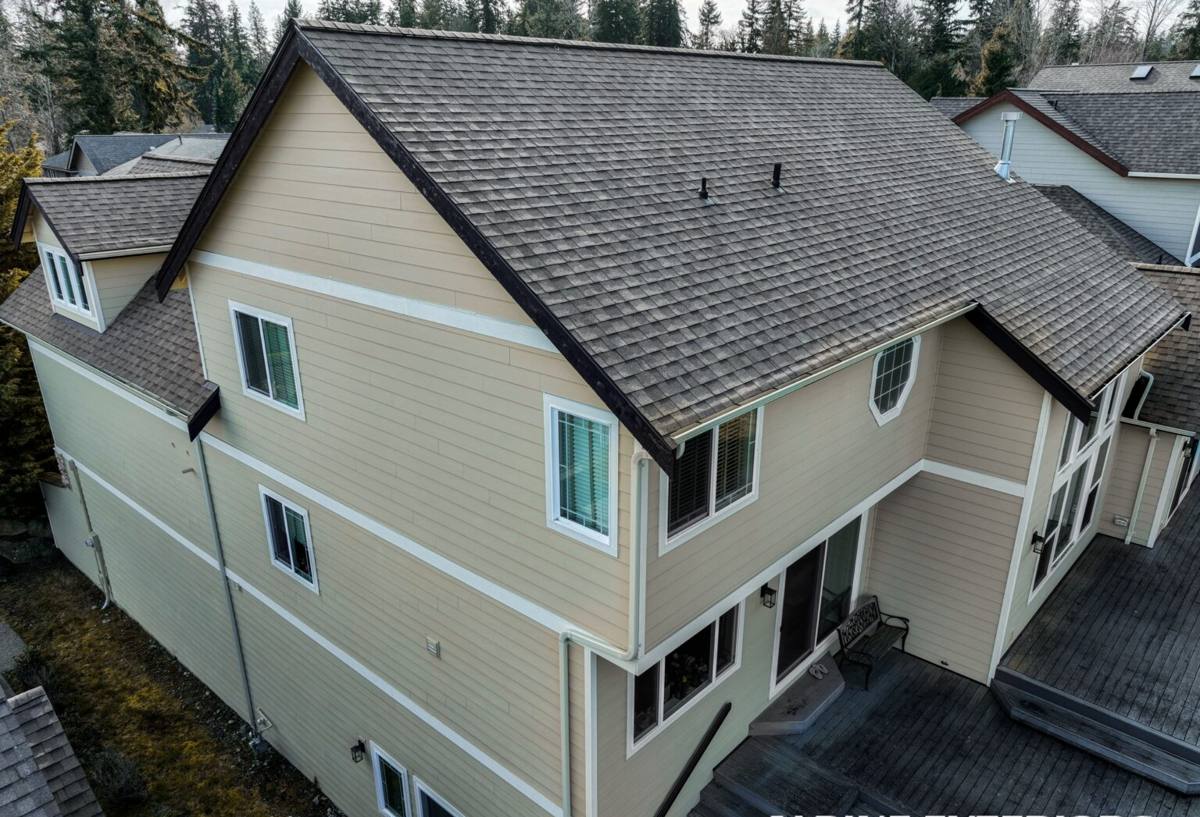
Signs You're Looking at a Repair, Not Just Cosmetic Wear
Homeowners often call us about something small — a soft board, a wobbly rail — and it turns out to be a symptom of something underneath. Here's what tends to matter most on a Semiahmoo deck:
- Soft, spongy, or spring board decking, especially near the house or in shaded corners where moss holds moisture
- Rust streaks around fasteners, hardware, or joist hangers — a sign salt air is already working on the metal
- Any movement or flex where the deck ledger board meets the house — this is a structural connection, not a cosmetic one
- Gaps opening up between decking boards, or boards that have cupped or crowned
- Railings that shift under hand pressure, or posts that feel loose at the base
- Persistent moss or algae film that comes back within weeks of cleaning
- Visible rot at the point where posts meet footings, or where decking meets the house siding
Some of these are simple fixes. Others — particularly ledger board separation or footing rot — are safety issues that need to be addressed before the deck sees regular use again. Part of our job on the initial visit is telling you honestly which category you're in.
Repair vs. Replacement
Not every deck problem means starting over, and we don't push replacement when a repair will hold up. As a general rule: if the framing and structural connections are sound and the damage is isolated to decking boards, railings, or surface-level rot, repair is usually the right call. If the ledger board, main support beams, or multiple footings are compromised, or if the deck is old enough that repairing one section just means the next section fails in a year or two, replacement is the more honest recommendation — and we'll say so.
What a Correct Deck Repair Involves
A repair that actually holds up in this climate goes beyond swapping out the board that's obviously bad. We look at the whole system, because a deck is only as good as its weakest connection.
Structural Checks First
Before any cosmetic work, we check the ledger board attachment, joist condition, post-to-footing connections, and railing post anchoring. If flashing at the ledger board is missing, damaged, or was never installed correctly, water has likely been getting behind it for years — that gets corrected as part of the repair, not left for later.
Fasteners and Hardware
Given the salt air here, we use fasteners and structural hardware rated for coastal or high-corrosion exposure. Standard galvanized fasteners that would be fine twenty miles inland don't hold up as well this close to the water — they're a common source of the rust staining and eventual fastener failure we see on older Semiahmoo decks.
Decking and Railings
Damaged boards are replaced to match existing material where possible, or upgraded if the homeowner wants to move toward a lower-maintenance option. Railings get the same structural scrutiny as the deck surface — a railing that looks fine but has a soft post base is a liability we won't leave in place.
Drainage and Airflow
A lot of moss and rot problems trace back to poor drainage or blocked airflow underneath the deck. Where it's practical, we correct grading, gaps, or debris buildup that's trapping moisture against the structure — this is one of the more overlooked parts of a repair, but it's often the difference between a fix that lasts and one that doesn't.
Decking Materials: How They Hold Up Locally
What your deck is built from changes both how it fails and how it should be repaired. Here's how the common options perform in Semiahmoo's conditions:
| Material | Common Failure Point Here | Repair Considerations |
|---|---|---|
| Pressure-treated wood | Surface checking, soft spots near ground contact, fastener corrosion | Board-by-board replacement is usually straightforward; framing underneath needs the same inspection |
| Cedar | UV graying, moss retention in shaded areas, splitting | Repairs well but needs consistent finish maintenance to keep pace with salt air and rain exposure |
| Composite decking | Fastener and hidden-clip issues, moisture trapped at cut ends if not sealed | Board replacement is clean but requires matching existing product; framing below still needs wood-specific checks |
| Older or mixed materials | Inconsistent wear, past patch jobs that didn't address structure | Often the most involved repair — requires sorting out what's actually sound before patching further |
Composite and PVC decking have gotten a lot more common on newer builds in the area, and they do resist rot and moss better than untreated wood. But we won't tell a homeowner that composite is maintenance-free — it still needs proper drainage and airflow underneath, and the framing supporting it is still wood in most cases, which means it still needs to be checked and protected.
Our Repair Process
- On-site inspection covering decking, framing, ledger board, footings, and railings — we point out what we find as we go, not just at the end
- Written scope of work with a clear breakdown of what's structural, what's cosmetic, and what's optional
- Repair or replacement of damaged framing and connections first, before any surface work
- Decking, railing, and hardware repair or replacement using materials matched to your existing deck or upgraded on request
- Drainage and airflow correction where it's contributing to the problem
- Final walkthrough so you know what was done and what to watch for going forward
What Affects Repair Cost
Every deck is different, but these are the factors that move the estimate up or down the most:
| Factor | Why It Matters |
|---|---|
| Extent of structural damage | Ledger board or footing repair costs more than surface board replacement because it involves the deck's load path |
| Material match | Matching older or discontinued decking or railing material can add cost versus a straightforward like-for-like swap |
| Access and deck height | Elevated decks or decks with limited underside access take more labor to inspect and repair properly |
| Hardware upgrades | Coastal-rated fasteners and hardware cost more than standard galvanized but reduce repeat repairs |
| Drainage corrections | Grading or airflow fixes add scope but address the root cause instead of just the symptom |
We'll give you a written estimate before any work starts, and we'll flag anything that could change the price once we're into the job — no surprises added after the fact.
Keeping a Repaired Deck From Repeating the Problem
A repair is only worth doing if it holds. A few things make a real difference here given the local climate:
- Rinse or sweep moss and debris off the deck surface regularly, especially in shaded or north-facing sections
- Keep gutters and downspouts clear so runoff isn't draining directly onto or under the deck
- Re-finish or re-seal wood decking on a schedule appropriate for coastal exposure — typically more often than manufacturer guidelines assume for inland climates
- Check fastener heads and hardware once a year for early rust staining
- Keep vegetation trimmed back from the deck edge to improve airflow and sun exposure underneath
Why Local Experience Matters for This Job
Deck repair looks similar on paper anywhere in Washington, but a crew that hasn't worked in Semiahmoo or greater Birch Bay specifically doesn't always know to check for the things that actually cause failure here — the corrosion pattern from salt air, the moss buildup in shaded pockets near the water, the way driving rain gets pushed into joints that would stay dry a few miles inland. We work in this area regularly, so we're not guessing at what's causing the damage — we've seen the same failure patterns on enough decks nearby to know where to look first and what's worth fixing properly versus what's just cosmetic.
If your deck in Semiahmoo has soft spots, loose railings, rust staining, or persistent moss that keeps coming back, we're glad to take a look. We'll give you a straight assessment of what's actually going on, a clear estimate, and no pressure either way — reach out below for a free estimate.