 Birch Bay
 Why Ferndale Roofs Take a Different Kind of Beating
Ferndale sits close enough to Puget Sound and the Strait of Georgia that homes here deal with a mix of weather most inland roofing crews rarely think about. It's not one big threat — it's three smaller ones working together year-round: salt-laden air, rain that comes in sideways more often than straight down, and a moss season that barely takes a break. None of these alone will destroy a roof overnight. Together, over ten or fifteen years, they explain why so many roofs in this part of Whatcom County fail from the inside out rather than the outside in.
Salt Air and Metal Fatigue
Coastal air carries fine salt particles that settle on exposed metal — flashing, fasteners, vent stacks, and drip edge. Over time that accelerates corrosion, especially at flashing seams and nail heads that weren't properly sealed or weren't rated for coastal exposure in the first place. A roof that looks fine from the ground can have flashing that's quietly rusting through at the joints, which is usually where leaks start.
Driving Rain, Not Just Rain
Wind off the water pushes rain sideways into roof valleys, wall-to-roof transitions, and under shingle tabs that were installed with minimal overlap. A roof built for a drier or calmer climate can perform fine for years and still fail during the handful of storms each winter where rain comes in nearly horizontal. Underlayment quality and flashing detail matter more here than in places where rain mostly falls straight down.
The Long Moss Season
Between the tree cover common to this area and a wet season that stretches from fall into late spring, north-facing slopes and shaded sections of roof rarely get enough sun to dry out fully. That's exactly the environment moss needs. Moss doesn't just look bad — it holds moisture against the shingle surface, works its way under tabs, and can lift roofing material enough to let water underneath.
Repair or Full Replacement: How to Read the Signs
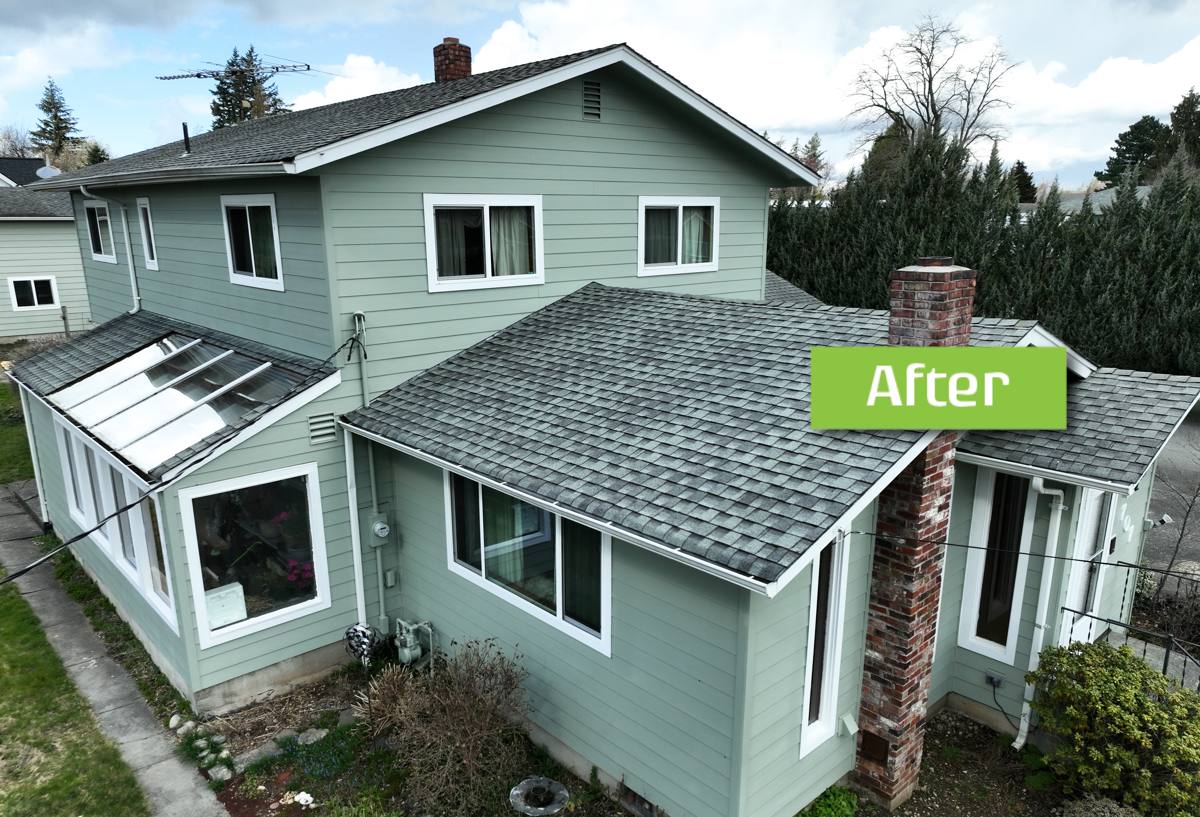
Not every roof problem in Ferndale means a full tear-off. But there's a point where patching becomes throwing money at a roof that's already lost the fight. A few signs tend to separate the two:
- Granule loss heavy enough that you can see bare fiberglass mat on multiple shingles, not just a few worn spots
- Moss established on more than a section or two, especially if it's lifting shingle edges rather than just sitting on the surface
- Flashing that's visibly rusted, cracked, or separating at chimneys, skylights, and roof-to-wall transitions
- Soft or spongy decking felt underfoot during an inspection, which points to moisture already in the plywood or planking
- A roof at or past the manufacturer's expected service life combined with any of the above
- Repeated leak calls to the same areas even after spot repairs
If a roof only shows one or two of these in isolated spots, targeted repair can still be the honest recommendation. When several show up together, replacement usually costs less over time than continuing to chase leaks.
What a Correct New Roof Installation Actually Involves
A new roof is more than stripping old shingles and nailing down new ones. The parts that don't show are usually what determine whether the roof holds up through a Whatcom County winter or starts leaking in year three.
Tear-Off and Deck Inspection
Full tear-off lets us see the actual roof deck, not guess at its condition from the attic. Any soft, delaminated, or water-stained sheathing gets replaced before anything new goes down — installing new roofing over a compromised deck just hides the problem for a while.
Underlayment and Water Protection
Given how much wind-driven rain this area gets, we treat underlayment as a real second layer of defense, not a formality. Self-adhered ice-and-water membrane goes in the vulnerable spots — valleys, eaves, around penetrations — with synthetic underlayment covering the rest of the field for tear resistance and consistent water shedding.
Flashing Details
Chimneys, skylights, sidewalls, and any roof-to-wall transition get new flashing, not reused flashing tucked under new shingles. This is where salt-air corrosion and driving rain do the most damage over time, so it's also where cutting corners shows up fastest as a leak.
Ventilation
Balanced intake and exhaust ventilation keeps the attic temperature closer to outdoor temperature, which reduces condensation on the underside of the deck and helps shingles last their full rated life. In a climate this damp, poor ventilation can trap moisture in the attic even when the roofing itself is doing its job.
Choosing Roofing Materials for This Climate
There's no single "best" roofing material — there's the material that fits your roof's exposure, your home's style, and how much long-term maintenance you're willing to do. For most Ferndale homes, the choice comes down to a few honest trade-offs.
| Material | Moss & Algae Resistance | Wind & Rain Performance | Typical Lifespan Here |
|---|---|---|---|
| Standard asphalt (3-tab) | Lower — needs algae-resistant granules to hold up in shaded areas | Adequate if installed with proper overlap and sealing | Shorter end of the range in this climate |
| Architectural / laminate asphalt | Better, especially with algae-resistant granule lines | Good — thicker profile handles wind-driven rain well | Longer than 3-tab, still climate-dependent |
| Standing seam metal | Excellent — smooth surface sheds moisture and resists moss | Very good, especially on steeper pitches | Long, with proper fastener and coating specification for salt air |
| Cedar shake | Requires regular maintenance to resist moss and rot in damp shade | Good when properly ventilated and treated | Shorter without diligent upkeep in this climate |
We're honest with homeowners about this: cedar can look great, but in a shaded, damp lot it demands more upkeep than most people expect, and neglect shows up fast as moss and soft spots. Asphalt with algae-resistant granules is the practical middle ground for most Ferndale roofs. Metal costs more up front but asks the least of you afterward.
Our Installation Process, Start to Finish
- On-site inspection and honest assessment of whether the roof needs repair or full replacement
- Written estimate with material options explained in plain terms, no pressure to upgrade
- Permit handled before work starts — requirements differ slightly depending on whether a property sits inside Ferndale city limits or unincorporated Whatcom County
- Tear-off, deck inspection, and any necessary sheathing repair
- Underlayment, flashing, and ventilation installed before the finish roofing material
- Roofing material installed to manufacturer specification, not shortcuts to save a day of labor
- Full site cleanup, including magnetic sweep for stray nails
- Final walkthrough and warranty paperwork explained, not just handed over
Why a Crew That Already Works Ferndale Matters
Roofing crews that mostly work drier, calmer climates sometimes underbuild for this area — thinner underlayment, minimal flashing, standard shingles where algae-resistant ones would hold up better. That's not usually dishonesty, it's just unfamiliarity with what wind off the water and a long wet season actually do to a roof over time.
A crew that regularly works Whatcom County and this stretch of coastline already knows which roof slopes tend to hold moss longest, which flashing details fail first under driving rain, and how the local permitting process runs. That local pattern recognition is hard to replace with a generic install checklist, and it's usually the difference between a roof that needs attention again in five years and one that doesn't.
Keeping a New Roof Moss-Free and Long-Lived
A correctly installed roof still needs some basic upkeep in this climate. None of it is complicated, but skipping it shortens the life of even a well-built roof.
- Clean gutters at least twice a year so water isn't backing up under the roof edge during heavy rain
- Trim back overhanging branches to cut down on shade and debris buildup on north-facing slopes
- Consider zinc or copper control strips near the ridge, which help suppress new moss growth as rain washes over them
- Have moss physically removed by a professional rather than pressure-washed, since pressure washing can strip granules and shorten shingle life
- Schedule a quick visual inspection every year or two, especially after a rough winter
- Address small leaks or flashing issues right away — in this climate, small problems don't stay small for long
What Affects the Cost of a Ferndale Roof Replacement
Every roof is different, so we're not going to throw out a number that doesn't mean anything until we've actually seen the roof. What we can tell you is what actually moves the price:
- Roof size and pitch — steeper roofs take longer and require more safety setup
- Number of existing layers to tear off and haul away
- Condition of the decking underneath, and how much sheathing needs replacing
- Material choice, from standard asphalt up through metal
- Complexity of the roofline — valleys, dormers, chimneys, and skylights all add labor and flashing work
- Access to the property and how the roof needs to be staged and cleaned up
Most full roof replacements on a typical single-family home in this area fall within a broad range depending on those factors — the only way to get a real number is a free on-site look, not a phone estimate.
If your roof is showing moss, granule loss, or you're just not sure whether it's a repair or a replacement, we're happy to take a look. The estimate is free, there's no pressure, and you'll get a straight answer either way — use the form below to get started.