 Birch Bay
 Why Point Whitehorn Siding Wears Differently
Point Whitehorn sits close enough to the water that homes here take on a different weathering pattern than siding a few miles inland. Salt-laden air drifts in off the Strait of Georgia and settles on exterior surfaces, where it accelerates corrosion on fasteners, trim flashing, and any metal components tied into the siding system. Add Whatcom County's long stretch of driving rain — wind-pushed moisture that hits walls at an angle instead of falling straight down — and you get water intrusion at joints and laps that a calmer climate would never test. Then there's moss. Point Whitehorn's tree cover and marine humidity keep siding damp for extended stretches during fall, winter, and spring, and moss doesn't just look bad — it holds moisture against the wall assembly and works into any gap it can find.
None of this means Point Whitehorn siding fails faster than it should. It means repairs here have to account for conditions a generic repair crew from outside the area might not think to check. A patch that holds up in a dry inland neighborhood can fail within a season on a home exposed to salt air and prevailing wind off the water.
Signs Your Siding Needs Repair, Not a Full Replacement
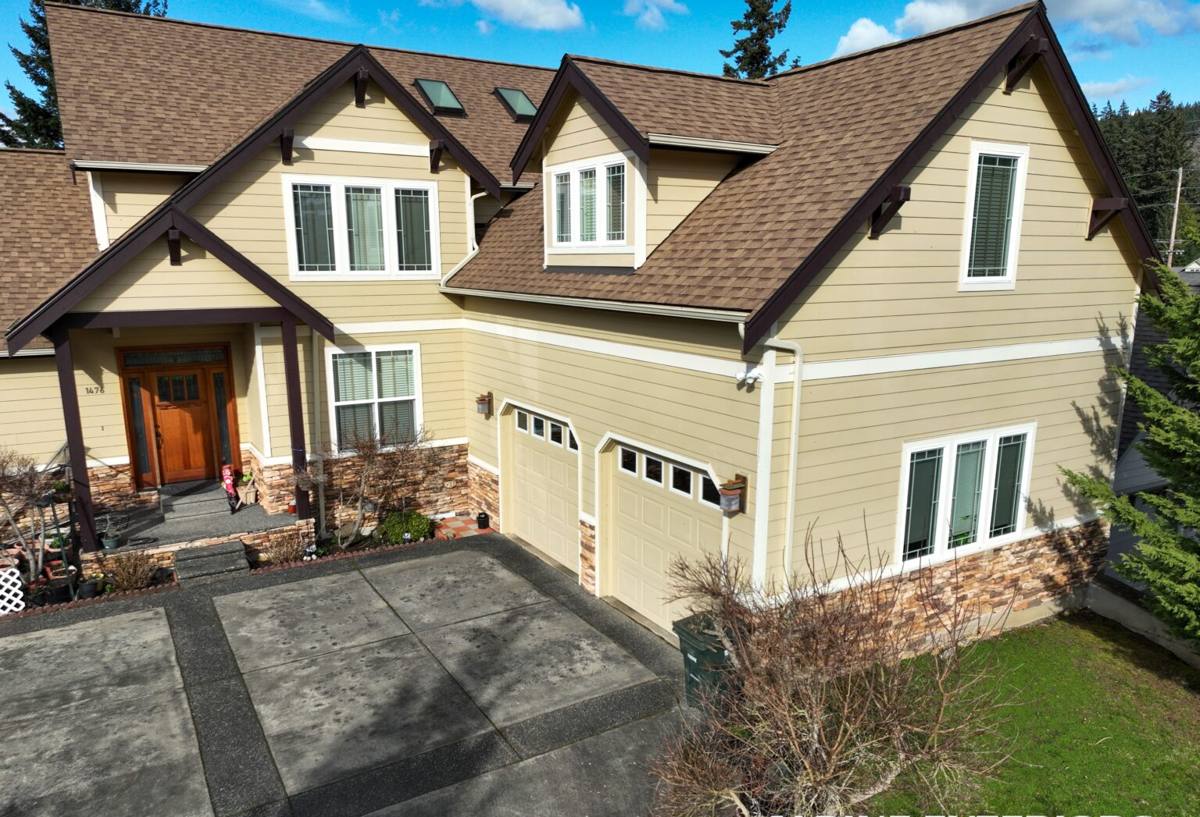
Most siding problems we see on Point Whitehorn homes are localized — a section near a downspout, a corner exposed to prevailing wind, an area under a tree that never fully dries out. Catching these early is what keeps a repair a repair instead of turning into a full re-side.
- Soft or spongy spots when you press on the siding, especially near the bottom courses or around window and door trim
- Visible cracking, chipping, or delamination on individual boards or panels
- Dark staining or streaking that doesn't wash off, often a sign of moisture tracking behind the surface
- Moss or algae buildup that's thick enough to hold water against the wall rather than just discoloring the surface
- Gaps opening up at butt joints, corners, or where siding meets trim, flashing, or the foundation
- Fasteners backing out, rust streaks below nail heads, or visible corrosion on trim pieces
- Paint or factory finish failing in one concentrated area while the rest of the wall still looks sound
If what you're seeing matches this list and it's confined to one or two areas, repair is usually the right call. Widespread soft spots across multiple walls, structural rot reaching into sheathing, or siding that's original to a much older home are different conversations — and we'll tell you honestly if that's what we're looking at instead of selling you a patch job that won't hold.
What a Correct Repair Actually Involves
Assessment Before Anything Gets Touched
Every repair starts with figuring out why the damage happened, not just where it is. If a section of siding failed because of a flashing gap, a clogged gutter dumping water onto a wall, or grade sloping toward the foundation, replacing the board without fixing the cause just buys you a repeat visit in a year or two. We check behind the affected siding whenever possible to see whether moisture reached the sheathing or house wrap, because that changes the scope of the fix.
Matching Material, Not Just Color
A repair that's visually mismatched is one thing — a repair that's mismatched in material behavior is worse. Mixing product types on one wall (patching fiber cement with a different composite, or vinyl next to fiber cement) creates different expansion rates, different moisture responses, and a seam that will telegraph over time. When we repair Hardie siding, we match it with Hardie. When a homeowner is repairing a home sided in a different product, we'll talk honestly about whether patching with unlike material is really the long-term answer, versus reserving replacement dollars for the sections that are actually failing.
Sealing and Flashing Details
The repair itself is often the easy part. What separates a repair that lasts from one that doesn't is the flashing, house wrap integration, and sealant work around it — the details that keep wind-driven rain from finding the same entry point again. On a site like Point Whitehorn, where rain doesn't just fall but gets pushed sideways into the wall, these details matter more than they would somewhere calmer.
Repair or Replace: How We Help You Decide
| Factor | Leans Toward Repair | Leans Toward Replacement |
|---|---|---|
| Extent of damage | One to a few isolated areas | Spread across multiple walls or elevations |
| Cause of failure | Identifiable and fixable (flashing, gutter, grade) | Systemic — original install issues throughout |
| Sheathing condition | Sound, dry behind the siding | Soft, wet, or rotted sheathing found |
| Age of siding | Mid-life, otherwise performing well | At or past its expected service life |
| Material match | Same product available for a clean patch | Product discontinued or mismatched |
We walk this same logic with every homeowner in person. If repair is genuinely the right call, that's what we'll recommend — a full re-side isn't the answer to every problem, and we'd rather do an honest smaller job now than have you doubt the next recommendation we make.
Why We Repair and Rebuild With James Hardie Fiber Cement
Our crew installs and repairs James Hardie fiber cement siding exclusively — we don't work in vinyl, LP SmartSide, Cemplank, Allura, or unfinished wood siding. That's a deliberate standard, not a limitation. Fiber cement doesn't absorb moisture the way wood-based products can, it's non-combustible, and Hardie's ColorPlus factory finish holds color and resists the kind of fading and chalking that shows up fastest on salt-exposed, sun-and-rain-cycled walls like the ones out here. Hardie's HZ5 product line is engineered specifically for the freeze-thaw and moisture demands of the Pacific Northwest, which matters when a repair needs to blend into and perform alongside siding that's already up.
When a repair calls for new material — a damaged section, a full elevation, or trim replacement — we use Hardie boards and panels so the patch matches the original in thickness, texture, and long-term behavior, not just paint color. If your home is currently sided in a different product and you're weighing repair against a future full replacement, we're glad to have that conversation honestly, including what we'd change and why.
Our Repair Process
- On-site inspection. We look at the damaged area, check for moisture behind the siding where accessible, and identify the root cause — not just the symptom.
- Honest scope and estimate. You get a clear explanation of what needs to happen, what it costs, and why — including if we think replacement makes more sense than repair.
- Source matching material. For fiber cement repairs, we match board profile, exposure, and color line so the finished patch reads as part of the wall, not a visible add-on.
- Correct the cause. Flashing, gutter, grading, or ventilation issues get addressed alongside the siding repair itself — otherwise the same damage returns.
- Install and seal. New material goes in per manufacturer spec, with attention to fastener placement, joint treatment, and weather barrier integration.
- Final walkthrough. We check the finished work with you before we consider the job done.
Moss Season and Ongoing Maintenance
Point Whitehorn's long moss season isn't something a single repair visit solves for good — it's an ongoing maintenance factor. Moss growing on or near siding holds moisture against the surface far longer than open air ever would, and over a season or two that can turn a cosmetic issue into a moisture problem underneath. Keeping gutters clear, trimming back vegetation that shades and dampens a wall, and gently removing moss buildup before it thickens all extend the life of a repair. If you're not sure whether what you're looking at is surface growth or something that's already compromised the siding underneath, that's exactly the kind of thing worth having a professional look at rather than guessing.
Why Hiring a Crew That Already Works Point Whitehorn Matters
Siding repair looks different depending on where a home sits. A crew that mostly works drier, inland neighborhoods may not think twice about a detail that's routine out here — the extra attention wind-driven rain flashing needs, how much moss buildup is normal versus concerning, or how salt air changes which fasteners and trim details are worth using. Working repeatedly in and around Birch Bay and Whatcom County's coastal communities means we're not guessing at how a repair will hold up against conditions specific to this stretch of shoreline — we've already seen how it plays out.
It also means straightforward logistics: material matching for existing Hardie siding, scheduling that accounts for our weather patterns rather than a generic seasonal calendar, and a crew that isn't learning the area's quirks on your dime.
Get an Honest Look at Your Siding
If you're seeing damage, staining, or moss buildup on your Point Whitehorn home and aren't sure whether it calls for a repair or something more, we're happy to take a look. The estimate is free, there's no pressure, and if repair is the right call, that's exactly what we'll tell you.