 Birch Bay
 Point Whitehorn: A Tougher Stretch of Coastline Than Most of Birch Bay Sees
Point Whitehorn sits along the Strait of Georgia shoreline in unincorporated Whatcom County, just north of Birch Bay proper. It's a quieter, more spread-out area than the main Birch Bay waterfront strip — wooded lots, bluff-top homes, and properties set back from the water but still well within reach of what comes off the Strait. That mix of exposure matters. A house tucked into trees a few hundred feet from the bluff edge deals with a different moisture and wind pattern than one sitting right on top of it, and any siding contractor working this area needs to plan for both conditions on the same street, sometimes the same lot.
We install exterior siding for homes throughout Birch Bay and the surrounding Whatcom County shoreline, and Point Whitehorn is a regular part of that work. On siding specifically, we install James Hardie fiber cement exclusively — not as a marketing position, but as the result of years watching how different materials actually hold up out here.
Salt Air Off the Strait
Homes closer to the bluff take a steady dose of salt-laden air coming directly off the water, with less tree cover to break it up than you'd find further inland in Birch Bay. Salt accelerates corrosion in fasteners, flashing, and trim, and it wears down lower-grade finishes faster than a sheltered site would. Even properties set back in the trees still get periodic direct exposure during storms, so the whole area needs to be treated as coastal, not just the lots right on the bluff.
Driving Rain and Wind-Driven Water
Wind off open water doesn't let rain fall straight down — it drives it sideways into wall assemblies, window and door flashing, and anywhere two building materials meet. That's a heavier real-world moisture load than the annual rainfall total suggests, and it's the kind of load that finds gaps in a job that was installed to a lower standard, or installed correctly for a calmer site but not for an exposed one. Bluff-facing walls and anything on the windward side of a Point Whitehorn home need more attention to flashing and sealing detail than a similar wall would need a few miles inland.
A Long Moss and Mildew Season
Shade, mild temperatures, and near-constant moisture add up to a moss and mildew season that runs most of the year on north-facing and tree-shaded walls, which describes a lot of Point Whitehorn's wooded lots. Any siding material that's even slightly porous, or that traps moisture against the substrate, becomes a growth surface over time. That's not just cosmetic — sustained moss cover holds water against the wall longer, which shortens the life of whatever's underneath it.
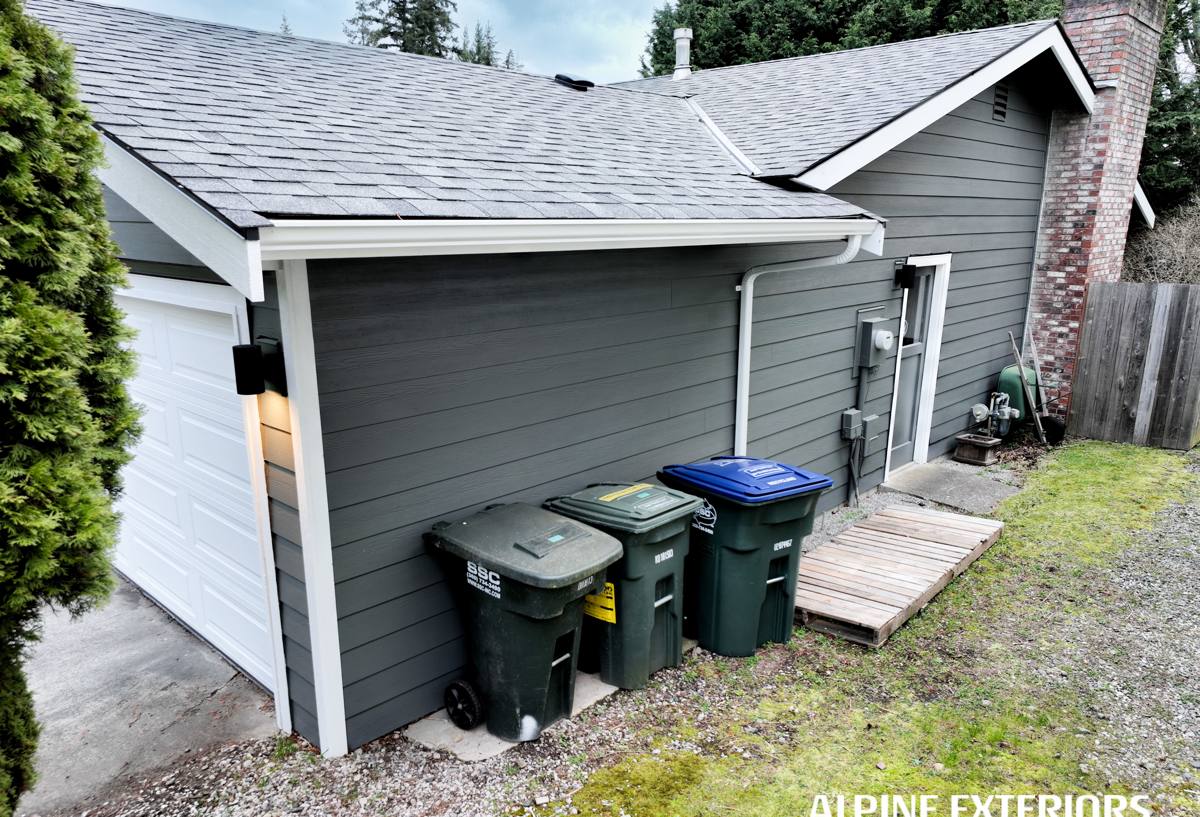
Why James Hardie Is What We Install — And Why We Don't Install the Alternatives
We used to offer a wider range of siding products. We stopped, and the decision came from what we kept finding on service calls and tear-offs in exactly this kind of exposure — salt, sustained moisture, and heavy shade — not from a supplier relationship.
- Non-combustible fiber cement core: It doesn't feed a fire the way wood-based products can, which matters for safety and can matter for insurance.
- Factory-applied ColorPlus finish: Baked on under controlled conditions rather than brushed on-site, it holds color and resists chalking and moisture intrusion far longer than field-applied paint.
- HZ5 climate engineering: Hardie's HZ5 formulation is built specifically for regions with heavy moisture exposure and freeze-thaw cycling — a fair description of this stretch of Whatcom County shoreline.
- Dimensional stability: Fiber cement doesn't swell, cup, or warp the way engineered wood siding can after repeated wet-season cycles.
- A strong transferable warranty: Hardie backs the product with a robust warranty structure, provided the installation follows their spec — which is on us to get right, not the homeowner.
We don't install LP SmartSide, vinyl siding, Cemplank, Allura, primed spruce, or cedar. Each has legitimate uses and satisfied owners in the right setting. LP SmartSide is an engineered wood product, which means it's more moisture-sensitive at cut edges and fastener penetrations than fiber cement — a real liability in a spot that stays damp for months at a time. Vinyl is inexpensive and low-maintenance in mild climates, but it can distort under direct sun and doesn't hold up as well against wind-driven debris and salt exposure over the long haul. Cemplank and Allura are also fiber cement, and reasonable products, but we've standardized on one manufacturer's system, warranty, and installation spec rather than juggling several. Primed spruce and cedar are attractive, traditional choices, but both are wood: they need ongoing refinishing, and in a climate with this much sustained moisture and moss pressure, that maintenance burden shows up faster and costs more over time than most owners expect going in. On a shoreline exposure like Point Whitehorn, we'd rather install and fully stand behind one system than offer a cheaper option that quietly shifts long-term upkeep onto the homeowner.
What Correct Installation Requires on a Point Whitehorn Lot
Fastening and Wind Exposure
Fastener type, spacing, and embedment all need to match Hardie's published spec, and that spec gets stricter as wind exposure increases. A bluff-facing wall on an open lot needs tighter attention to fastener schedule and panel clearance than a sheltered wall in the trees a quarter-mile inland — treating every wall on a job the same way is one of the more common shortcuts that shows up as a callback a few years later.
Flashing and Drainage Behind the Panels
Fiber cement performs as designed only when the water management behind it is done right: correct clearance from grade and roof lines, proper flashing at every window, door, and roof-to-wall transition, and drainage or rain-screen detailing where the wall assembly calls for it. In a driving-rain climate, most siding failures actually start behind the panel, not on its face — water gets in through a poorly flashed penetration and does its damage out of sight until it shows up as soft trim or interior staining.
Joints, Trim, and Finish Integrity
Factory-mitered corners and properly caulked, gapped joints keep water from tracking into seams, and they protect the factory ColorPlus finish from the edges in. Cut edges need to be sealed with the manufacturer's touch-up product before installation, not left raw — a small step that's easy to skip and expensive to fix once the wall is closed up.
Signs a Point Whitehorn Home's Siding Needs Attention
- Moss or algae staining that follows shaded or bluff-shadowed sections of the wall rather than the whole house evenly
- Caulk that's cracked, shrunk, or pulled away at panel joints and trim edges
- Rust streaking below fastener heads or trim screws, especially on wind-exposed elevations
- Soft or spongy trim near grade, deck ledgers, or window sills
- Paint or finish that's chalking, fading unevenly, or peeling faster on the windward side than the sheltered side
- Visible gaps or daylight at panel joints, corners, or where siding meets roofing or trim
What Drives the Cost of a Siding Project Here
| Factor | Why It Matters at Point Whitehorn |
|---|---|
| Wind exposure of the lot | Bluff-facing and open sites need tighter fastening and flashing detail than sheltered, tree-covered lots — more labor, same material |
| Condition of the existing wall | Hidden moisture damage behind old siding is common in this climate and often isn't visible until tear-off begins |
| Site access | Wooded lots, steep driveways, and bluff-edge properties can limit staging and equipment access, which affects labor time |
| Trim and detail complexity | More windows, corners, and roof-to-wall transitions mean more flashing and joint work, which is where quality is won or lost |
| Color and profile selection | Standard ColorPlus colors and common profiles are more readily available than custom orders, which can affect lead time and price |
We give a firm, written quote after walking the actual site — not a phone estimate — because these factors vary more than people expect from one Point Whitehorn lot to the next.
Our Process for a Point Whitehorn Project
We start with an on-site assessment of the existing siding, looking specifically at how it's handled moisture and wind exposure so far — moss patterns, joint condition, and any soft spots near grade or trim. Where existing siding is coming off, we check the wall sheathing and framing underneath before anything new goes up, since covering damage is worse than finding it. From there we put together a clear, written scope and timeline before signing anything, and we handle flashing, drainage, and fastener detail as standard practice on every wall — not as an upgrade reserved for the exposed side of the house.
Why Local Experience With This Shoreline Actually Matters
A siding crew that mostly works drier, inland neighborhoods can install Hardie siding competently and still get the details wrong for a spot like Point Whitehorn, because the failure points here are different: more aggressive flashing needs at wind-exposed corners, more attention to shaded-wall drainage, and fastener choices that account for sustained salt air rather than occasional exposure. Working this stretch of Whatcom County regularly means we've already seen how these specific conditions play out over years, not just at the point of installation.
A Simple Checklist Before Hiring for Siding Work Here
- Ask what siding material they install and why, and whether they'll put a written warranty behind it
- Confirm current Washington contractor licensing and active liability insurance
- Ask how they detail flashing at windows, doors, and roof-to-wall transitions on wind-exposed walls specifically
- Ask whether they check for hidden moisture damage before installing new siding, not just after a problem shows up
- Get a clear, written scope of work — material, prep, and detailing included — before signing anything
If you're weighing siding options for a home in Point Whitehorn or anywhere else around Birch Bay, we're glad to walk the exterior with you and give an honest read on what it actually needs. Reach out below for a free, no-pressure estimate.