 Birch Bay
 Siding Repair Built for Cottonwood Beach's Coastline
Cottonwood Beach sits close enough to the water that its homes take a different kind of weathering than houses a few miles inland in Whatcom County. Salt-laden air moves through siding seams and fastener holes that inland homes rarely have to deal with, wind-driven rain gets forced sideways into laps and trim joints during winter storms, and the shaded, damp stretches along the bluff and tree line stay wet long enough each year to grow moss on anything that doesn't dry out fast. None of this means your siding is doomed — it means repairs here have to be diagnosed and done differently than a generic patch job.
We work this neighborhood regularly, which matters more than it sounds. A contractor who mostly works subdivisions twenty minutes inland will assess your siding the same way they assess theirs. A crew that actually walks Cottonwood Beach properties knows which elevations take the worst of the weather, where moisture tends to hide behind trim, and which repairs hold up here versus which ones fail again in two winters.
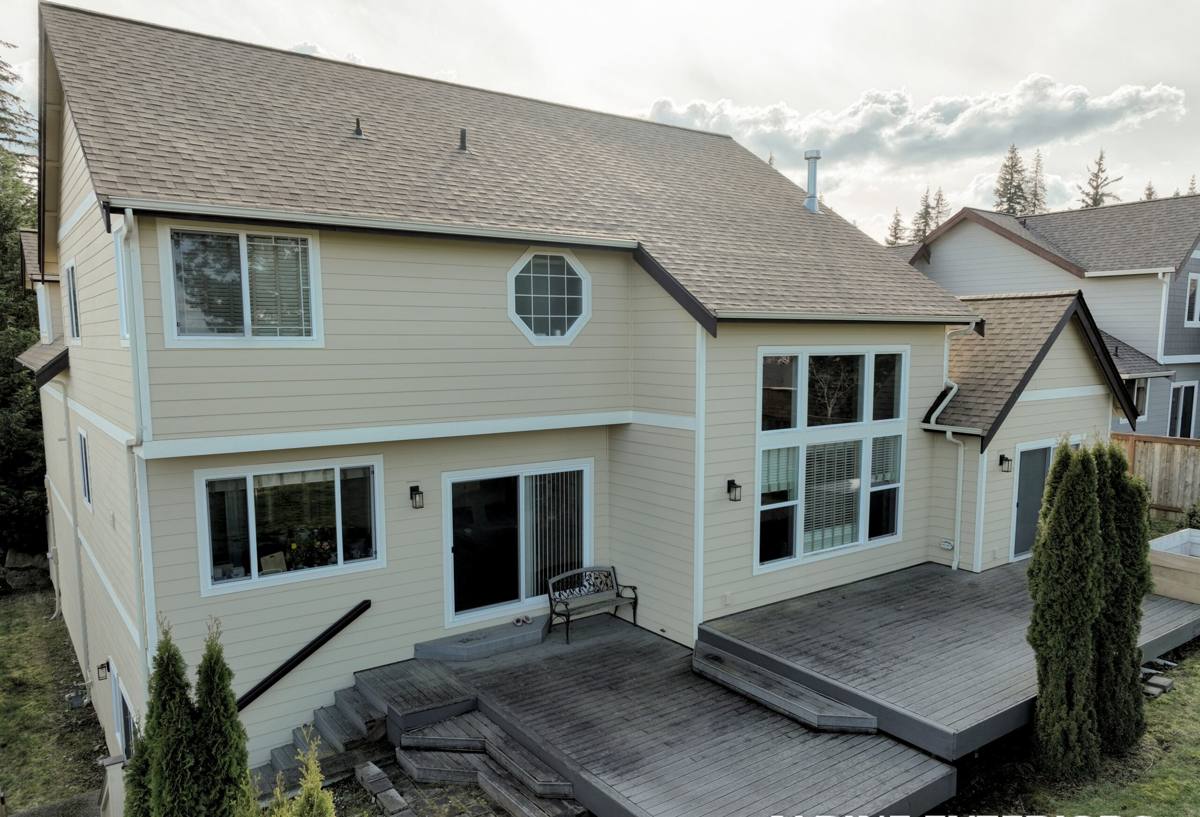
What Coastal Weather Actually Does to Siding
Salt Air
Airborne salt doesn't just sit on the surface — it works into fastener heads, cut edges, and any spot where a factory finish has been compromised. On metal fasteners and trim accessories, that means accelerated corrosion. On painted or coated siding, salt residue holds moisture against the surface longer than plain rainwater would, which speeds up finish breakdown and, on wood-based products, speeds up rot at the points salt has concentrated.
Wind-Driven Rain
Ordinary rain falls straight down and sheds off properly lapped siding without much trouble. Storm-driven rain near the water doesn't fall straight down — it comes in at an angle and gets pushed upward under laps, around window and door trim, and into any gap where caulking has shrunk or cracked. Over time this is what turns a small sealant failure into hidden water intrusion behind the siding, which is a much bigger repair than the visible symptom suggests.
Moss and Sustained Dampness
Cottonwood Beach's tree cover and coastal humidity create long stretches — sometimes months — where north-facing and shaded walls simply don't dry out between rain events. That's exactly the environment moss and algae need. Beyond looking bad, moss holds moisture directly against the siding surface, which on wood-based products accelerates rot and on painted surfaces breaks down the finish faster than sun-exposed walls nearby.
Signs a Cottonwood Beach Home Needs Siding Repair
Some damage is obvious. A lot of it isn't — it shows up as a small cosmetic issue while the real problem is happening behind the siding. Here's what we check for on every inspection:
- Soft or spongy spots when you press on the siding, especially near the bottom courses and around windows
- Visible cracking, splitting, or buckling in individual boards or panels
- Paint that's peeling, bubbling, or alligatoring rather than just fading evenly
- Streaking, staining, or moss growth concentrated on shaded or north-facing walls
- Caulking at trim joints and butt seams that's cracked, shrunk, or missing altogether
- Rust streaks below fasteners or trim accessories
- Warping or waviness in the wall plane, which usually points to moisture already trapped behind the siding
- A musty smell or interior wall staining near an exterior wall — a sign water has already gotten past the siding
Any one of these on its own might be a minor fix. Several of them together, especially on the same wall, usually means water has been getting in longer than the visible damage suggests.
What a Correct Repair Actually Involves
A siding repair that just covers the visible damage without checking what's underneath is a repair that comes back. On coastal properties like Cottonwood Beach, that shortcut fails faster than it would inland, because there's more moisture pressure working against a bad patch.
A repair we stand behind involves:
- Removing enough surrounding material to actually see the extent of the damage, not just the piece that looks bad.
- Checking the water-resistive barrier and flashing underneath — house wrap tears, missing flashing at windows, and improperly lapped seams are usually the real reason a section failed.
- Assessing the sheathing behind the siding for soft spots or rot, since siding damage that's been developing for a while often means the sheathing needs attention too.
- Matching or replacing material correctly — patched-in pieces need to lap and fasten the way the surrounding siding does, not just look similar from the ground.
- Re-sealing and re-flashing properly so the repaired section sheds wind-driven rain the same way the rest of the wall does.
- Repainting or refinishing so the repair doesn't stand out as a visibly different patch.
Skipping any of those steps is how a $400 patch turns into a $4,000 wall repair two years later.
Repair vs. Replacement: How We Decide
Not every problem area needs full replacement, and we don't push replacement when a proper repair will genuinely hold. But there's a point where patching stops making financial sense. Here's generally how that decision breaks down by material:
| Siding Material | Repair Outlook | When Replacement Makes More Sense |
|---|---|---|
| James Hardie fiber cement | Individual boards can usually be cut out and replaced cleanly; ColorPlus finish is durable and touch-up matching is manageable | Widespread impact damage or if the original install had systemic flashing errors |
| Vinyl | Cracked or warped panels can be swapped if matching stock is still available | Older vinyl runs are often discontinued, making color-matched replacement panels hard to source |
| Cedar or primed wood | Spot repairs are possible on isolated rot, but repainting the whole wall is usually needed to blend it | Rot has spread past a few boards, or maintenance has clearly lapsed for years |
| LP SmartSide or engineered wood | Sound sections can be patched if caught early | Swelling or delamination at seams and cut edges, which tends to spread once it starts |
When a wall has gone past the point where patching makes sense, we'll tell you plainly and explain why — not push a full re-side when a repair would genuinely do the job.
Why We Only Install James Hardie When Replacement Is the Right Call
If a wall at your Cottonwood Beach property is far enough gone that replacement is the honest recommendation, we install James Hardie fiber cement and nothing else. It's not the only siding product on the market, but for this climate — salt air, driving rain, and a moss season that doesn't let walls dry out for months at a time — it's the one we're willing to put our name behind. It's non-combustible, the HZ5 product line is engineered for the moisture and freeze-thaw conditions the Pacific Northwest actually sees, and the factory-applied ColorPlus finish holds up to UV and moisture far longer than field-applied paint on wood or engineered wood products. It also carries a strong transferable warranty, which matters on a coastal property where the elements don't let up.
We're not going to tell you your existing vinyl, cedar, or engineered wood siding is a mistake if it's still sound — repair is repair, and we'll work with what's on your house. But when it comes time to replace a wall or a whole exterior, Hardie is what we recommend and what we install.
Our Process for Cottonwood Beach Siding Repair
Every job starts with an honest look at the wall, not a sales pitch.
- Inspection: we check the visible damage plus the areas around it — corners, trim, and lower courses where water tends to collect
- Diagnosis: we open up enough of the wall to confirm what's happening behind the siding before quoting anything
- Written scope: you get a clear explanation of what's damaged, why, and what fixing it correctly involves — no vague line items
- Repair or replace: we do the work to match the surrounding wall, address the underlying moisture issue, and finish it so it doesn't stand out
- Walkthrough: we show you what we found and what we did before we consider the job finished
Why a Crew That Works This Neighborhood Matters
Siding repair looks the same on paper everywhere — remove damaged material, check what's underneath, replace, reseal, refinish. In practice, knowing which walls in Cottonwood Beach take the worst wind-driven rain, which shaded corners grow moss fastest, and which older homes here were built with siding details that don't hold up to salt air anymore makes the difference between a repair that lasts and one that doesn't. That's the kind of judgment that comes from working a specific stretch of coastline repeatedly, not from a general service-area map.
If you're seeing peeling paint, soft spots, moss buildup, or cracked caulking on your Cottonwood Beach home, it's worth having someone look at it before the next round of winter storms pushes rain further into the wall. We offer free, no-pressure estimates — we'll tell you honestly whether you're looking at a repair or something bigger, and there's no obligation either way. The form below gets you on our schedule.