 Birch Bay
 Why Windows Matter More in Nooksack's Climate
Windows take more abuse than almost any other part of a house in this part of Whatcom County. They're the thinnest section of the building envelope, the part with the most moving joints, and the first place a homeowner notices trouble — a draft by the couch in January, condensation fogging the glass, a sill that's gone soft. In Nooksack, where marine air off the Sound mixes with long stretches of driving rain and a moss season that can run most of the year, an old or poorly sealed window doesn't just waste energy. It becomes a slow entry point for moisture, and moisture is the thing that actually damages a house.
This page is specifically about energy-efficient window installation for homes in and around Nooksack. It's not a general primer — it's what we've learned working on houses in this specific corner of Whatcom County, where the weather pattern is consistent enough that we can tell you almost exactly what an old window is doing wrong before we even get up the ladder.
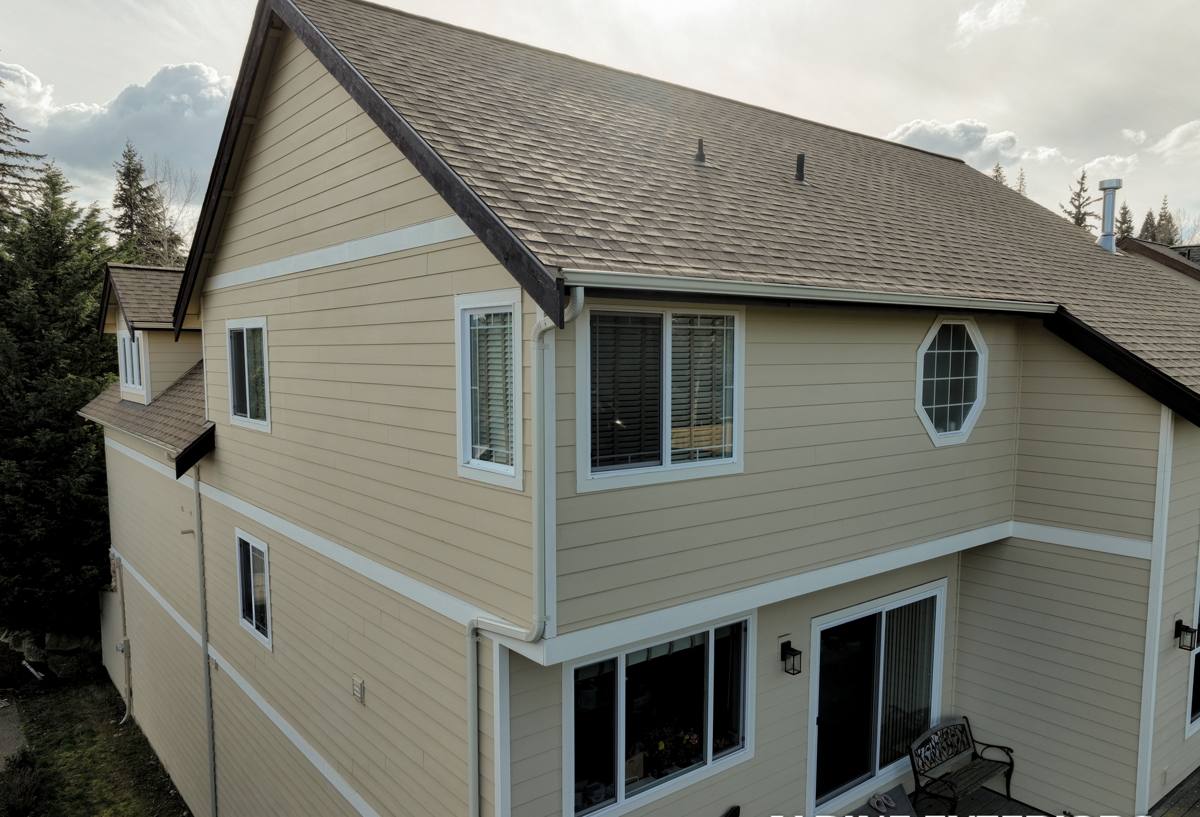
What Driving Rain, Moss, and Marine Air Do to Older Windows
Three things define the local climate's effect on windows here, and each one attacks a different part of the assembly.
Driving rain doesn't fall straight down in this region — wind pushes it sideways, right into vertical wall assemblies and window flanges. A window that was installed without proper flashing or a continuous weather-resistive barrier behind it will eventually let water track behind the frame, even if the glass and sash look fine. This is usually invisible until there's staining on interior trim or soft framing around the rough opening.
Moss and organic growth thrive in the shade and moisture that's common around Nooksack, especially on north-facing walls and anywhere siding overhangs a window. Moss holds water against building materials far longer than open air ever would, which accelerates rot in wood trim and sills and breaks down caulk and sealant faster than manufacturers rate for.
Marine air carries fine salt and moisture that, over years, degrades certain hardware finishes and can be harder on lower-grade seals and gaskets than a drier inland climate would be. It's a slower effect than rain intrusion, but it adds up over the 15-20 year service life of a typical window.
None of this means Nooksack is an unusually hostile place to own a house. It means windows here need to be selected and installed with these three factors in mind, rather than treated the same way you'd treat a window install in a dry climate.
What "Energy-Efficient" Actually Means
The term gets used loosely. For a Whatcom County home, energy efficiency in a window comes down to three things working together — the glass, the frame, and the installation. Get one wrong and the other two don't matter much.
Glass and Coatings
Most homes in this climate do well with double-pane, low-E (low-emissivity) glass with an argon or krypton gas fill between the panes. The low-E coating reflects radiant heat while still letting visible light through, which matters in a region that already gets limited winter daylight. Triple-pane glass offers a further step up in insulation value and sound dampening, but it adds weight and cost — worth discussing case by case rather than assuming it's always the right call.
Frame Material
Frame choice matters as much as glass in a wet, moss-prone climate. Vinyl, fiberglass, and wood-clad frames all perform differently under sustained moisture exposure, and we'll walk through the trade-offs in the comparison below.
Installation Detail
This is the part that's easy to overlook and the part that causes the most callbacks industry-wide. A high-performance window installed without correct flashing, backer rod, and sealant sequencing will underperform a mid-grade window installed correctly. Proper installation in this climate means integrating the window flange with the wall's weather-resistive barrier so water is always directed outward, never trapped behind the frame.
Signs It's Time to Replace Your Windows
- Visible condensation or fogging between the panes (a sign the seal has failed and the gas fill is gone)
- Drafts you can feel near the frame even when the window is fully latched
- Soft, discolored, or spongy wood on the sill or interior trim
- Windows that are difficult to open, close, or lock — often a sign the frame has swelled or shifted
- Visible moss, black staining, or paint failure concentrated around the window opening
- A noticeable jump in heating costs without any other explanation
- Single-pane glass anywhere in the home — original construction in older parts of the county often still has it
Any one of these on its own isn't necessarily urgent. Two or three together, especially combined with visible moisture damage, usually means it's worth having someone look at the whole opening rather than just the glass.
Frame Material Comparison for This Climate
| Frame Material | Moisture & Rain Performance | Maintenance | Relative Cost |
|---|---|---|---|
| Vinyl | Good — won't rot, handles driving rain well when properly installed | Low — no painting or sealing needed | Lower |
| Fiberglass | Very good — dimensionally stable, resists warping in wet-dry cycles | Low to moderate | Higher |
| Wood-clad | Depends heavily on cladding integrity — once compromised, wood core is vulnerable to moss-driven moisture | Higher — cladding seams need periodic inspection | Higher |
| Aluminum | Weak thermal performance; prone to condensation without a thermal break | Low | Moderate |
We don't push one material on every job. A vinyl or fiberglass frame is usually the more sensible default for Nooksack's rain and moss exposure because there's no painted or clad surface that can fail and let water reach a wood core. Wood-clad windows can still be the right architectural choice for some homes — we just make sure the client understands the added maintenance responsibility that comes with it in this climate before they commit.
Our Installation Process
1. On-Site Assessment
We start by inspecting each opening, not just measuring for a new window. That means checking the sill, framing, and existing flashing for hidden moisture damage before we ever quote the job. A window replacement is also the one time it's cheap and easy to fix rot that would otherwise be buried behind new trim for another 20 years.
2. Removal and Opening Prep
Old windows come out carefully to avoid damaging surrounding siding or trim more than necessary. Any soft framing, deteriorated sheathing, or failed prior flashing gets addressed at this stage — this is the step that's easiest for a rushed crew to skip and the one that determines whether the new window actually stays dry.
3. Flashing and Weather Barrier Integration
We integrate new window flashing with the existing weather-resistive barrier in the correct shingle-lap sequence — bottom, sides, then top — so any water that does reach the wall is directed back out rather than trapped. This step matters more in a driving-rain climate than the window itself.
4. Setting, Sealing, and Insulating
The window gets set level and plumb, shimmed correctly so it won't bind or sag, and the gap between frame and rough opening is insulated and sealed with materials rated for exterior use — not just caulked and left.
5. Finish and Walkthrough
Interior and exterior trim gets finished, the window is tested for smooth operation, and we walk the homeowner through what to expect and how to spot early trouble down the road.
What a Correct Job Involves — A Practical Checklist
- Rough opening inspected for rot or moisture damage before the new window goes in
- Flashing installed in the correct sequence and integrated with the existing weather barrier
- Window shimmed level and plumb, not just wedged into place
- Gaps insulated with exterior-rated material, not just filled with spray foam and forgotten
- Exterior sealant applied in the right locations — and, just as important, left out of the wrong ones so water has a path to drain
- Interior and exterior trim reinstalled or replaced to match the home
- Final operation check — the window opens, closes, and locks smoothly
Why Local Experience in Nooksack Matters
Window installation isn't identical everywhere. A crew that mostly works dry-climate jobs may not think twice about flashing sequence or moss-prone shading patterns, because it's never cost them a callback where they're from. Working regularly in Whatcom County means we've seen how driving rain actually behaves against a wall here, which sides of a house hold moss longest, and where marine air tends to shorten the life of certain hardware and sealants faster than the label suggests.
That local pattern recognition is what shows up as fewer callbacks and windows that actually perform the way they're rated to, years after the crew has left. It's also why we're comfortable telling a homeowner when a window doesn't need replacing yet — a full inspection sometimes turns up a sealant or trim repair that solves the problem for a fraction of the cost, and we'd rather have that conversation honestly than sell a job that isn't needed.
Get a Free, No-Pressure Estimate
If you're dealing with drafts, fogged glass, or visible moisture damage around your windows in Nooksack, we're happy to take a look and give you an honest read on what's going on — whether that means a full replacement, a targeted repair, or just some maintenance advice. Fill out the form below and we'll set up a free estimate with no pressure attached.