 Birch Bay
 Birch Bay Village sits in one of the more exposed residential pockets of Birch Bay, close enough to the water that salt air, wind-driven rain, and a moss season that runs most of the year are just part of owning a home here. The mix of housing in this neighborhood is wide — older cottages and cabins that started out as seasonal getaways, homes that have been added onto or converted for year-round living, and newer builds oriented toward the water view. What they all have in common is an exterior that takes a harder hit from the weather than a home set back a few miles inland.
Siding is one of the first systems to show that wear, and it's the one we specialize in. We install James Hardie fiber cement siding exclusively — no vinyl, no LP SmartSide, no Cemplank, no Allura, no primed spruce or cedar. This page covers what that means specifically for Birch Bay Village: what the local exposure demands, what a correct installation actually involves, and why the details matter more here than they would somewhere calmer.
What Birch Bay Village's Exposure Does to Siding
Salt Air and Corrosion
Proximity to the water means Birch Bay Village siding deals with a steady dose of salt-laden air, and salt is hard on more than just the visible surface of a wall. It accelerates corrosion in fasteners, flashing, and any metal trim tied into the siding system, and it breaks down lower-grade finishes faster than a drier, more inland climate would. A siding product and its hardware both need to be chosen with that corrosion risk in mind from the start, not picked on appearance alone.
Wind-Driven Rain
Water exposure here doesn't come straight down. Storms off the water push rain sideways into wall assemblies, seams, and butt joints, which is a different and heavier load than a simple rainfall total suggests. Siding and flashing details that hold up fine in a sheltered, calm location can still fail here specifically because wind pushes moisture into gaps that would never get tested somewhere less exposed.
A Long Moss and Mildew Season
Shade, mild temperatures, and near-constant dampness add up to a moss and mildew season that can run most of the year on north-facing and tree-shaded walls, which describes a lot of lots in this neighborhood. Any siding material that's even slightly porous, or that holds moisture against the substrate, becomes a growth surface over time. That's a maintenance burden as much as an appearance issue, since trapped moisture behind organic growth is what eventually leads to rot in the wall assembly underneath.
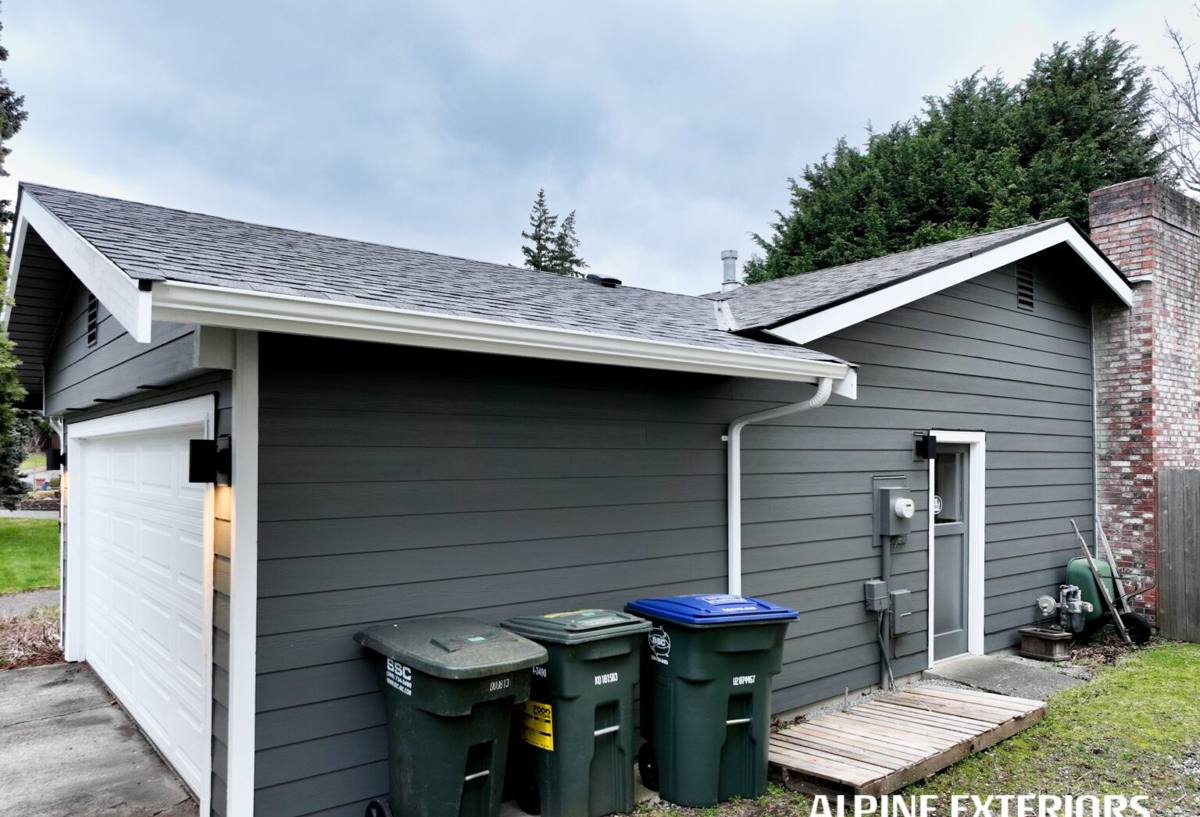
Why James Hardie Is the Only Siding We Install
We didn't always install a single brand. The switch came from a pattern we kept seeing on tear-offs and service calls in exactly this kind of climate — salt air, sustained moisture, heavy moss — not from a supplier deal or a sales angle.
- Non-combustible core: fiber cement doesn't feed a fire the way wood-based siding products can, which matters for both safety and, in many cases, insurance considerations.
- Factory-applied ColorPlus finish: the color coat is baked on in a controlled factory process rather than brushed on in the field, which resists fading, chalking, and moisture intrusion longer than site-applied paint does.
- Climate-engineered HZ5 formulation: Hardie's HZ5 product line is built for regions with sustained moisture exposure and freeze-thaw cycling, which fits waterfront Whatcom County closely.
- Dimensional stability: fiber cement doesn't swell, cup, or warp the way engineered wood products can after repeated wetting through a wet season.
- Strong transferable warranty: Hardie backs the product with one of the more substantial warranty structures in the industry, provided the installation follows their published spec.
Vinyl, LP SmartSide, Cemplank, Allura, primed spruce, and cedar each have a place in the market, and plenty of homeowners are satisfied with them in less demanding settings. On a Birch Bay Village lot, we've made the professional call that a single system we fully stand behind is worth more than a lower-cost option that shifts long-term maintenance risk onto the homeowner.
What a Correct Hardie Installation Involves Here
Fastening and Clearance
Fiber cement only performs as designed when the fastener type, size, and spacing match Hardie's specification, and when the panel bottom edge keeps proper clearance from grade, decks, and roof lines. Undersized or corrosion-prone fasteners are a real weak point in a salt-air setting — they're one of the first things to fail, and a failed fastener lets a whole panel start moving before anything else looks wrong.
Drainage and Rain-Screen Behind the Panels
Wind-driven rain will find its way behind lap siding on an exposed lot no matter how tight the seams look from the street. A drainage plane or rain-screen gap behind the panels gives that incidental moisture a path to drain and dry instead of sitting against the wall sheathing. On a Birch Bay Village home, we treat this detail as standard, not optional, because it's the difference between moisture that dries out in a day and moisture that sits until it becomes a rot problem.
Joints, Corners, and Trim
Butt joints, corner boards, and trim transitions are where most fiber cement callbacks actually originate, not the field of the panel itself. Factory-mitered corners or properly caulked and backed joints, correct overlap at butt seams, and trim that's flashed rather than just caulked over are what keep water out of those transition points over the long run.
Practical Checklist During Installation
- Confirm fastener type and spacing match Hardie's published specification for your siding profile
- Ask whether a drainage gap or rain-screen is included behind the panels, and why
- Check that clearance from grade, decks, and roof lines meets Hardie's minimums
- Ask how butt joints and corners are detailed, not just how they'll look once painted
- Get written confirmation of which HZ product line is being used and that it's rated for this climate zone
- Confirm what's covered under warranty — material and installation labor are often separate
Hardie Product Lines and Finish Options for This Climate
Hardie makes several siding profiles — traditional lap, board and batten, and shingle-style panels among them — and most of them are available in the HZ5 formulation appropriate for this region. Which profile fits best usually comes down to the home's existing architecture: a cottage-style home in Birch Bay Village often reads well with a traditional lap profile, while a more contemporary or renovated home may suit board and batten or a mixed approach better. On finish, the factory-applied ColorPlus system holds its color and resists chalking longer in salt air and UV exposure than a field-applied paint job, which matters on a home that's going to face sun, salt, and rain in roughly equal measure through the year. We'll walk through profile and color options against your specific home rather than defaulting to whatever's fastest to install.
James Hardie vs. Other Siding in Birch Bay Village
| Material | Moisture Behavior | Maintenance in Salt Air | Typical Longevity Here |
|---|---|---|---|
| James Hardie fiber cement | Dimensionally stable; resists swelling and cupping | Low; factory finish resists fading and chalking | 30+ years with correct installation |
| Vinyl siding | Can distort or warp with heat; seams are a moisture entry point | Low upfront, but fasteners and seams stay an exposure risk | Variable; often shorter in high-wind coastal spots |
| LP SmartSide / engineered wood | Wood-based core is moisture-sensitive at cut edges and seams | Moderate; edge sealing and caulk upkeep matter a lot here | Depends heavily on installation quality and upkeep |
| Cedar / primed wood | Absorbs and releases moisture readily | High; regular refinishing needed in wet, salty air | Shorter without consistent, ongoing maintenance |
The pattern that shows up across all of these is that moisture-sensitive materials need more ongoing homeowner attention to perform well in this exposure, while fiber cement's dimensional stability and factory finish reduce that burden. None of the alternatives are unusable elsewhere — they're just a harder sell on a lot that gets this much salt air and wind-driven rain.
Our Installation Process
- On-site assessment — we walk the home, check the existing siding and wall condition, and note sun exposure, shade patterns, and how close the lot sits to the water
- Product and profile recommendation — HZ5 Hardie in the profile and ColorPlus color that fits the home, explained with the reasoning behind it
- Written scope and timeline — a clear scope of work and realistic schedule before anything is torn off
- Tear-off and wall inspection — old siding comes off and we check the sheathing and wall assembly underneath for hidden moisture damage before new siding goes on
- Drainage plane and installation — rain-screen or drainage detailing goes in first, then panels are fastened, jointed, and trimmed to Hardie's specification
- Final inspection — we walk the finished exterior and check fastening, clearances, and joints before calling the job complete
What Actually Drives Cost on a Birch Bay Village Hardie Job
A handful of factors move price on a fiber cement job more than anything else: total square footage and the home's overall complexity (corners, dormers, multiple roof-to-wall transitions add labor), whether the existing wall sheathing needs repair once old siding comes off, the profile chosen, and whether a full tear-off or an over-existing-siding approach is appropriate for the home. Homes closer to the water or with more shaded, moss-prone walls sometimes need more sheathing repair once the old siding is removed, since hidden moisture damage tends to concentrate in those spots. We won't quote a number without seeing the wall condition in person, but we'll walk through which of these factors apply to your project before you commit to anything.
Why a Local Birch Bay Village Crew Matters
Manufacturer installation guidance is written for average conditions in a moderate climate, and Birch Bay Village doesn't fit that description. Salt air, wind-driven rain, and a long wet season put more stress on fastening, drainage detailing, and joint work than the baseline spec assumes. A crew that has actually installed and repaired siding on this specific stretch of coastline knows which parts of that guidance are non-negotiable here, and where extra time on drainage or fastener grade is worth it even in spots that wouldn't need it a few miles inland.
That experience shows up in decisions that don't come up in a sales pitch — how much rain-screen gap a shaded north wall actually needs, which fastener grade holds up over the long run this close to the water, when a butt joint needs extra backing instead of relying on caulk alone. Those are the details that decide whether a Hardie installation is still performing cleanly in thirty years or showing moisture problems in eight.
What to Ask Before Hiring for Hardie Installation
- Ask how many Hardie projects they've completed in Birch Bay or similarly exposed coastal settings
- Confirm they're following Hardie's published installation specification, not a generic approach
- Ask specifically about drainage or rain-screen detailing behind the panels
- Confirm current Washington contractor licensing and active insurance
- Get a written scope of work and warranty terms before signing anything
If you're weighing a siding project for a Birch Bay Village home, whether it's an older cottage due for a replacement or a newer build you want built right the first time, we're happy to take a look and give you an honest read on what the home needs. Use the form below for a free, no-pressure estimate.