 Birch Bay
 Siding Replacement for California Creek Homes
California Creek sits in that quieter, tree-covered stretch near Birch Bay, and homes here deal with a slightly different mix of weather than places right on the open water. The lots tend to be lower and more shaded, which holds moisture longer after a storm, while the same salt-laden marine air and wind-driven rain that shape the rest of this part of Whatcom County still reach in here too. Add a moss season that can run most of the year on shaded, north-facing walls, and you get a climate that's genuinely hard on siding — not dramatic, just steady and relentless in a way that shows up as slow, hidden damage rather than sudden failure.
This page is about one job specifically: replacing siding on a California Creek home. We install James Hardie fiber cement exclusively, and everything below explains what this particular setting needs from a siding replacement, what a correct job actually involves, and how our process works from first walk-through to final trim.
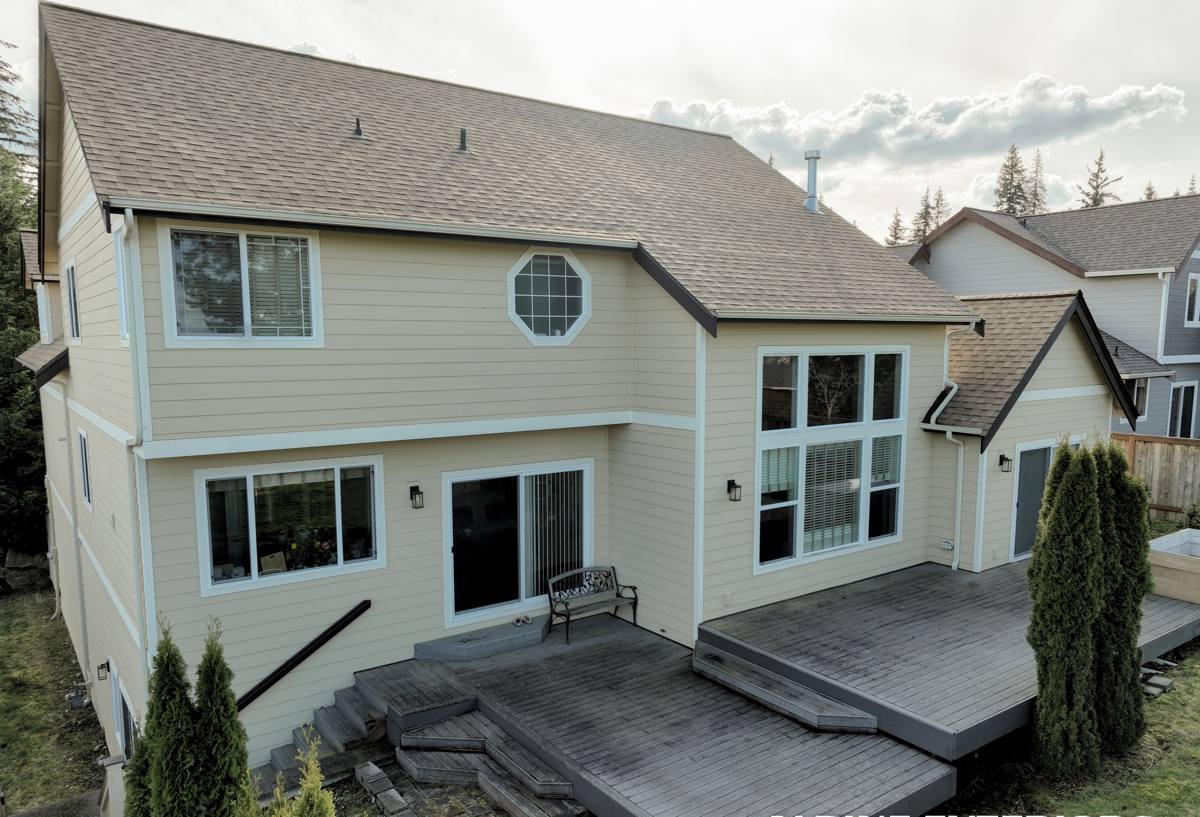
What Salt Air, Driving Rain, and Moss Do to Siding Here
Salt Air That Drifts Inland
You don't have to be right on the water to feel the effects of salt air. It carries on prevailing wind into creek-side and tree-covered lots too, settling on siding, trim, and fasteners over time. Salt accelerates corrosion in lower-grade metal hardware and can break down a weak finish faster than it would in a drier inland climate. Anything installed on a California Creek home — siding, flashing, fasteners — needs to be chosen with that slow corrosion risk in mind, not just picked for upfront cost.
Driving Rain That Doesn't Fall Straight Down
Storms moving through this part of Whatcom County routinely push rain sideways rather than letting it fall straight down, and wind-driven rain gets into places a calmer, drier climate never would test. It works into lap joints, corner boards, and window flashing, and it finds any siding installation that was detailed to shed rain but not to resist wind pushing that rain sideways and upward. This is one of the most common ways older or poorly installed siding starts failing quietly, years before a homeowner notices anything wrong at eye level.
Shade, Moisture, and a Long Moss Season
California Creek's tree cover is part of what makes it a nice place to live, but it also means siding here stays wet longer after rain than siding on an open, sun-exposed lot. Slower drying time is exactly the condition moss and mildew need to establish, and once organic growth takes hold on a wall, it holds moisture directly against the siding surface instead of letting it evaporate off. On a lot of California Creek homes, north-facing and heavily shaded walls will need closer attention than the sections that get regular sun.
Signs a California Creek Home Needs Siding Replacement
Siding failure in this climate is rarely sudden. It's worth knowing what to look for before a small problem becomes a wall full of rot.
- Soft, spongy spots when you press on the siding, especially near the bottom courses or under windows
- Persistent moss, algae, or dark staining on shaded walls that keeps coming back after cleaning
- Visible cupping, warping, or separation at seams and corner boards
- Paint or finish that's chalking, peeling, or failing well before it should
- Rising energy bills that suggest the wall assembly may no longer be sealing properly
- Interior signs — musty smell, bubbling paint, or soft drywall — near exterior walls
Any one of these on its own might be minor. Several together, especially on shaded walls, usually mean the water has been getting in for a while.
What a Correct Siding Replacement Actually Involves
What's Underneath Matters More Than What's On Top
A siding replacement is only as good as what happens after the old siding comes off and before the new siding goes on. Tear-off is when we actually get to see the sheathing, framing, and existing house wrap, and on a California Creek home with shaded, slow-drying walls, that inspection often turns up moisture damage that was invisible from the outside. Skipping this step — or covering over compromised sheathing instead of repairing it — is one of the most common ways a siding job looks fine for a year or two and then fails from the inside out.
Flashing, Housewrap, and Drainage Details
The materials that never make it into a sales conversation are usually the ones that decide whether a wall stays dry. Correct window and door flashing, properly lapped house wrap, and drainage detailing behind the siding matter more here than on a drier, more sheltered site, because wind-driven rain and prolonged wall dampness put more demands on every one of those layers. We treat these details as standard practice on every California Creek job, not as an upgrade a homeowner has to ask for.
Fastening and Clearance
Fiber cement siding needs correct fastener type, spacing, and clearance from grade and roofline to perform the way it's engineered to. On a shaded, moisture-heavy lot, proper clearance from grade also matters for keeping the bottom courses of siding from sitting in standing moisture or splash-back longer than they should.
Why We Only Install James Hardie Fiber Cement
We used to install a wider range of siding products. We narrowed to one system after seeing, repeatedly, what held up in this specific combination of salt air, sustained moisture, and shaded, slow-drying wall exposure — and what quietly became a maintenance problem a few years later.
- Non-combustible core: Fiber cement doesn't feed a fire the way wood-based siding can, which matters for both safety and insurance considerations.
- Factory-applied ColorPlus finish: The color is baked on under controlled factory conditions instead of brushed on in the field, so it resists fading, chalking, and moisture intrusion far longer than site-applied paint — an advantage that matters on shaded walls that stay damp longer.
- Climate-engineered HZ product lines: Hardie builds specific formulations for regions with heavy moisture exposure and freeze-thaw cycling, which describes this part of Whatcom County well.
- Dimensional stability: Fiber cement doesn't swell, cup, or warp the way engineered wood siding can after repeated wet-season moisture cycles.
- Strong transferable warranty: Hardie backs its products with a solid warranty structure when installation follows spec, which gives homeowners real protection instead of a marketing claim.
We don't install LP SmartSide, vinyl siding, Cemplank, Allura, primed spruce, or cedar. Each has a place in the broader market and homeowners elsewhere who are satisfied with them. On a lot like this — shaded, moisture-holding, exposed to salt air drifting in from the bay — we've made a professional call to install one system we fully stand behind rather than offer something cheaper that shifts maintenance risk onto the homeowner down the road.
Choosing the Right Hardie Product for a California Creek Home
| Product Line | Best Use | Why It Fits This Setting |
|---|---|---|
| HardiePlank lap siding | Most single-family homes | Traditional lap profile sheds wind-driven rain when installed with correct overlap and flashing |
| HardiePanel vertical siding | Gables, accent walls, modern designs | Clean vertical lines with fewer horizontal joints for water to work into on shaded walls |
| HardieShingle siding | Craftsman-style homes, accent sections | Textured look without the moisture absorption and upkeep real wood shingle needs in a damp, shaded setting |
| HardieTrim boards | Corners, window and door casing, fascia | Factory-finished trim resists the same prolonged moisture and freeze-thaw exposure as the field siding |
Color and profile come down to the individual home, but the product family and installation approach stay consistent — we spec what actually fits a California Creek property's shade and moisture exposure rather than defaulting to whatever's easiest to install.
Our Siding Replacement Process
- On-site walk-through: We look at the existing siding, trim, and any visible moisture signs, paying particular attention to shaded and north-facing walls.
- Tear-off and inspection: Old siding comes off and we inspect the sheathing and house wrap underneath before anything new goes on.
- Repair as needed: Any compromised sheathing or framing gets repaired before new siding is installed — never covered over.
- House wrap and flashing: New house wrap and correctly lapped flashing go in at every window, door, and penetration.
- Hardie installation to spec: Siding goes on with the fastener pattern, clearance, and joint detailing James Hardie specifies for this climate zone.
- Trim, caulking, and final walkthrough: Trim and corner details are finished, and we walk the completed job with the homeowner before calling it done.
Cost Factors for a California Creek Siding Job
| Factor | What It Affects | Why It Matters Here |
|---|---|---|
| Substrate condition at tear-off | Repair costs before new siding goes on | Shaded, slow-drying walls are more likely to have hidden sheathing or framing damage under old siding |
| House size and complexity | Labor time and material quantity | More corners, gables, and wall transitions mean more flashing and cutting |
| Tree cover and site access | Staging, cleanup, and scheduling | Wooded lots common around California Creek can mean tighter access and more debris management |
| Product line and trim package | Material cost | Panel and shingle profiles with more trim detail cost more than standard lap siding |
| Existing moisture damage | Whether the job is a straightforward re-side or includes structural repair | Long-term trapped moisture on shaded walls can affect sheathing and framing, not just the siding itself |
Exact pricing depends on the specific home and what we find once tear-off starts, which is why we walk the property in person before giving a real number rather than quoting off a generic price sheet.
Why a Crew That Already Works California Creek Matters
A crew that regularly works this part of Birch Bay already knows how the shade, moisture, and salt exposure around California Creek behave on real homes over a full year — not just how a product performs on a spec sheet. That shows up in practical decisions on install day: which walls stay wet longest and need extra flashing attention, how much clearance to leave at grade on a lot with slower drainage, and which fastener grade makes sense given the salt air drifting in from the bay. Getting those details right the first time is the difference between a siding job that lasts decades and one that needs attention again in five or six years.
If your California Creek home needs new siding, or you'd just like an honest read on whether you're looking at a repair or a full replacement, we're happy to walk the property with you. Reach out using the form below for a free, no-pressure estimate.