 Birch Bay
 Why Windows Work Differently in Sumas
Sumas sits in a part of Whatcom County where weather doesn't do things halfway. Winters bring hard cold snaps and gusty outflow wind funneling down from the Fraser Valley, while the rest of the year is defined by long stretches of damp, gray drizzle. That combination is tough on windows in a way that a mild, dry climate never tests. Old or poorly installed windows don't just let heat escape — they let cold air, moisture, and wind noise straight into the house, and over a full Whatcom County winter that shows up as a real number on your utility bill.
We're a siding contractor first, which means we spend our days looking at how water and air actually move around a house exterior — not just how a window looks from inside the showroom. Window performance and siding performance are the same problem: keeping the building envelope tight. When we replace windows in Sumas, we're thinking about how that opening ties into the wall assembly around it, not just the glass in the frame.
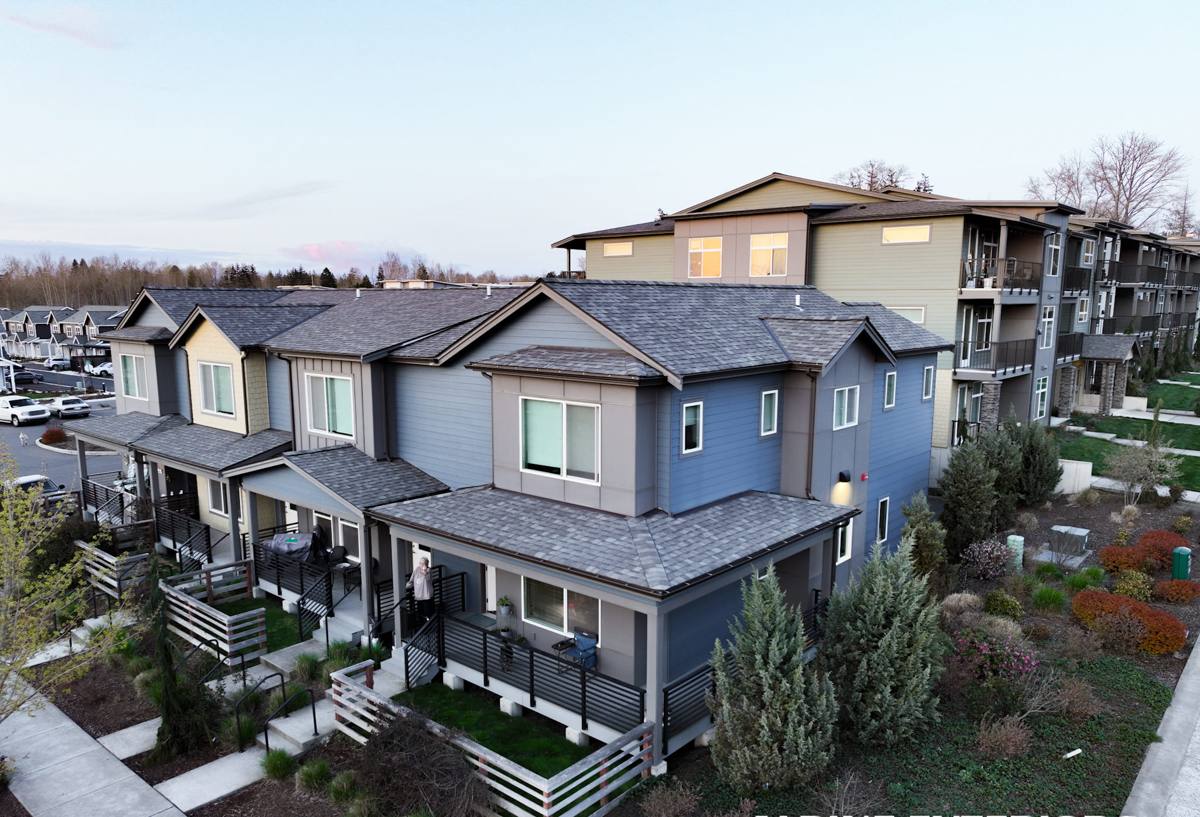
What Sumas Homes Actually Need From Their Windows
"Energy-efficient" gets used as a marketing word a lot. For a home in this part of Whatcom County, it should mean something specific:
- Low air infiltration — a tight seal that holds up against sustained wind, not just a still-air lab test.
- Good insulating value (low U-factor) — so the frame and glass both resist heat loss during long cold stretches.
- Moisture management — flashing and drainage details that shed the region's near-constant rain instead of trapping it behind the trim.
- Condensation resistance — inland cold snaps combined with indoor humidity can fog or even frost interior glass on a poorly rated window.
- Durable exterior finish — something that won't chalk, warp, or grow moss film during a damp season that can run many months of the year.
Notice that only two of those five are really about the glass. The rest are about installation quality and how the window is detailed into the wall — which is where most "energy-efficient" window jobs actually fall short.
The Moss and Moisture Factor
Anywhere in Whatcom County that stays shaded and damp for long periods — whether it's salt-tinged air closer to the water at Birch Bay or the cooler, wetter microclimate further inland around Sumas — ends up dealing with the same enemy: organic growth and slow moisture intrusion around exterior penetrations. Windows are one of the biggest penetrations in any wall. A gap in the flashing or a bead of failed caulk doesn't announce itself; it just lets water track down inside the wall cavity, quietly, for years.
Signs Your Current Windows Are Costing You Money
You don't need to be a contractor to spot most of these. Walk your house on a cold or windy day and check for:
- A noticeable draft near the frame, even with the window latched shut
- Condensation or fog forming between window panes (a sign the seal has failed)
- Soft or discolored trim/siding directly around a window
- Difficulty opening, closing, or locking a window that used to move freely
- Rooms near windows that feel noticeably colder than the rest of the house
- Visible daylight around the frame from outside
Any one of these is worth a look. Several together usually means the window and the flashing around it are both past their useful life.
What a Correct Window Installation Actually Involves
Swapping the glass unit is the easy part. Doing the job right in a climate like this means paying attention to the parts nobody sees once the trim goes back on:
- Remove the old unit carefully and inspect the rough opening for hidden rot or prior water damage before anything new goes in.
- Repair the sheathing and framing if moisture has already gotten in — installing a new window over a compromised opening just resets the clock on the same failure.
- Install flashing in the correct order — sill pan first, then side flashing, then head flashing lapped over the top — so water is always directed outward and down, never behind the siding.
- Seal and insulate the gap between the frame and the rough opening without over-packing it, which can bow the frame and cause the window to bind.
- Set the window plumb, level, and square — a window that's slightly racked will never seal properly, no matter how good the weatherstripping is.
- Tie the water-resistive barrier and flashing back into the existing siding system, not just caulk over the seam and call it finished.
- Finish with backer rod and quality exterior sealant, sized and installed to actually flex through temperature swings instead of cracking after one season.
That last step on the list — tying flashing back into the siding — is exactly where window-only companies and general handymen most often cut corners, because they're not thinking about the wall as a whole system. It's also exactly where we don't, because siding integration is our core trade.
Window Options: An Honest Comparison
There's no single "best" window for every Sumas home — it depends on the home's age, exposure, and budget. Here's how the common choices stack up on the factors that actually matter in this climate:
| Frame Material | Insulating Value | Moisture Tolerance | Maintenance |
|---|---|---|---|
| Vinyl | Good | Very good — won't rot | Low |
| Fiberglass | Very good | Very good, dimensionally stable | Low |
| Aluminum | Poor unless thermally broken | Good | Moderate |
| Wood | Very good | Requires diligent upkeep | High |
| Wood-clad | Very good | Good if cladding is intact | Moderate |
For most Sumas homes, we steer people toward vinyl or fiberglass frames paired with a double- or triple-pane, Low-E, argon- or krypton-filled glass unit. Wood and wood-clad windows can look great and perform well, but they carry a real maintenance burden in a climate this wet — that's an honest trade-off to weigh, not a knock on the product itself.
Glass Package Basics Worth Knowing
- Low-E coating — a microscopically thin metallic layer that reflects heat back where you want it (in during winter, out during summer) without noticeably darkening the glass.
- Argon or krypton gas fill — inert gas between panes that insulates better than plain air.
- U-factor — lower is better; this is the single most useful number for judging how well a window resists heat loss in our cold snaps.
- Look for NFRC-labeled performance numbers rather than taking a brand's marketing claims at face value — the label is independently rated and comparable across manufacturers.
What Drives the Cost
Pricing varies a lot by home and scope, but the factors are consistent. Rather than quote numbers that won't hold up project to project, here's what actually moves the price:
| Factor | Why It Matters |
|---|---|
| Number and size of window openings | More openings and larger units mean more material and labor |
| Frame material chosen | Fiberglass typically costs more upfront than vinyl |
| Condition of the rough opening | Hidden rot or damage found during removal adds repair time |
| Access and second-story work | Ladders, staging, and tight access all add labor time |
| Coordinating with siding work | Doing windows and siding in one pass reduces duplicate labor versus two separate jobs |
That last line matters more than people expect. If your siding is due for attention in the same area as your windows, tackling both together usually saves money and produces a better seal than doing them years apart.
Our Process
We keep it straightforward:
- On-site walkthrough of every window being considered, checking framing and siding condition around each one
- Straight talk about which windows make sense for your home and budget — no upselling to a product you don't need
- A written scope covering flashing, sealing, and how the new window ties into your existing siding
- Careful removal and inspection of each opening before anything new goes in
- Installation following the sequence above — sill pan, flashing, air sealing, sealant — every time, not just when it's convenient
- Site cleanup and a final walkthrough so you can see the finished work before we call it done
Why a Local Whatcom County Crew Matters
A crew that already works the Sumas and Birch Bay area understands what this climate does to a building envelope over time, because we see the results of bad flashing jobs and skipped steps regularly — not as a theory, but as repair calls. That local experience shapes how we detail every window we install: we're not guessing at what "durable" means here, we're building to what actually holds up through a Whatcom County winter and the wet season that follows it.
It also means someone answers the phone if a question comes up after the job is done, and that we're not driving in from out of the area to chase a one-off installation.
If your windows are drafty, fogged, or original to a home that's due for an upgrade, we're happy to take a look and give you a straight, no-pressure estimate — just fill out the form below and we'll get in touch.