 Birch Bay
 Why Cottonwood Beach Roofs Take a Different Kind of Punishment
Cottonwood Beach sits close enough to the water that every roof up here is doing double duty. It's not just shedding rain like a roof inland — it's holding up against salt-laden air blowing off the water, near-constant damp during the fall and winter, and a moss season that can run eight months or longer in a wet year. A roofing product that performs fine forty miles inland can fail early out here if it wasn't chosen and installed with this specific exposure in mind.
Metal roofing, done correctly, is one of the better answers to that combination. It sheds moss and debris more easily than composition shingles, it doesn't absorb water the way organic roofing mats can, and a properly coated panel resists the slow chemical breakdown that salt air causes. But "metal roofing" isn't one product — it's a category with real differences in panel type, coating, fastener choice, and detailing, and those differences matter more here than almost anywhere else in Whatcom County.
What Salt Air and Coastal Moisture Actually Do to a Roof
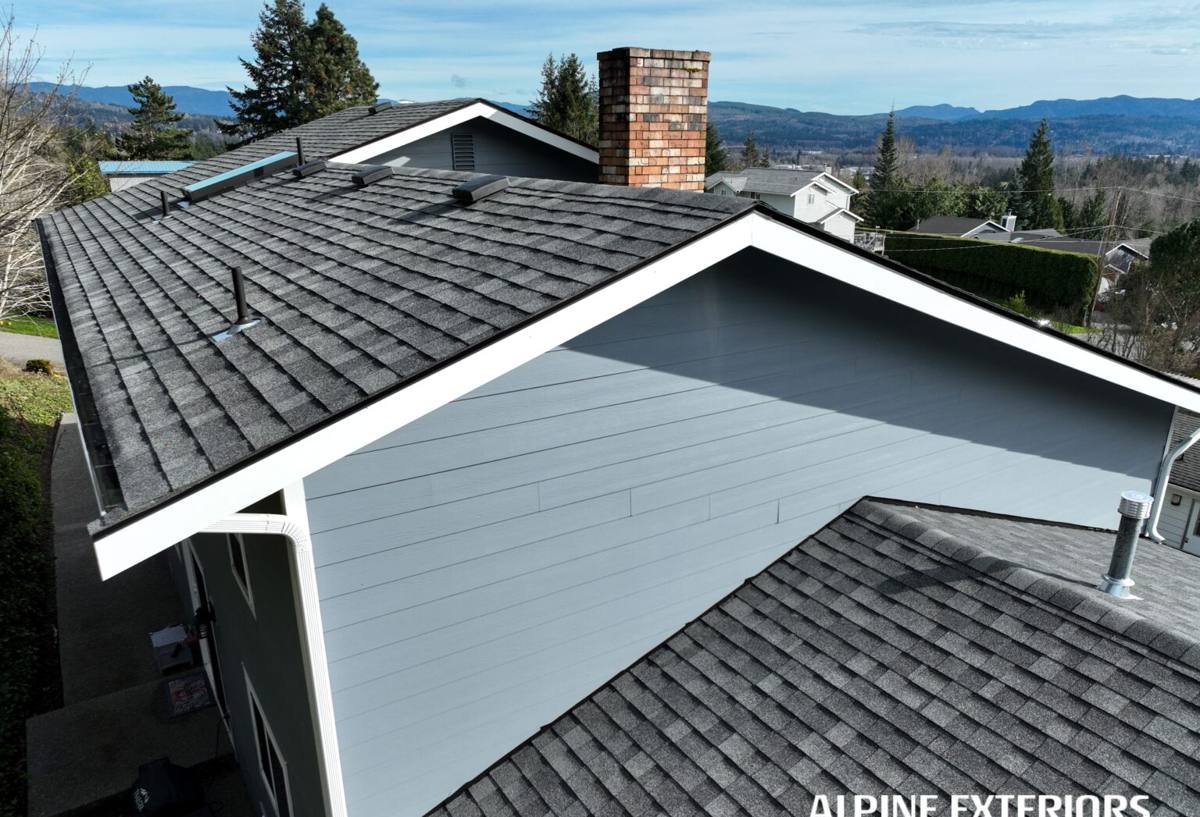
Salt air isn't just an inconvenience — it's a slow, ongoing chemical process. Airborne salt settles on every exposed surface and accelerates oxidation on unprotected or poorly coated metal, on fasteners, and on flashing. Combine that with Birch Bay's driving, wind-pushed rain — which hits roof surfaces at an angle instead of falling straight down — and you get water finding its way into laps, seams, and fastener penetrations that would stay dry in a calmer climate.
Add in the moss. Whatcom County's long wet season, mild temperatures, and shade from mature trees create ideal moss conditions on north-facing and shaded roof slopes. Moss holds moisture against the roof surface far longer than open air would, which is exactly the kind of prolonged dampness that speeds up corrosion at seams and fastener heads. On a roof near the water, moss isn't just a cosmetic nuisance — it's a moisture trap sitting directly on top of a surface that's already under chemical stress from salt.
None of this means metal roofing is a bad fit for Cottonwood Beach — it means the coating, fastener metallurgy, and panel detailing have to be chosen specifically for this exposure, not just picked off a general product list.
The Three Things That Actually Determine How a Metal Roof Ages Here
- The base metal and coating system — some perform meaningfully better in salt air than others
- Fastener compatibility — mismatched metals at the fastener create galvanic corrosion, often the first visible failure point
- Detailing at penetrations, valleys, and eaves — this is where water actually gets in, far more often than through the field of the panel itself
Choosing the Right Metal Roofing System for a Coastal Property
There are two broad categories of metal roofing installed on homes: standing seam panels with concealed fasteners, and exposed-fastener corrugated or ribbed panels. Both can work in Birch Bay's climate, but they age differently and carry different maintenance expectations near the water.
| Factor | Standing Seam | Exposed-Fastener Panel |
|---|---|---|
| Fastener exposure | Concealed under the seam — not exposed to weather | Fasteners penetrate the panel face and sit exposed to rain and salt air |
| Long-term maintenance | Lower — no fastener washers to inspect or replace | Higher — rubber washers on exposed screws degrade and need periodic checking |
| Upfront cost | Higher material and labor cost | Generally the lower-cost metal roofing option |
| Typical use | Full roof replacement, higher-end coastal properties | Outbuildings, budget-conscious projects, some full roofs |
| Salt air performance | Strong — fewer weak points for corrosion to start | Adequate with the right coating, but fastener washers are the first thing to watch |
For a property sitting close to the water in Cottonwood Beach, we lean toward standing seam whenever the budget allows, specifically because it removes the exposed-fastener washer from the equation — that's the single most common early failure point we see on exposed-fastener metal roofs in salt-air locations. That said, a well-installed exposed-fastener system with a quality coating and correctly matched fasteners is still a legitimate, durable option, and it's the right call for plenty of projects.
Coating Matters as Much as Panel Style
The coating is what actually stands between the steel or aluminum substrate and the salt air. Galvalume and painted steel coatings vary in how well they hold up under chloride exposure, and aluminum panels avoid ferrous corrosion entirely, which is why they're often favored on properties directly exposed to marine air. We'll walk through the realistic coating options for your specific roof and exposure during the estimate — this is not a one-size-fits-all decision, and it's worth getting right the first time since it's not something you fix later without redoing the roof.
Fasteners and Flashing: The Details That Decide How Long the Roof Lasts
Most metal roof failures we get called out to inspect near the water aren't failures of the panel itself — they're failures at the connections. Galvanic corrosion happens when two dissimilar metals are in contact in the presence of moisture, and salt-laden moisture accelerates it significantly. A mismatched screw, an incompatible flashing metal, or a fastener washer left to degrade will cause a leak years before the panel itself is anywhere near the end of its life.
Correct detailing for a Cottonwood Beach roof includes:
- Fasteners matched to the panel metal to avoid galvanic reaction at every penetration
- Ice-and-water shield underlayment at eaves, valleys, and penetrations — not just felt paper — given how often wind-driven rain gets pushed under panel edges here
- Properly lapped and sealed ridge and hip flashing, since these are high-exposure points for wind-driven rain
- Closure strips at eaves and ridges to keep out wind-blown debris and pests without blocking ventilation
- Sealant chosen for UV and salt exposure, not a generic caulk that will chalk and crack within a couple seasons
This is the part of a metal roofing job that doesn't photograph well and that homeowners often can't evaluate by looking at the finished roof — but it's the part that determines whether the roof is still performing in fifteen years or leaking in five.
Moss, Drainage, and Roof Design for a Long Wet Season
Moss doesn't just grow on shingles — it will establish on metal too, especially in shaded valleys, behind chimneys, and on north-facing slopes where the roof surface stays damp longest. Metal sheds moss far more easily than composition roofing because there's no rough mat surface for spores to anchor into, but standing water and debris buildup at valleys, gutters, and low-slope transitions still create the conditions moss needs to get started.
Good design choices reduce this before it becomes a maintenance headache: proper panel overlap and slope at valleys so water and debris don't pool, gutter and downspout sizing that actually keeps pace with Whatcom County's rain volume, and keeping penetrations and transitions as simple as the roof design allows, since every extra seam is another spot for debris to catch.
How Our Process Works
- On-site assessment. We look at your existing roof structure, decking condition, ventilation, and how exposed the property is to wind and salt air before recommending a system.
- Material and coating selection. We walk through panel style, coating, and color options suited to your specific exposure and budget — not just what's cheapest to stock.
- Tear-off and deck inspection. We remove the old roofing and check the decking underneath for rot or moisture damage before anything new goes on — this step gets skipped by crews in a hurry, and it's where problems hide.
- Underlayment and flashing. Ice-and-water shield at vulnerable areas, correctly lapped flashing, and fastener selection matched to the panel metal.
- Panel installation. Installed to manufacturer spec for fastener spacing, panel overlap, and expansion allowance — metal roofing needs room to move with temperature changes, and skipping that detail causes oil-canning and stress at seams over time.
- Final walkthrough. We go over the completed roof with you, including what maintenance to expect and what to watch for going forward.
What Homeowners Can Do to Extend Roof Life
A correctly installed metal roof in this climate needs less maintenance than shingles, but "less" isn't "none." A simple annual routine goes a long way toward getting the full service life out of the system.
- Clear gutters and downspouts at least twice a year, more often if you're under mature trees
- Rinse accumulated salt film and debris off the roof surface periodically, especially on sections facing the water
- Check for moss establishing in shaded valleys or behind chimneys and remove it before it spreads
- Look at exposed fastener washers (on exposed-fastener panel systems) every year or two for cracking or wear
- Have a professional inspect flashing and sealant at penetrations every few years, since these are the components most likely to need attention before the panels do
Why Hiring a Crew That Already Works Cottonwood Beach Matters
Metal roofing installation isn't unique to the coast — but installing it correctly for coastal exposure is a specific skill, and it's one a lot of crews who mostly work inland don't get much practice at. A crew that regularly works Birch Bay and the surrounding Whatcom County coastline already knows which coatings hold up here, which fastener combinations cause problems a few years down the road, and how much underlayment and flashing detail this exposure actually calls for — because they've seen what happens when it's skipped.
That local experience shows up in decisions you won't necessarily notice on installation day but will feel the difference from over the life of the roof: the coating recommendation that matches your actual sun and wind exposure, the flashing detail at a valley that's shaded and slow to dry, the fastener spec that won't start corroding at year six. It's the difference between a roof that's technically installed correctly on paper and one that's actually built for where it sits.
What Affects the Cost of a Metal Roof in This Area
| Cost Factor | Why It Matters Here |
|---|---|
| Panel style (standing seam vs. exposed-fastener) | Standing seam costs more upfront but reduces long-term maintenance from fastener wear in salt air |
| Coating and metal type | Higher-grade coatings and aluminum resist salt-air corrosion longer, at a higher material cost |
| Roof complexity | More valleys, penetrations, and transitions mean more flashing labor and more potential moss-catch points |
| Deck condition | Rot or moisture damage found during tear-off adds repair scope before new roofing goes on |
| Access and slope | Steep or hard-to-access roofs increase labor time and staging requirements |
We give straight numbers based on your actual roof, not a generic per-square estimate pulled off a chart — the assessment is what makes the number accurate.
If you're weighing metal roofing for a home in Cottonwood Beach or elsewhere around Birch Bay, we're glad to walk your roof, talk through the options that make sense for your exposure and budget, and give you a straightforward, no-pressure estimate. There's a form below to get that started.