 Birch Bay
 Why Decks Wear Out Faster in Cottonwood Beach
Cottonwood Beach sits close enough to the water that salt-laden air is a daily fact of life, not an occasional nuisance. That air finds every exposed fastener, every joint in a ledger board, and every low spot where water sits after a storm rolls through. Add in Whatcom County's long, wet winters and the extended moss season that follows, and you have a set of conditions that ages an ordinary deck years ahead of schedule.
A deck built with standard-grade lumber and mixed hardware might look fine for the first few years. The problems usually start underneath, where moisture gets trapped against framing that never fully dries out between rain events. By the time surface boards start cupping or railings feel loose, the structure underneath has often been quietly failing for a while. That's the pattern we see over and over on decks in this neighborhood, and it's the reason a replacement here needs to be planned differently than a deck build in a drier inland area.
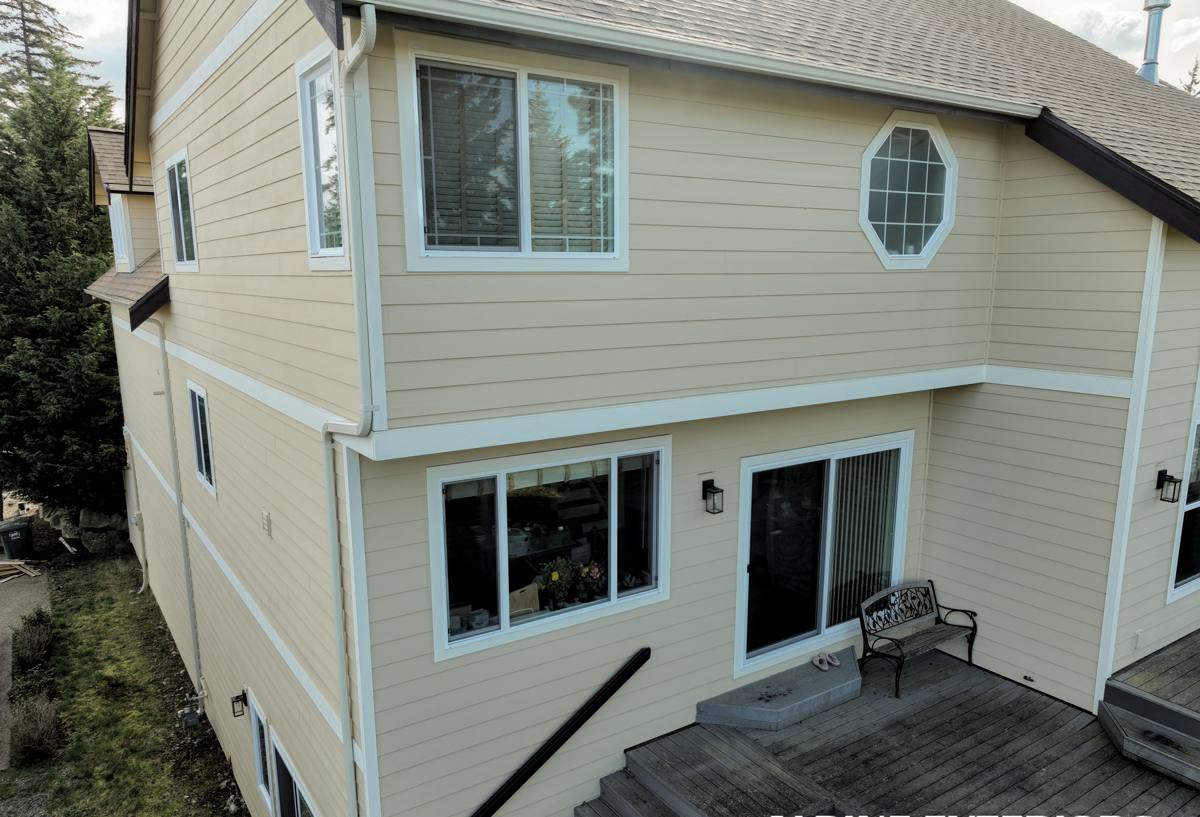
Signs a Deck Needs Replacing, Not Just Repair
Not every tired-looking deck needs to come out entirely. But there's a point where patching individual boards stops making sense, either because the framing underneath is compromised or because the repair cost starts approaching what a full replacement would cost. Some signs worth taking seriously:
- Soft or spongy spots in the decking surface, especially near the ledger board or stair stringers
- Visible rust streaking from fasteners or hardware onto the wood surface
- Railing posts that flex or wiggle when pushed by hand
- Persistent moss or dark staining that returns within weeks of cleaning
- Gaps opening up between boards, or boards that have cupped and no longer sit flat
- A ledger board connection that shows gaps, rot, or water staining on the siding or rim joist behind it
If you're seeing more than one or two of these, it's worth having someone pull a board or two and look at the joists directly rather than guessing from the surface.
What a Correct Deck Replacement Actually Involves
A deck replacement isn't just swapping old boards for new ones. Done right, it starts from the ground up, and in a salt-air, high-rainfall environment like this one, a few structural details matter more than they would somewhere drier.
Ledger Board and Flashing
The ledger board — where the deck attaches to the house — is the single most common failure point on decks near the water. If it isn't properly flashed to shed water away from the house framing, moisture gets trapped between the ledger and the siding and rots both from the inside out. A correct install uses proper flashing detail and a gap or drainage path so water has somewhere to go instead of sitting against the wall.
Footings and Frost Depth
Footings need to be sized and set to current code requirements, which in this area accounts for both soil conditions and frost depth. Undersized or shallow footings are one of the more common shortcuts on older decks, and they're not something you want to inherit when you're already investing in a full replacement.
Joist Spacing and Hardware
Joist spacing has to match the decking material being installed — composite and PVC boards often call for tighter spacing than solid wood to prevent sagging over time. Every joist hanger, screw, and bolt in that framing should be rated for exterior, corrosion-resistant use, because in this environment mixed or mismatched hardware is where premature failure starts.
Choosing Decking Material for a Salt-Air Environment
There's no single "best" decking material for every homeowner — it comes down to how much maintenance you want to take on, your budget, and how long you want the deck to last before it needs attention again. In a salt-air, high-moisture setting like Cottonwood Beach, though, some materials clearly hold up better than others.
| Material | Moisture & Salt Resistance | Maintenance | Typical Lifespan |
|---|---|---|---|
| Pressure-treated wood | Fair — needs sealing to perform well | Annual cleaning and re-sealing recommended | 10-15 years with upkeep |
| Cedar | Good natural resistance, but surface still weathers | Periodic cleaning and finish renewal | 15-20 years with upkeep |
| Composite decking | Very good — resists rot and salt corrosion | Occasional washing, no sealing | 25-30 years |
| Capped PVC decking | Excellent — fully sealed surface, no absorption | Occasional washing only | 25-30+ years |
We'll walk through these trade-offs honestly during an estimate rather than steering you toward whatever happens to be easiest for us to install. Some homeowners want the look and feel of real wood and are fine with the upkeep that comes with it. Others would rather pay more up front for composite or PVC and be done thinking about sealing and staining. Both are reasonable choices — the wrong choice is picking a material without understanding what it actually needs from you over the next decade.
Railings, Fasteners, and Hardware That Actually Hold Up
Hardware is where a lot of decks near the water quietly fail first, long before the decking boards themselves show real wear. Standard zinc-coated screws and brackets corrode faster in salt air than most homeowners expect, and once a fastener starts rusting it weakens the connection it's holding together.
- Stainless steel or coated exterior-rated fasteners throughout, not just at the visible surface
- Hot-dip galvanized joist hangers and structural hardware sized to code
- Railing posts through-bolted to framing rather than just screwed to the rim joist
- Post bases with proper standoff to keep wood posts off standing water
- Stair stringers connected with hardware rated for the same exposure as the rest of the frame
None of this is visible once the deck is finished, which is exactly why it's worth asking a contractor directly what hardware they're using before work starts.
Our Deck Replacement Process
The process itself is straightforward, but the sequence matters — skipping steps or rushing the inspection stage is how problems get built back into a new deck.
- On-site assessment of the existing deck, including checking joists, the ledger connection, and footings where accessible
- A written estimate that covers material options, structural scope, and a realistic timeline
- Full tear-off of the old deck, with framing inspected as it's exposed
- New footings, framing, ledger flashing, and structural hardware installed to current code
- Decking, railings, and stairs installed per the material specifications
- Final walkthrough so you can see the finished work and ask questions before we consider the job done
We don't quote a deck replacement without actually looking at the existing structure first. Photos and phone descriptions miss too much — particularly the framing and ledger condition, which are the parts that determine whether a job is a straightforward rebuild or something more involved.
Permits and Local Considerations
Deck replacements of most sizes require a permit in Whatcom County, and inspections typically happen at the framing stage before decking goes down. This isn't paperwork for its own sake — the inspection is a real check on footing depth, ledger attachment, and structural hardware, which are exactly the details that matter most in a coastal environment like this one. We handle the permit process as part of the job rather than leaving it for the homeowner to sort out separately.
Cottonwood Beach's proximity to the water also means some properties fall within shoreline-adjacent review areas, which can affect setbacks or scope depending on the specific lot. We'll flag this during the estimate if it applies to your property rather than assuming it doesn't.
Maintenance After Installation
Even a well-built deck needs some seasonal attention here, particularly through the moss season that stretches from fall through spring. A few habits go a long way toward protecting the investment:
- Sweep debris off the deck surface regularly so moisture and organic matter don't sit and feed moss growth
- Rinse salt residue off the surface periodically, especially after storms with onshore wind
- Keep gutters and downspouts near the deck clear so runoff isn't draining directly onto it
- For wood decking, plan on re-sealing on the schedule the manufacturer or finish recommends
- Check railings and stair connections once a year for any looseness before it becomes a bigger issue
Composite and PVC decking cut this list down considerably, which is part of why many homeowners in this area lean that direction when replacing an older wood deck.
Why Local Experience Matters for This Job
A deck replacement done to generic specs, without accounting for salt air and Whatcom County's rainfall, tends to show its age within a few years — even if it looks great on installation day. Crews that already work Cottonwood Beach regularly know which hardware grades actually hold up here, where moss tends to collect on a finished deck, and how the local permitting and inspection process runs from experience rather than guesswork. That familiarity shows up less in what you see on day one and more in how the deck performs five and ten years down the road.
If your current deck is showing wear, or you're just trying to figure out whether it's a repair or a replacement, we're happy to take a look and give you a straight answer. Reach out for a free, no-pressure estimate using the form below.