 Birch Bay
 Decking Built for Cottonwood Beach's Coastal Conditions
Cottonwood Beach sits close enough to the water that every deck out here deals with the same three enemies year-round: salt-laden air, driving rain off the Strait, and a moss season that can stretch from October well into spring. A deck built for an inland neighborhood in Whatcom County doesn't automatically hold up here. The fasteners corrode faster, the wood grain opens up under repeated wet-dry cycles, and any flat or shaded surface becomes a moss magnet if it isn't detailed to shed water and dry out between storms.
Composite decking has become the practical answer for a lot of Cottonwood Beach homeowners precisely because it removes several of those failure points. It doesn't have grain to swell and crack, it doesn't need annual staining, and the better product lines resist moss and mildew far more consistently than untreated wood. That said, composite is not maintenance-free or foolproof — it still has to be installed correctly for this specific environment, or you end up trading one set of problems for another.
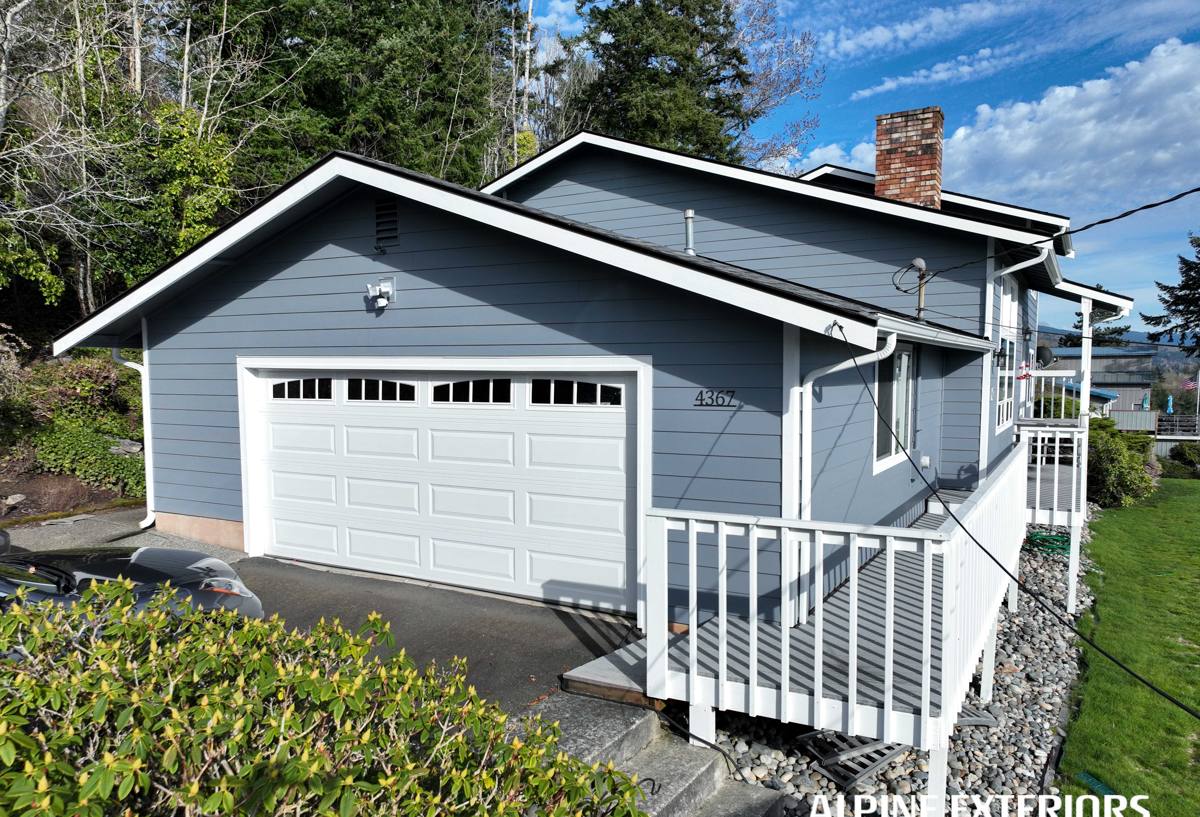
What Salt Air and Coastal Rain Actually Do to a Deck
It helps to understand the mechanics before deciding on materials and installation details.
Salt Air and Metal Fasteners
Airborne salt accelerates corrosion on anything metal — screws, joist hangers, flashing, railing brackets. Standard galvanized hardware that would last decades in a drier inland setting can start showing rust streaks and weakening within a few years this close to the water. This is one of the most common causes of premature deck failure we see near the coast, and it's almost always invisible until the hardware has already lost strength.
Driving Rain and Water Intrusion
Rain that comes in sideways off the water finds its way into places vertical-only rain never would — under rail base plates, behind fascia boards, into end-grain cuts that weren't sealed. Once water gets behind a board or into a substrate, it doesn't dry quickly in our climate, and that's when rot and hidden structural damage start.
Moss and the Long Wet Season
Moss doesn't need standing water — it just needs shade, moisture, and time, and Whatcom County gives it plenty of all three. Deck boards with tight, low-drainage gaps, north-facing sections that stay shaded most of the day, and any spot where debris collects will grow moss faster than the rest of the deck. On wood, that moss holds moisture against the board and speeds up decay. On composite, it's mostly cosmetic, but it still needs airflow and drainage to stay under control.
Why Composite Makes Sense for This Specific Location
We don't push composite on every job — there are homeowners in drier, more sheltered parts of Birch Bay where a well-maintained cedar deck still makes sense. But for Cottonwood Beach's exposure, composite generally holds up better with less ongoing work, for a few concrete reasons:
- No annual sanding, staining, or sealing to keep ahead of moisture intake
- Consistent density means no soft spots or splintering from repeated wet-dry cycling
- Better resistance to mold and moss growth on the board surface itself (though not on hidden framing — more on that below)
- Color and finish hold up more consistently under UV and salt exposure than stained wood
- Long product warranties from manufacturers, provided the installation meets their spec
The trade-off is upfront cost and the fact that composite still relies entirely on correct substructure work underneath it. Composite boards don't rot, but the wood framing under them still can if it's not protected and ventilated properly — and that's where a lot of composite deck problems actually originate.
What a Correct Composite Deck Installation Involves Here
The composite boards themselves get most of the attention, but in a coastal environment like Cottonwood Beach, the parts you don't see matter just as much.
Framing and Fasteners
We spec stainless steel or heavily coated corrosion-resistant fasteners and hardware for anything within reach of salt air, not standard galvanized. Joist hangers, ledger bolts, and structural screws take the brunt of long-term corrosion exposure, and cutting corners here is the single most common reason a deck needs early hardware repairs.
Joist Protection and Drainage
Composite decking doesn't rot, but the joists underneath it are still usually wood, and they take on more sustained moisture under composite than under a gapped wood deck because composite sheds water differently. Joist tape or a comparable protective barrier over the top of each joist, plus proper end-gap spacing and a slight slope for drainage, keeps water from pooling against the framing.
Ventilation Underneath
Low-clearance decks and decks built close to grade are common on beach-adjacent lots, and they're also the ones most prone to trapped moisture and moss creeping in underneath. We build in enough airflow beneath the deck surface so it can actually dry out between rain events rather than staying damp for weeks at a time.
Railing and Ledger Connections
Rail posts and ledger boards are the two places driving rain most often finds a way in. Flashing details and sealed connections at these points matter more here than almost anywhere else on the structure.
Comparing Decking Options for a Cottonwood Beach Property
| Factor | Composite Decking | Pressure-Treated Wood | Cedar |
|---|---|---|---|
| Upfront cost | Higher | Lowest | Moderate to high |
| Ongoing maintenance | Occasional cleaning | Restain/seal every 1-2 years near coast | Annual staining recommended |
| Moss/mildew resistance (surface) | Good, especially with capped boards | Poor without regular treatment | Moderate |
| Corrosion-sensitive hardware needs | Yes, same as any deck | Yes | Yes |
| Typical lifespan in this climate | 25-30+ years with correct install | 10-15 years, shorter if maintenance lapses | 15-20 years with consistent upkeep |
| Best fit | Low-maintenance priority, long-term coastal exposure | Budget-driven, owner willing to maintain | Natural wood look, owner committed to upkeep |
These are general ranges, not guarantees — actual lifespan always comes down to how the substructure was built and how consistently a deck gets basic upkeep, regardless of the surface material chosen.
Our Process for a Cottonwood Beach Composite Deck
Every job starts with a look at the specific lot — sun exposure, wind direction, proximity to the water, existing drainage, and the condition of anything we're replacing. From there:
- On-site assessment of the existing structure or build site, including grading and drainage around the footprint
- Structural framing built or reinforced to current code, sized for the composite product's span ratings
- Corrosion-resistant fastener and hardware selection appropriate for coastal exposure
- Joist protection and drainage detailing before a single composite board goes down
- Composite board installation with manufacturer-spec gapping for expansion and drainage
- Railing, stair, and edge detailing with attention to water shedding at every connection point
- Final walkthrough covering care basics specific to a composite deck in this climate
Simple Maintenance Checklist for Composite Decks Near the Water
- Rinse or sweep off salt residue and debris a few times a year, more often in winter storm months
- Clean shaded or low-airflow areas first — that's where moss establishes
- Check railing posts and stair connections annually for any sign of loosening or corrosion staining
- Keep gutters and downspouts nearby clear so runoff isn't dumping extra water onto the deck
- Trim back vegetation that's shading sections of the deck and slowing drying time
Why Hiring a Crew That Already Works in Birch Bay Matters
A lot of composite deck problems we get called to fix didn't come from a bad product — they came from an installer who built the deck the same way they'd build one 30 miles inland. Standard fastener specs, no joist protection, tight-to-grade framing with no airflow — all common practices that work fine in a dry, sheltered yard and cause real problems on a lot exposed to Birch Bay's salt air and rain.
Working this specific stretch of Whatcom County regularly means we're not guessing at what the conditions demand. We know which corners of a Cottonwood Beach lot tend to stay shaded and damp longest, what kind of exposure a deck is likely to see depending on which direction it faces, and which hardware and detailing choices actually hold up here versus which ones look fine for the first year or two and then start failing quietly underneath the boards.
Get a Straightforward Estimate
If you're weighing composite decking for a home near Cottonwood Beach, we're happy to take a look at your specific site, talk through what your exposure and layout actually call for, and give you a clear, no-pressure estimate. Use the form below to get started.