 Birch Bay
 Why Decks in Blaine Wear Differently Than Decks Inland
A deck in Blaine doesn't age the way a deck fifty miles inland does. Sitting this close to Semiahmoo Bay and Drayton Harbor means salt-laden air is a daily fact of life, not an occasional coastal breeze. Add Whatcom County's long wet season, driving rain that comes in sideways off the water during winter storms, and a moss season that can stretch from October well into spring, and you get a specific set of failure patterns we see over and over on decks throughout the Blaine and Birch Bay corridor. Understanding those patterns is the difference between a repair that lasts and one that's patched over and failing again in two years.
This page is about deck repair specifically — not a general remodel pitch. If your deck is structurally sound but showing wear, or if you've got a soft spot, a rotted board, or fasteners that are bleeding rust, this is the service you need and the information that should shape how it's done.
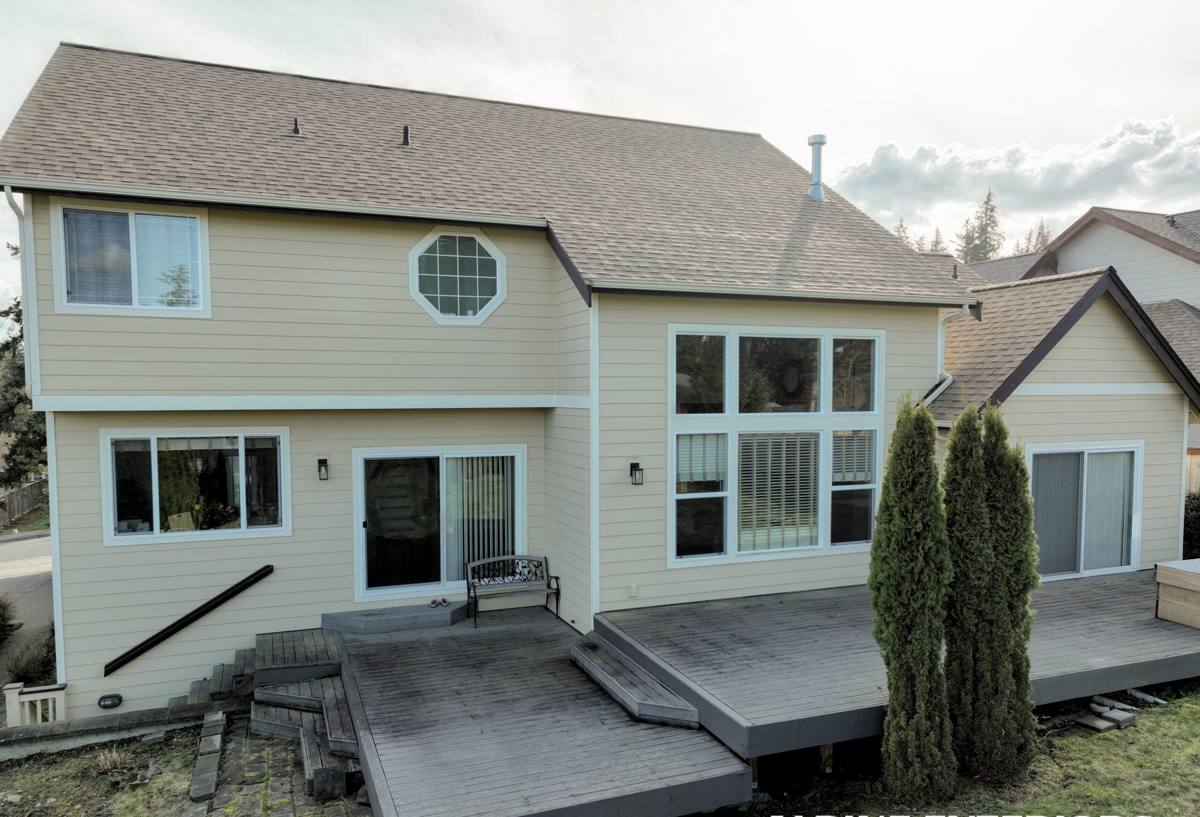
What Salt Air, Rain, and Moss Actually Do to a Deck
Salt Air and Fastener Corrosion
Standard electro-galvanized screws and nails are not built for a marine-influenced environment. Over a few seasons of salt exposure, the zinc coating breaks down, and once that happens, corrosion moves fast. You'll usually see it first as rust streaking down the face of decking boards, radiating out from screw heads. That staining isn't just cosmetic — it means the fastener holding that board down is losing its grip, and it's often a sign that every fastener installed at the same time, from the same batch, is in the same condition even where you can't see it yet.
Driving Rain and Hidden Moisture
Wind-driven rain finds its way into places vertical rain never would. On a deck, the ledger board — the framing member bolted to the house that the whole structure hangs from — is the single most common place we find hidden rot, because it sits directly against the house wall where flashing details are easy to get wrong or simply age out. Once water gets behind a ledger board and can't dry out between storms, rot sets in on both the ledger and the rim joist of the house framing behind it, and that's a structural problem, not a cosmetic one.
Moss and the Slip Hazard Nobody Thinks About
Moss doesn't just look bad — on a horizontal deck surface it holds moisture against the wood constantly, accelerates rot in the boards themselves, and creates a genuinely slick, dangerous walking surface, especially on stairs. In a climate where deck surfaces rarely get more than a few dry days in a row for months at a time, moss isn't an occasional nuisance — it's a maintenance cycle homeowners have to plan around.
The Failure Points We See Most Often on Blaine Decks
- Ledger board rot where the deck attaches to the house, often hidden until decking is pulled up
- Corroded joist hangers and fasteners, especially on decks built or last repaired more than 10-15 years ago
- Soft, spongy, or delaminating decking boards — most common on lower-grade treated lumber that was never sealed
- Post bases sitting in standing water or buried too deep in soil, leading to rot at the base of support posts
- Loose or wobbly guardrails, usually from rotted blocking or corroded rail-post connections
- Persistent moss and algae buildup that's outpaced regular cleaning
- Stair stringers showing rot at the point where they contact grade or concrete footings
What a Correct Deck Repair Actually Involves
Deck repair done right isn't just swapping out the board that looks bad. It starts with figuring out why that board failed, because in this climate the visible damage is frequently a symptom of a moisture or corrosion problem that's already spread further than what you can see from the surface.
Step One: Structural Inspection, Not Just a Surface Look
Before any repair estimate means anything, we check the ledger connection, the framing underneath, the post bases, and the fastener condition — not just the decking surface. A board that looks fine on top can be sitting on a joist that's lost most of its structural integrity underneath.
Step Two: Matching the Repair to What's Actually Wrong
Sometimes the fix really is isolated — a few boards, a rail section, a stair tread. Other times what looks like a small repair opens up into a ledger or framing issue that needs to be addressed before anything else is put back. We tell you which situation you're in before work starts, not after we've opened things up and found a surprise we didn't mention.
Step Three: Rebuilding With Materials That Fit the Climate
This is where a lot of deck repairs go wrong even when the labor is done competently — the wrong fastener or the wrong flashing detail gets used because it's what's on the truck, not because it's right for a coastal Whatcom County property. We use stainless steel or coated fasteners rated for corrosive exposure, proper self-adhering flashing membrane at ledger connections, and decking material chosen for how it will actually perform here, not just how it looks the day it's installed.
Step Four: Rail and Guardrail Code Compliance
Any time we're rebuilding a guardrail section, we bring it up to current code — proper height, baluster spacing that meets code, and solid post connections. It's not optional, and it's not something we skip to save time on a repair job.
Repairing vs. Replacing: How We Help You Decide
Not every deck with problems needs a full rebuild, and not every deck is worth patching. The honest answer usually comes down to how much of the structure — not just the decking surface — is affected.
| Situation | Usually a Repair | Usually Points to Replacement |
|---|---|---|
| Decking boards | A handful of boards showing rot, splitting, or corrosion staining | Most boards are soft, cupped, or delaminating across the whole deck |
| Ledger board | Localized rot caught early, framing behind it still solid | Rot has spread into the house rim joist or wall framing |
| Support posts | One or two posts with base rot, rest of structure sound | Multiple posts compromised or original posts undersized for current code |
| Fasteners | Isolated corrosion, structure otherwise intact | Widespread corrosion across joist hangers and structural connections |
| Age of deck | Under 15-20 years, built to a reasonable structural standard | Original construction is older, undersized, or was never permitted correctly |
We'll walk you through which column your deck falls into and why, in plain terms, before we quote anything.
Decking Material Choices for a Repair
When we're replacing boards on an existing deck, the material decision matters more here than in a drier climate. Each option has real trade-offs, and we'll tell you honestly what they are rather than pushing whatever's easiest to install.
Pressure-Treated Lumber
The lowest upfront cost and easy to source, but it needs regular sealing to hold up against constant rain and salt exposure, and it's the material most prone to moss growth if maintenance lapses. It's a reasonable choice for a budget-conscious repair on a deck you're not planning to fully replace soon.
Cedar
Naturally more rot-resistant than treated fir, and it tends to shed moss less aggressively, but it's a softer wood that shows wear and requires its own maintenance schedule to keep looking good over time.
Composite Decking
Higher upfront cost, but it doesn't rot, doesn't need sealing, and resists moss buildup far better than wood — a real advantage given how long the wet season runs here. The trade-off is that composite is less forgiving to install correctly and has its own fastening and spacing requirements that matter for long-term performance.
How Our Process Works
- On-site inspection — we check framing, ledger, posts, and fasteners, not just the surface
- Honest scope and estimate — you'll know whether you're looking at a targeted repair or something larger before we start
- Repair work — done with corrosion-resistant fasteners, correct flashing at the ledger, and code-compliant railings where applicable
- Cleanup — old material hauled off, site left clean
- Maintenance guidance — practical advice on keeping the repair from becoming a repeat job
Keeping a Repaired Deck From Needing Repair Again
- Sweep debris and standing organic matter off the deck surface regularly, especially in fall
- Clean moss and algae off decking and stairs before it builds up a slick layer — pressure washing on a low setting works, but avoid gouging softwood surfaces
- Reseal wood decking on a regular schedule; don't wait until it's visibly gray and dry
- Check for standing water pooling against the house at the ledger connection after heavy rain
- Look at fastener heads once a year for early rust staining — it's cheaper to address a handful of fasteners than to wait for board failure
- Keep vegetation and irrigation spray away from post bases and framing
Why a Crew That Already Works Blaine and Birch Bay Matters
Deck repair here isn't the same trade as deck repair in a dry inland climate, and a crew that mostly works elsewhere is more likely to default to generic materials and generic assumptions about how much moisture exposure a repair needs to handle. A crew that works the Blaine and Birch Bay area regularly already knows what salt air does to fasteners over a five-year span, knows how aggressive moss growth gets on north-facing deck sections here, and builds accordingly — using flashing, fasteners, and material specs suited to this specific coastal stretch of Whatcom County rather than a one-size-fits-all approach. We also handle the coordination that structural repair work typically requires locally, so you're not managing that piece on your own.
Get a Straight Answer on Your Deck
If your deck has a soft board, rust streaking, a wobbly rail, or you're just not sure whether what you're looking at is a quick fix or something bigger, we're happy to take a look and give you a straight answer — no pressure, no upsell. Fill out the form below for a free estimate.