 Birch Bay
 Custom Windows for Blaine, Built for What the Water Throws at This Coastline
Blaine sits close enough to the water that its houses take a different kind of weathering than homes even a few miles inland. Salt-laden air off the Strait, wind-driven rain that comes in sideways during winter storms, and a long stretch of the year when moss and moisture just sit on every north-facing surface — all of that works on window frames, seals, and glazing year after year. When we replace or install custom windows for a home in this area, we're not just fitting glass into an opening. We're accounting for a climate that's harder on exterior materials than the Whatcom County average, and a lot harder than what most window products are engineered and warrantied for in drier parts of the country.
"Custom" windows means the units are built to your home's actual openings and needs, not pulled off a shelf in a handful of stock sizes. For older Blaine homes with settled framing, oddly proportioned openings, or additions built at different times, that's often the only way to get a window that actually seals well. It also means you can match glazing, frame material, and hardware to what the exposure on each side of the house actually calls for, instead of using one spec for the whole building.
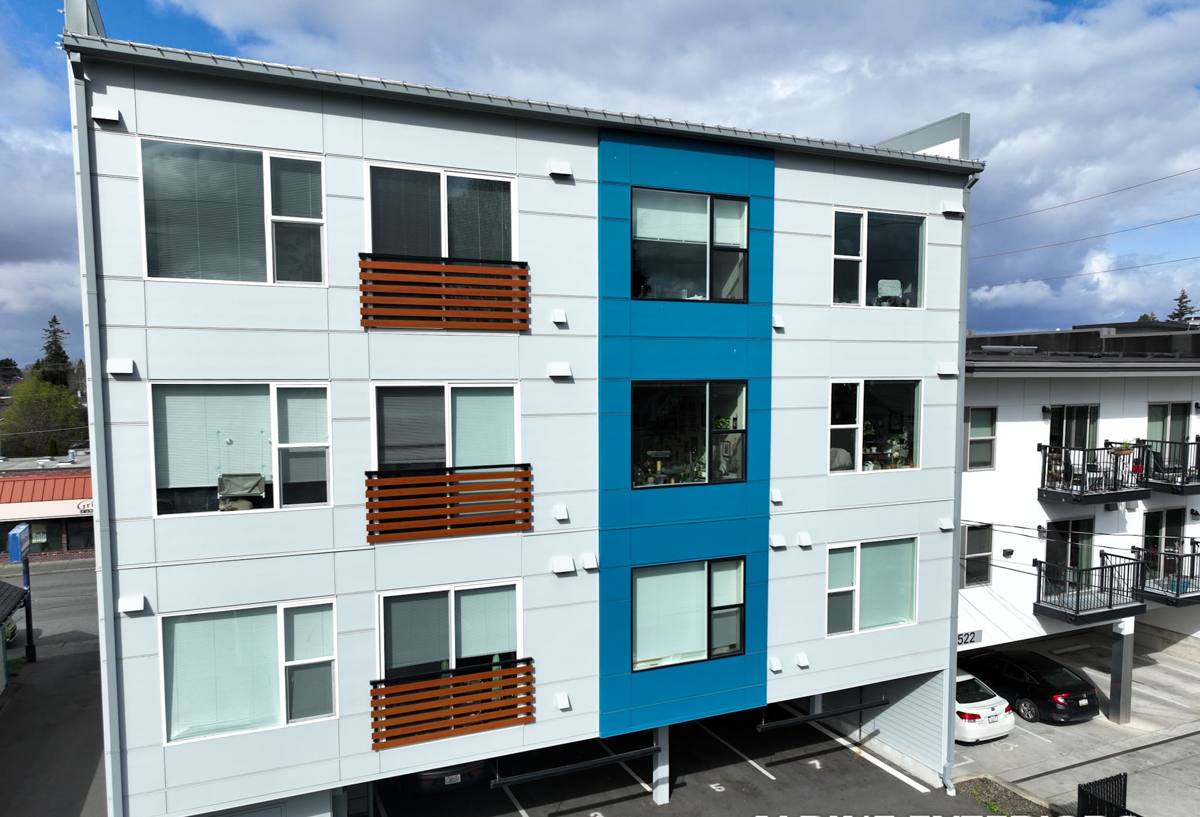
Why Windows Fail Faster in a Salt-Air, High-Rain Climate
Every window is a compromise between glass, frame, sealant, and flashing. In a coastal Whatcom County climate, several of those components degrade faster than a spec sheet written for a national market would suggest:
- Salt air corrodes hardware. Cheaper aluminum components, uncoated fasteners, and low-grade weatherstripping clips corrode noticeably faster this close to the water than they would twenty or thirty miles inland.
- Driving rain finds gaps under wind pressure. Rain that falls straight down rarely causes leaks. Rain that's being pushed sideways by a storm off the water tests every seam, sill pan, and piece of flashing — which is exactly the kind of weather Blaine gets several times a winter.
- Moss and constant dampness feed rot at wood contact points. Wood sills, trim, and any exposed wood-clad frame material stay damp longer here because the drying window between storms is shorter. That moisture is what starts rot, not any single storm event.
- UV and temperature swings stress seals over time. Insulated glass units rely on a sealed gas-filled gap between panes. When that seal breaks down — often faster in coastal conditions — you get fogging between the panes that can't be cleaned because it's inside the sealed unit.
None of this means windows can't hold up here. It means the frame material, glazing package, and installation details all need to be chosen with this specific exposure in mind, not a generic set of assumptions.
What Goes Into a Correctly Specified Custom Window
Frame Material
Vinyl, fiberglass, and wood-clad each have real trade-offs — none of them is automatically "the best" choice. Our job is to walk through those trade-offs honestly for your specific exposure, budget, and the look you want, rather than pushing one product line regardless of fit.
Glazing Package
Double-pane with a low-E coating and argon fill is the baseline we recommend for most Blaine homes — it balances thermal performance, condensation resistance, and cost. Triple-pane adds further insulation value and can help with street or wind noise on more exposed lots, at a higher price point and added window weight, which matters for larger custom sizes.
Hardware and Weatherstripping
Locks, hinges, balance systems, and weatherstripping take the brunt of salt-air corrosion over time. We spec corrosion-resistant hardware for coastal installs rather than the standard-grade hardware that ships on some builder-grade lines, because replacing failed hardware on a custom window years down the road is a far bigger hassle than replacing it on a stock size.
Sizing and Fit
Because these are custom units, we field-measure every opening individually rather than assuming uniform sizes across a house. Older homes especially can have openings that are slightly out of square or have settled unevenly, and a window built to the actual as-built opening seals far better than one forced to fit a "close enough" stock size.
Frame Material Comparison for Coastal Whatcom County Homes
| Material | Coastal Durability | Maintenance | Typical Trade-Off |
|---|---|---|---|
| Vinyl | Good — won't rust or rot, handles salt air well | Low — occasional cleaning | Fewer color/finish options, can't be repainted |
| Fiberglass | Very good — dimensionally stable, resists corrosion | Low | Higher upfront cost than vinyl |
| Wood-clad | Depends heavily on cladding integrity and installation | Higher — exposed wood elements need monitoring | Best traditional look, most exposure risk near the water |
| Aluminum | Poor in salt air unless marine-grade and well-finished | Moderate | We generally don't recommend standard aluminum this close to the coast |
We're upfront that we steer most Blaine clients away from standard aluminum-frame windows for this reason — not because the product is inherently bad everywhere, but because unprotected aluminum's corrosion behavior in salt air is a poor match for this specific site condition, and it's a maintenance burden we'd rather you not inherit.
How Our Installation Process Works
- On-site assessment. We look at each opening, check for existing rot, moisture staining, or settled framing, and note which elevations take the worst weather exposure.
- Field measurement. Every opening is measured individually — custom windows are built to these exact dimensions, not rounded to a stock size.
- Material and glazing selection. We walk through frame material, glazing package, and hardware options against your budget and the exposure on that side of the house.
- Removal and opening prep. Old units come out carefully; we inspect the sill, jack studs, and sheathing underneath for hidden rot or water damage before anything new goes in.
- Flashing and sill pan installation. This is the step that determines whether a window leaks in five years or twenty. We detail it below because it matters that much.
- Window installation and shimming. The unit is set plumb, level, and square, then shimmed and fastened per the manufacturer's specification — not just "close enough."
- Sealing and trim. Interior and exterior sealant, insulation around the frame, and trim work close out the install.
- Final check. We test operation, confirm the seal, and walk the finished install with you before we consider the job done.
Why Flashing Detail Matters More Here Than Almost Anywhere Else
A window can be an excellent product and still leak if it's flashed wrong. In a climate with regular wind-driven rain off the water, the flashing and sill pan are what actually keep water out of the wall cavity — the window unit itself is only part of the system. We install a proper sloped sill pan under every window, lap flashing tape in the correct shingle-style order (so water is always directed outward and down, never trapped behind a layer), and tie the window's flashing into the home's existing weather-resistive barrier correctly. Skipping or rushing this step is one of the most common causes of hidden water damage behind window openings — damage that often isn't visible until there's rot in the wall framing, well after the window itself looks fine from outside.
Signs Your Current Windows Are Already Losing the Fight
- Fogging or a permanent haze between the panes that cleaning doesn't fix — the seal on the insulated glass unit has failed
- Soft or discolored wood at the sill or lower corners, especially on the sides of the house that face prevailing wind and rain
- Visible corrosion on hardware, hinges, or locks
- Persistent moss or dark staining at the sill that keeps returning after cleaning
- Drafts or a noticeable temperature difference near the window on windy days
- Difficulty opening, closing, or locking — often a sign the frame has shifted or the balance mechanism has corroded
Any one of these on its own isn't necessarily urgent. Several of them together, especially on the same window, usually means it's time for a closer look before the damage spreads into the surrounding wall.
What Drives Cost on a Custom Window Project
| Factor | Why It Matters |
|---|---|
| Frame material | Vinyl is typically the most affordable; fiberglass and wood-clad cost more upfront but bring different durability and appearance trade-offs |
| Glazing package | Double-pane low-E/argon is the standard baseline; triple-pane and specialty coatings add cost |
| Opening condition | Hidden rot or out-of-square framing found during removal adds repair scope before the new window can go in correctly |
| Number and size of openings | Larger or non-standard custom sizes cost more to manufacture and install than smaller stock-adjacent sizes |
| Exterior finish work | Matching existing trim, siding cuts, or paint around the new window adds labor |
We don't quote from a distance for this reason — an accurate number depends on what we find at each opening, not just a square-footage estimate.
Living With Custom Windows in a Moss-and-Salt-Air Climate
Even a correctly installed window benefits from a little seasonal attention in this environment. A short annual routine goes a long way toward getting the full lifespan out of the investment:
- Rinse accumulated salt residue and grime off frames and glass a couple times a year, especially on wind-exposed elevations
- Clear moss and debris from sills and tracks before it holds moisture against the frame
- Check weep holes on the exterior sill are clear so water can drain out rather than pool
- Look for early signs of hardware corrosion and address it before it affects operation
- Keep an eye on caulking and exterior sealant lines — UV and moisture cycling break these down faster here than inland
Why a Crew That Already Works Blaine Is Worth Choosing
Window installation done well is mostly about judgment calls at the details — how much to slope a sill pan, which flashing sequence handles this particular wall assembly, whether a frame material is genuinely appropriate for a given elevation's exposure. A crew that's already worked houses in Blaine and the surrounding Birch Bay area has seen how local homes actually hold up over time, not just how a product performs on a spec sheet. That local pattern recognition — knowing which sides of a house take the worst weather, what typical framing and moisture issues look like in homes of a certain age in this area, and how to sequence a job around the region's rain — is the difference between an installation that looks right on day one and one that's still performing correctly ten winters later.
If you're weighing custom windows for a home in Blaine or elsewhere around Birch Bay, we're glad to come take a look, walk the openings with you, and put together a straightforward, no-pressure estimate. There's a form below to get started.