 Birch Bay
 Siding Replacement for Sumas Homes, Built for the Weather We Actually Get
If you own a home in the Sumas area of Whatcom County, you already know the siding on your house is working harder than siding on a house inland or further south. Salt-laden air moving in off the water, driving rain that comes at the wall sideways instead of straight down, and a moss season that seems to stretch longer every year all put steady pressure on whatever material is covering your exterior walls. Siding replacement out here isn't just a cosmetic upgrade — it's a chance to correct whatever let moisture in the first time and put something on the house that's actually built for this climate.
We install siding in Birch Bay and the surrounding Whatcom County communities, including Sumas, and the patterns repeat from house to house: siding that looks fine from the street but is soft, delaminating, or hiding rot at the bottom courses and around window trim. Catching that early — and replacing it correctly — is the difference between a project that lasts decades and one you're revisiting in five years.
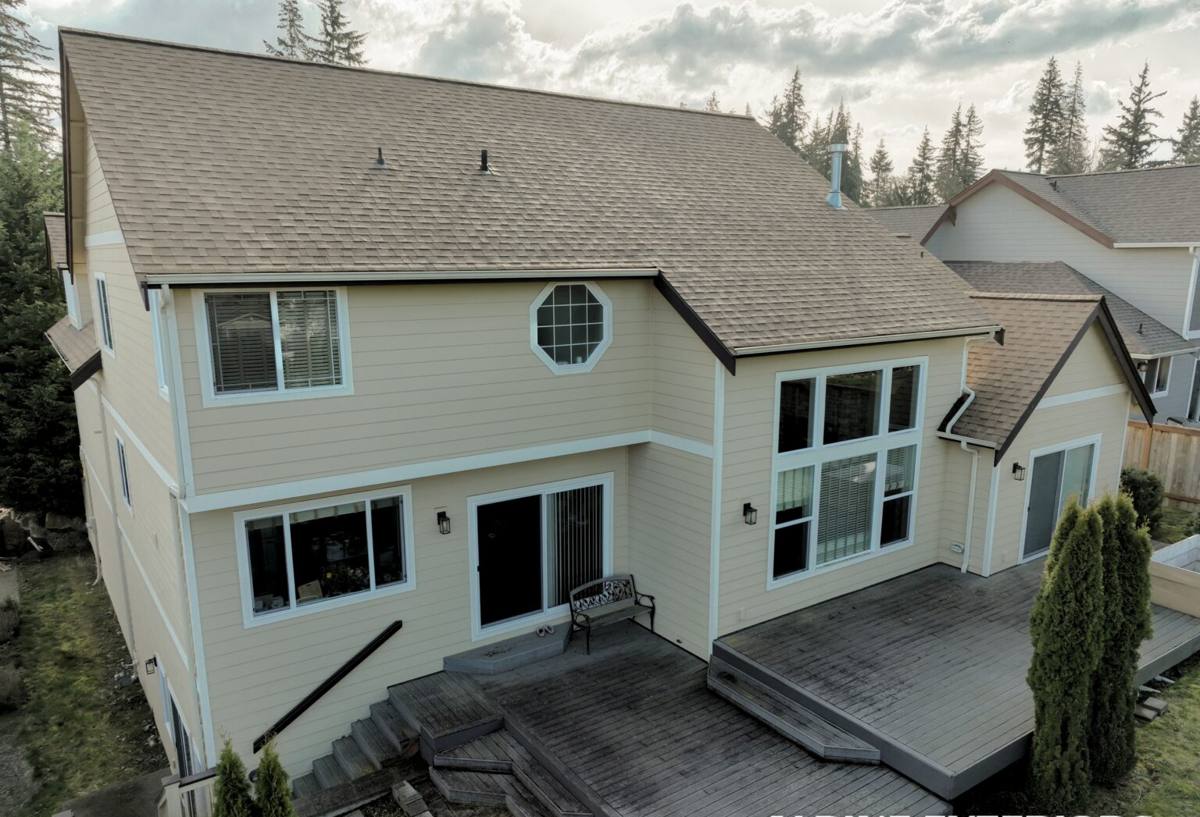
What Whatcom County Weather Does to Siding Over Time
A lot of siding failure isn't dramatic. It's slow, cumulative moisture damage that finally shows up as a soft spot, a stain, or a section that's started to sag. In this region, three conditions do most of the damage:
- Salt air: accelerates corrosion of fasteners, flashing, and any exposed metal, and speeds up the breakdown of finishes that aren't formulated to resist it.
- Driving rain: wind-driven moisture finds every gap in flashing, caulking, and butt joints — and once it's behind the siding, it stays wet far longer than it would in a drier climate.
- Long moss season: shaded walls and north-facing elevations stay damp for months at a time, which feeds moss and algae growth that holds moisture directly against the siding surface.
None of this means siding is doomed here — it means the material and the installation both have to be matched to the conditions. A product that handles moisture poorly, or an installation that skips proper flashing and clearances, will fail faster in Sumas than it would somewhere drier and calmer.
Signs Your Siding Has Reached the End of Its Useful Life
Homeowners often wait too long to replace siding because the damage isn't visible from the driveway. A walk around the exterior, paying attention to the details below, tells you a lot more than a glance from the street.
- Soft or spongy spots when you press on the siding, especially near the bottom of walls and below windows
- Visible cracking, warping, or bubbling of the surface finish
- Persistent moss or dark staining that keeps coming back no matter how often it's cleaned
- Peeling or chalking paint that won't hold a fresh coat
- Gaps opening up at seams, corners, or trim boards
- A musty smell or visible staining on interior walls that share an exterior wall with damaged siding
- Siding that's noticeably older than the roof and has never been replaced
Any one of these on its own might just need a repair. Several of them together, especially on a home that's original siding is decades old, usually points to full replacement being the more honest recommendation.
What a Correct Siding Replacement Actually Involves
Siding replacement done right is not simply pulling off the old material and nailing up new panels. The parts of the job that don't show once it's finished are the parts that determine whether it lasts.
Tear-off and inspection
Removing the old siding down to the sheathing lets us actually see what's underneath — rot, damaged sheathing, missing or failed weather-resistive barrier, and problem areas around windows and doors that were never properly flashed. Covering over these issues with new siding just hides the problem for a few more years.
Repair before cover
Any rotted sheathing or framing gets cut out and replaced. This is the step that gets skipped when a contractor is trying to keep a bid low, and it's the step that determines whether the new siding is going onto a sound wall or a compromised one.
Weather-resistive barrier and flashing
A correctly lapped weather barrier, properly integrated window and door flashing, and correct kick-out flashing at roof-to-wall intersections are what actually keep driving rain out of the wall assembly. This is the least visible part of the job and the part most likely to be shortcut on a cheap installation.
Fastening and clearances
Fiber cement siding has specific fastening patterns, nail placement, and clearance requirements from grade, roof lines, and adjoining surfaces. Getting these wrong doesn't usually cause a problem on day one — it causes one in year three or four, once moisture has had time to find the gap.
Finish work
Trim, caulking at the right joints only, and touch-up of factory-finished panels close out the job. Over-caulking a fiber cement installation is as much of a mistake as under-caulking it — the material needs to be able to manage moisture the way it was engineered to.
Why We Install Only James Hardie Fiber Cement
We made a deliberate decision to install James Hardie fiber cement siding exclusively, and we don't install vinyl, LP SmartSide, Cemplank, Allura, primed spruce, or cedar. That's not a marketing position — it's a standard we hold because of what we see in this climate over the long term.
Vinyl is affordable and low-maintenance in the short run, but it's a petroleum-based product that expands and contracts with temperature swings, can crack in impact or extreme cold, and doesn't hold up structurally the way a fiber cement panel does. Wood products like primed spruce and cedar look great when they're new, but they need consistent maintenance — repainting, caulking, moisture monitoring — to survive a climate with this much sustained dampness, and moss growth on wood siding isn't just cosmetic, it holds water against the surface. Engineered wood products like LP SmartSide use a wood-strand substrate that, while treated, is still an organic material that can be vulnerable at cut edges and joints if installation isn't precise. Other fiber cement brands like Cemplank and Allura are legitimate competitors to Hardie, but we've standardized on one product line so we can guarantee our crews' installation expertise, warranty support, and color-match consistency stay consistent across every job.
James Hardie fiber cement is non-combustible, holds a factory-applied ColorPlus finish that's baked on and warrantied against fading and chipping, and comes in HZ5 product lines engineered specifically for climates like ours — freeze-thaw cycles, sustained moisture, and coastal-influenced weather. When it's installed to Hardie's specifications, it comes with a strong transferable warranty that protects the investment if you sell the home. We'd rather install one product exceptionally well than several products adequately.
Our Siding Replacement Process
Every siding replacement we do in the Sumas area follows the same sequence, whether it's a small elevation or a full re-side:
- On-site inspection. We walk the exterior with you, check problem areas, and give you an honest read on what we're likely to find once the old siding comes off.
- Written estimate. A clear scope of work and price, including what happens if we find sheathing damage once tear-off starts.
- Tear-off and assessment. Old siding comes off, sheathing and framing get inspected, and we show you what we find before covering anything up.
- Repair. Any compromised sheathing or framing is repaired or replaced before the new weather barrier goes on.
- Weather barrier and flashing. Properly lapped house wrap, window and door flashing, and roof-to-wall flashing details go in first.
- Hardie siding installation. Panels are installed to manufacturer fastening and clearance specifications, with attention to the details that keep water out over the long term.
- Trim, caulk, and final inspection. Finish details are completed and we walk the job with you before calling it done.
We don't skip the tear-off-and-inspect step, even when a homeowner asks us to just install over existing siding to save money. What's underneath is exactly what determines whether the new siding lasts.
What Affects the Cost of Siding Replacement
Every home is different, so we don't quote prices without seeing the house, but the factors below are what typically move a project's cost up or down.
| Factor | Why It Matters |
|---|---|
| Home size and elevation count | More square footage and more corners, gables, and dormers mean more material and more labor hours |
| Condition of sheathing underneath | Rot or moisture damage found during tear-off requires repair before new siding can go on |
| Siding profile and accessories | Lap width, trim style, and corner details affect material cost and installation time |
| Accessibility | Steep sites, tall walls, or limited access around the home affect staging and labor |
| Window and door count | Each opening needs its own flashing and trim detail, which adds labor |
| Existing siding removal | Full tear-off costs more upfront than installing over existing material, but it's the only way to properly inspect and repair the wall |
The honest range for a full siding replacement varies widely based on these factors — we'll walk your specific home and give you real numbers rather than a generic per-square-foot figure that doesn't account for what your house actually needs.
Why Hiring a Crew That Already Works in Sumas and Birch Bay Matters
Siding installation isn't uniform across the country — what works in a dry, mild climate can fail in a few years out here. A crew that regularly works Whatcom County homes already knows which elevations take the worst weather exposure, where moss and algae growth tends to concentrate, and which flashing details actually hold up against sustained driving rain and salt-influenced air. That local pattern recognition matters more than it sounds like it should — it's the difference between a crew that follows a generic checklist and one that knows what this specific climate does to a wall assembly over ten or twenty years.
It also means faster response if something needs attention after the job is done, and a contractor who's going to be around locally to stand behind the work and the warranty — not a crew that showed up from out of the area for one job and moved on.
Maintenance After Replacement
James Hardie siding is low-maintenance, not no-maintenance. A simple annual routine keeps it performing the way it's designed to:
- Rinse the exterior yearly to clear salt residue, pollen, and early moss or algae growth before it takes hold
- Keep gutters clear and downspouts directed away from the foundation so walls aren't getting extra splash-back moisture
- Trim back vegetation and tree limbs that keep an elevation shaded and damp
- Recaulk joints if you notice separation, and touch up any impact damage promptly rather than letting it sit
- Walk the exterior once a year and check the same trouble spots — bottom courses, window trim, and any north-facing walls
That routine, combined with siding and installation matched to this climate in the first place, is what gets a home the full service life the product is built for.
If your Sumas-area home's siding is showing its age, or you just want a straight answer about whether it needs replacement or repair, we're happy to take a look. Reach out for a free, no-pressure estimate — we'll walk the exterior with you and tell you honestly what we find.