 Birch Bay
 Cherry Point Roofs Take a Different Kind of Beating
Cherry Point sits right where the open water of the Salish Sea meets Whatcom County's shoreline, and that exposure changes what a roof has to deal with compared to a house a few miles inland. Wind off the water arrives with more force and less warning, driving rain sideways under shingle tabs and into flashing seams that would stay dry almost anywhere else. Add the salt content in that air, which speeds up corrosion on fasteners, flashing, and gutter hardware, and you have a roof that ages faster than the calendar suggests.
Then there's moss. Birch Bay's long wet season and the shade from mature evergreens common in this area give moss months at a time to take hold on north-facing slopes and anywhere debris collects. Moss doesn't just look bad — it holds moisture against the roofing material, lifts shingle edges as it grows, and creates channels for water to travel sideways instead of running off. A storm that a healthy roof would shrug off can turn into a real leak on a roof that's already been softened up by moss and salt air.
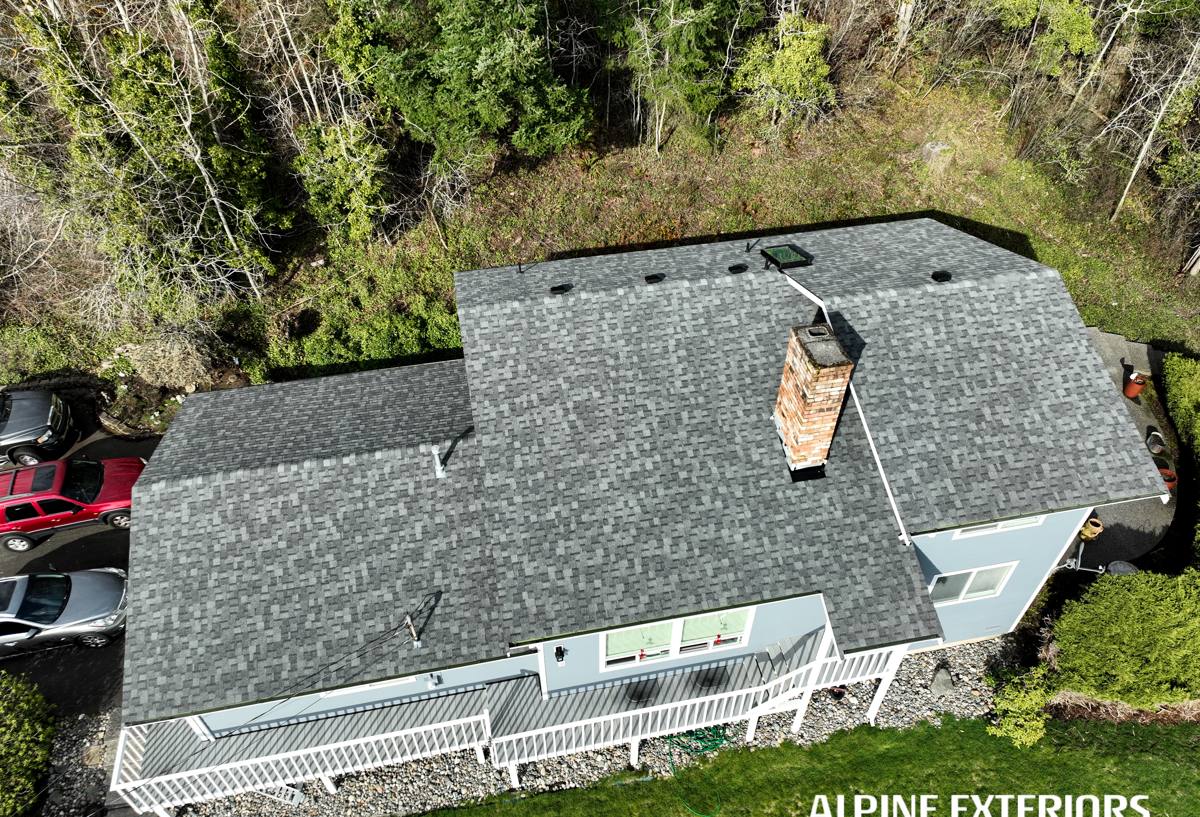
What Storm Damage Actually Looks Like on a Cherry Point Roof
Homeowners often picture storm damage as something dramatic — a tree limb through the roof, or shingles scattered across the yard. Sometimes it's that obvious. More often, it's quieter and easier to miss:
- Shingles that got lifted or creased by wind gusts and didn't fully reseal afterward, leaving a gap for the next rain to find
- Granule loss from wind-driven rain and hail, which shows up as bare, shiny patches on the shingle surface
- Flashing around chimneys, vents, and roof-to-wall transitions that worked loose or corroded and is no longer sealing the joint
- Gutters and downspouts pulled loose or clogged with wind-blown debris, causing water to back up under the roof edge
- Soft spots or discoloration on interior ceilings that show up days or weeks after the storm, once water has had time to travel
The gap between when damage happens and when it becomes visible is exactly why storm damage repair works best as an inspection-first service, not a guessing game.
Why Waiting Costs More Than the Repair
A small storm-related opening in a roof rarely stays small. Water that gets under a lifted shingle or past a failed flashing seam doesn't just sit there — it follows the roof deck downhill, soaks into the underlayment, and eventually finds a nail hole, a seam, or a low spot to drip through. By the time a stain appears on a ceiling, the moisture has usually been active for a while, and it's often affected more of the decking than the visible stain suggests.
In a marine climate like Birch Bay's, wet wood doesn't dry out on its own between storms the way it might in a drier region. That means a delayed repair isn't just risking a bigger patch later — it's risking rot in the sheathing, damaged insulation, and in bad cases, mold that spreads into the attic space. Catching storm damage early and repairing it properly is almost always cheaper than repairing storm damage plus the water damage it caused.
Our Storm Damage Roof Repair Process
Inspection and Documentation
We start on the roof, not with a sales pitch. That means walking the slopes where it's safe to do so, checking flashing points, and inspecting from the attic side when possible to see if water has already made its way through. We document what we find with clear notes and photos, which matters if you're planning to file an insurance claim — adjusters respond better to a specific, itemized assessment than a vague description of "storm damage."
Repair Plan and Straight Answers
Once we know what's actually wrong, we tell you plainly what needs to happen: a targeted shingle and flashing repair, a larger section replacement, or in some cases a recommendation that a full roof replacement makes more sense than continuing to patch an aging roof. We're not going to talk you into more work than the roof needs, and we're not going to undersell a problem that's bigger than it looks from the ground.
The Repair Itself
For most storm damage, that means removing and replacing damaged shingles down to sound decking, replacing any flashing that's corroded or no longer sealing properly, and checking the underlayment underneath the repair area rather than just covering it back up. We match materials as closely as possible so a repair doesn't stand out as an obvious patch, and we reseal every seam we open.
Repair or Replace? What Actually Drives That Decision
Not every storm-damaged roof needs full replacement, and not every roof that "just needs a patch" is actually a good repair candidate. Here's how we think through it:
| Factor | Points Toward Repair | Points Toward Replacement |
|---|---|---|
| Roof age | Under roughly two-thirds of expected lifespan | Already near or past expected lifespan |
| Damage spread | Limited to one section or slope | Multiple areas showing granule loss, curling, or moss damage |
| Decking condition | Solid, dry sheathing under the damaged area | Soft, delaminating, or rotted decking found during inspection |
| Moss history | Light, recently treated | Long-term moss growth with visible shingle lift across the roof |
| Underlying material | Newer underlayment still intact | Older or missing underlayment throughout |
We'll walk through these factors with you directly rather than defaulting to whichever answer is more profitable for us. A well-executed repair on a fundamentally sound roof is good work; recommending replacement on a roof that only needed a repair isn't something we do.
Materials That Hold Up in This Environment
Given the salt air and moss pressure around Birch Bay, we lean toward corrosion-resistant flashing and fasteners rather than standard hardware that's more prone to rust in coastal air. On the shingle side, we match or upgrade to products with reasonable algae and moss resistance where it makes sense for the roof, since standard shingles in a shaded, damp spot will grow moss again within a few seasons regardless of how clean the repair looks on day one. We're not chasing the cheapest materials that will pass inspection today — we're choosing what's reasonable to expect will still be doing its job in ten or fifteen years under these specific conditions.
That said, material choice is only half the equation. Even a premium shingle fails early if it's installed with the wrong nailing pattern, insufficient overlap, or flashing that isn't properly integrated with the roof-wall junction. Correct installation matters as much as the product itself, especially in a climate that doesn't forgive shortcuts.
Why Local, Cherry Point-Familiar Experience Matters
A roofing crew that regularly works Whatcom County's coastal edge already knows which slopes in this area tend to take the worst wind exposure, which roof styles hold moss longest, and what a genuine storm-damage claim looks like versus routine wear that's been building for years. That familiarity shows up in faster, more accurate inspections and repair plans that account for what's actually likely to happen to this roof again next winter — not just what's wrong with it today.
It also matters for response time. After a significant windstorm, roofing crews get busy fast, and homeowners who need someone to look at an active leak don't want to wait weeks for an inspection. Working this area regularly means we're not learning the terrain for the first time when your roof needs attention.
Protecting Your Roof Between Storms
Storm damage repair fixes what's already happened. The bigger win for most Cherry Point homeowners is reducing how much damage the next storm can do, and most of that comes down to basic maintenance that's easy to let slide.
- Clear gutters and downspouts before the wet season so storm runoff has somewhere to go
- Have moss treated or removed before it spreads across a full slope, not after
- Check flashing around chimneys and vents annually — this is where most slow leaks start
- Trim back branches that overhang the roof, since they drop debris and create shaded, damp zones where moss thrives
- After any significant windstorm, do a visual check from the ground for missing or lifted shingles
- Address small repairs promptly rather than waiting for them to combine into a bigger problem
None of this eliminates storm risk entirely — no roof in this climate is immune to a bad enough windstorm — but it narrows the gap between a roof that shrugs off a storm and one that takes real damage from it.
Get a Straightforward Look at Your Roof
If a recent windstorm has you wondering whether your roof took real damage, or you've noticed a stain, a draft, or shingles in the yard after a rough night, it's worth getting an honest inspection before the next system rolls through. We'll give you a clear, no-pressure estimate that spells out exactly what we found and what we'd recommend — reach out below to schedule a free assessment for your Cherry Point home.