 Birch Bay
 Why Marietta Siding Takes More Punishment Than People Expect
Marietta sits close enough to the water that homes here deal with a combination most inland Whatcom County properties don't: salt-laden air, wind-driven rain that hits siding sideways instead of straight down, and a moss and algae season that can run most of the year in our marine climate. None of those things are dramatic on their own. Together, over ten or fifteen years, they're exactly what wears out the wrong siding material and exposes sloppy installation work.
Salt air is corrosive to exposed metal fasteners and trim, and it accelerates the breakdown of paint films and cheaper composite materials. Driving rain finds every gap, seam, and undersized flashing detail and pushes water behind the siding rather than letting it run off the face. And moss doesn't just sit on a roof — it colonizes shaded, damp siding surfaces too, holding moisture against the wall long after a storm has passed. A siding system that isn't built and installed for this combination will show it early: chalking finishes, soft spots, staining, and paint failure well before the material should be due for replacement.
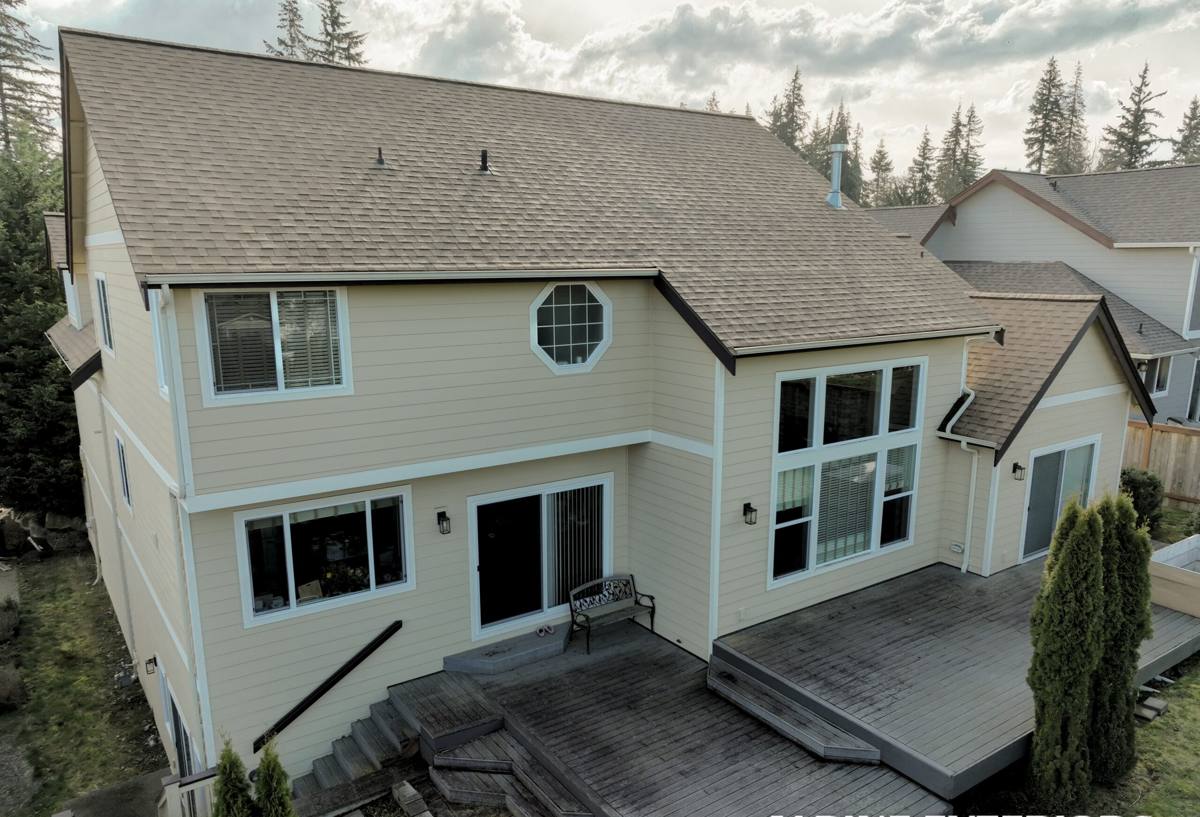
What Siding Actually Needs to Do in This Climate
Before talking about products, it helps to be specific about what "good siding" means for a Marietta home rather than a generic house in a dry climate. The job has four parts, and all four matter equally:
- Shed bulk water fast, even when rain is hitting the wall at an angle instead of falling straight down
- Resist moisture absorption into the material itself, not just at the surface
- Hold a factory finish that doesn't chalk, fade, or fail under repeated salt-air exposure
- Allow the wall assembly behind it to dry out between wet events instead of trapping moisture
A lot of siding failures we see aren't really "the siding failed" — they're a material that couldn't handle sustained damp conditions, installed without the flashing and drainage details this coastline demands. That's the combination that matters here, and it's the reason product choice and installation quality can't be separated from each other.
Why We Standardized on James Hardie
We install James Hardie fiber cement siding exclusively. We don't offer vinyl, LP SmartSide, or other composite or engineered-wood products, and that's a deliberate call, not a lack of options. Fiber cement is non-combustible, doesn't absorb water the way wood-based composites can, and holds its shape and finish under the kind of repeated wet-dry cycling that defines a marine climate like ours.
James Hardie's HZ product engineering matters specifically for a place like Marietta. Their HZ5 formulation is built for the moisture-heavy, humid conditions found in coastal and Pacific Northwest zones — it's not the same board specified for a dry inland climate. Paired with the ColorPlus factory finish (baked-on, not field-applied), it holds color and resists the chalking and fading that shows up on painted siding after a few Whatcom County winters. The transferable warranty backing the product also reflects that Hardie is confident in how it performs long-term in exactly these conditions, provided it goes on correctly.
What We're Not Installing, and Why
Vinyl siding is inexpensive and low-maintenance in mild climates, but it becomes brittle in cold snaps, can warp under close sun exposure on south and west-facing walls, and its seams are a weak point against wind-driven rain. Wood-based composites like LP SmartSide use engineered wood strand cores — even with treated surfaces, wood-based products are more vulnerable to sustained coastal moisture than a cement-based product. Primed spruce and cedar are attractive but demand a maintenance schedule most homeowners can't keep up with once salt air and moss are working against the finish year-round. None of these are "bad" products in the right setting. We simply don't think they're the right call for homes that sit this close to the water.
James Hardie Product Lines That Fit Marietta Homes
| Product | Typical Use | Why It Fits This Climate |
|---|---|---|
| HardiePlank Lap Siding | Most common choice, traditional lap look | Widest color range in ColorPlus, proven long-term performance in wet climates |
| HardiePanel Vertical Siding | Modern facades, accent walls, gable ends | Fewer horizontal seams for water to find on high-exposure walls |
| HardieShingle | Accent areas, dormers, character homes | Textured look without the moisture problems of real cedar shingle |
| HardieTrim | Corners, window and door trim, fascia | Won't rot or absorb water the way wood trim does at joints and end cuts |
Most Marietta jobs end up being a mix — HardiePlank across the main field of the house, HardieTrim at every corner and opening, and sometimes HardiePanel or HardieShingle on gables or accent sections where the homeowner wants a different texture. What matters more than which product you pick is that every one of them is installed with the moisture management details this climate requires.
What a Correct Installation Actually Involves
James Hardie siding is only as good as the installation behind it. This is where most of the real-world failures we get called out to inspect actually come from — not the material, but shortcuts in how it went on.
Water Management Comes First
A correct install starts with a weather-resistive barrier and properly lapped flashing at every window, door, and horizontal transition — installed so water is directed out and down, never trapped behind the siding. This matters more here than almost anywhere else in the county, because Marietta's exposure means the wall assembly gets tested by driving rain regularly, not occasionally.
Fastening and Clearances
Hardie specifies exact fastener spacing, nailing patterns, and minimum clearances from grade, roof lines, and other transitions. Skipping the clearance requirements is one of the most common corner-cutting mistakes in this industry — it looks fine on install day and causes moisture and rot problems in the wall framing two or three years later.
Caulking and Joint Treatment
Butt joints, trim intersections, and penetrations need to be sealed with the right products, not just caulked over generically. In a salt-air environment, using the wrong sealant means premature failure at exactly the seams most exposed to weather.
Finish Touch-Up
Field-cut edges need factory-matched touch-up paint applied to the cut ends so raw material isn't left exposed to moisture. It's a small step that's easy to skip and shows up later as staining and edge deterioration.
Our Process for Marietta Homes
- On-site assessment — we look at wall exposure, existing moisture damage, and how your specific lot and orientation face prevailing wind and rain
- Tear-off and inspection — removing old siding lets us check sheathing and framing for hidden rot before anything new goes on, which matters on older Whatcom County homes especially
- Weather barrier and flashing — installed to current best practice, not just code minimum
- James Hardie installation — plank, panel, trim, or shingle per the plan, fastened and spaced to manufacturer spec
- Finish detail and cleanup — caulking, touch-up, and a final walk-through before we call the job done
We don't treat this as a generic install. A home a few blocks from the water gets more attention to flashing and drainage detail than one set further back and more sheltered, and we'll tell you honestly which category yours falls into.
Living With Hardie Siding in a Salt Air, High-Moss Climate
Correctly installed James Hardie siding is low-maintenance, not zero-maintenance. A little seasonal attention goes a long way toward getting the full lifespan out of it:
- Rinse siding once or twice a year to clear salt residue and organic buildup, especially on north and shaded walls where moss takes hold first
- Keep gutters clear so overflow isn't running down the wall face during heavy rain events
- Trim back vegetation and landscaping that keeps siding shaded and damp longer than it needs to be
- Have caulking and joints checked periodically — sealant is the one component that ages faster than the board itself
- Address any impact damage or cracked caulk promptly rather than letting moisture find a way in over a wet winter
What This Costs
| Factor | Why It Moves the Price |
|---|---|
| Tear-off condition | Hidden sheathing or framing repair adds cost but is critical to price fairly, not skip |
| Product mix | Trim, panel, and shingle accents cost more per square foot than straight lap siding |
| Wall exposure | High-exposure elevations facing prevailing weather need more flashing and detail work |
| Home size and complexity | More corners, windows, and rooflines mean more trim and flashing labor |
| ColorPlus vs. field paint | Factory-finished ColorPlus costs more upfront but avoids a repaint cycle |
We won't quote a number without seeing the house, but we're happy to walk through these factors with you and explain what's driving your specific estimate before you commit to anything.
Why It Matters That We Already Work This Area
A crew that regularly works Marietta and the rest of the Birch Bay area already knows how differently this coastline behaves compared to inland Whatcom County. We're not learning your microclimate on your dime — we already know how much more attention a west-facing wall needs here versus a sheltered one, what moss growth patterns tell us about a wall's moisture history, and how local wind exposure should change flashing detail. That local pattern recognition is worth more than it sounds like, because it's usually the difference between a siding job that looks right on day one and one that still performs correctly ten winters in.
If you're weighing a siding project for a Marietta home, we're glad to come take a look, walk the exterior with you, and give you a straightforward, no-pressure estimate — no hard sell, just an honest read on what your home needs.