 Birch Bay
 Birch Bay Village sits right up against one of the more exposed stretches of shoreline in Whatcom County, and a lot of the decks in this community are showing it. The neighborhood has a well-known mix of older seasonal cottages and cabins — many converted over the years into full-time homes — alongside newer construction, and it's common to find decks on both that were never built with this specific exposure in mind. A deck that would hold up fine a few miles inland can start failing years early here, and by the time it's visibly sagging, graying, or soft underfoot, repair usually isn't the honest answer anymore.
This page is about full deck replacement specifically for Birch Bay Village — what pushes a deck past the point of repair in this climate, what a correct replacement actually involves, and how our process works for homes in this neighborhood. Salt air off the bay, driving rain, and a moss season that runs most of the year all shape the decisions that go into a replacement here, and treating this like a generic deck job anywhere in Whatcom County misses details that matter specifically in Birch Bay Village.
Why Decks Fail Early in Birch Bay Village
Salt Air Off the Bay
Birch Bay's shallow, open bay means salt-laden air reaches homes well back from the waterline, not just the ones directly on the water. That air works on exposed metal continuously — fasteners, joist hangers, post brackets, railing hardware — and corrosion doesn't wait for a fastener to look bad before it starts losing holding strength. On an older deck built with standard hardware instead of coastal-rated fasteners, that's often the hidden reason a deck feels loose or springy years before the decking boards themselves look worn out.
Driving Rain
Storms coming off the water here don't fall straight down. Wind pushes rain sideways, up under railings, and into ledger connections and fastener holes that a straight-down rain would never reach. A deck built to shed water on a calm day can still trap moisture the moment wind gets involved, and in Birch Bay Village that's a regular condition, not an occasional one.
A Long Moss Season
Mild, damp conditions give moss and mildew a growing season that runs close to year-round in this part of Whatcom County. Horizontal deck surfaces hold water longer than a wall does and stay damp between rain events, so they're often the first place moss takes hold — especially on shaded decks or north-facing sections, which are common given how many Birch Bay Village lots are tree-covered or tucked close to a neighboring structure.
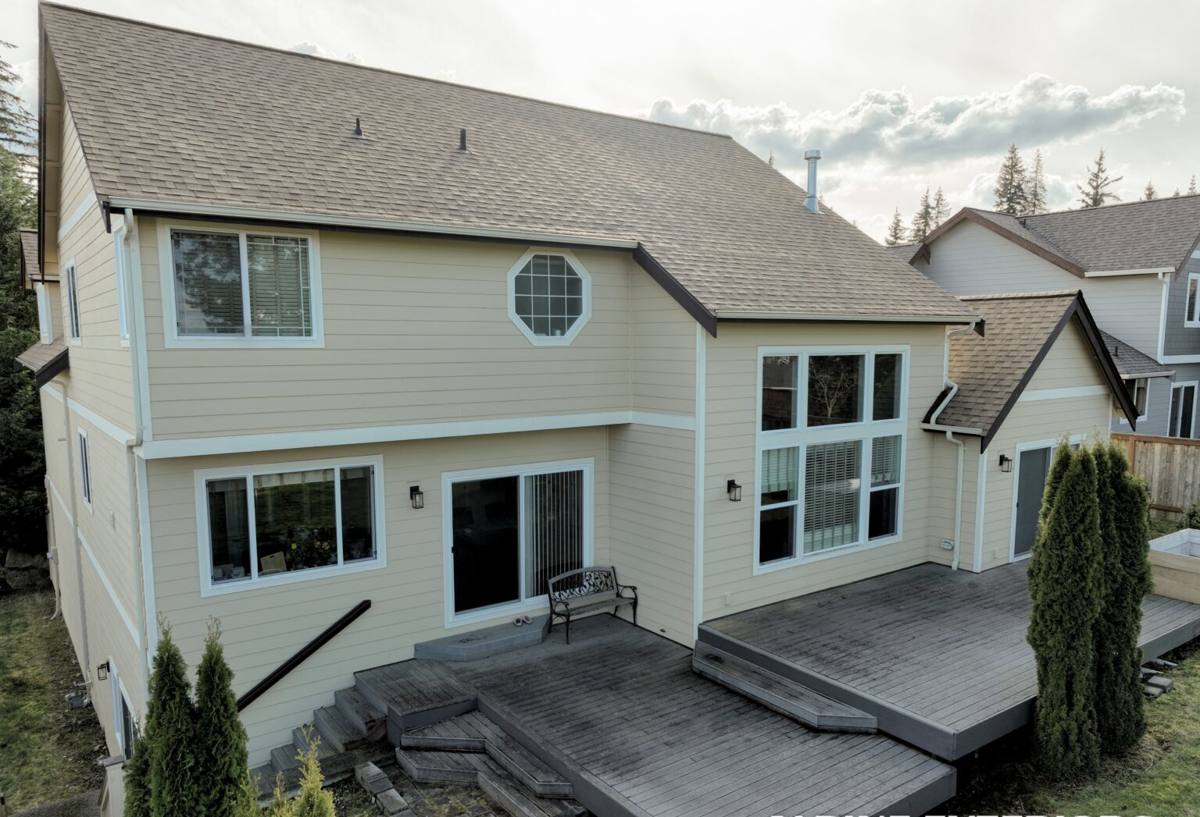
Signs a Deck Needs Replacement, Not Repair
Not every aging deck needs a full tear-out. But in this climate, certain signs mean the structure itself has been compromised, and patching around them just delays a bigger problem. Worth checking for:
- Soft, spongy, or springy spots in the decking or framing when you walk across them
- Visible rot, dark staining, or crumbling wood at the ledger board where the deck meets the house
- Fasteners or hardware showing heavy rust, corrosion staining, or that have worked loose
- Posts or railings that feel wobbly or shift under normal weight
- Persistent moss or mildew that comes back within weeks of cleaning, especially on shaded sections
- Gaps between boards that have closed up or widened unevenly, suggesting framing movement underneath
- A deck older than 20-25 years that has never had the substructure inspected or hardware upgraded
Any one of these on its own might be a repair. Several together, especially involving the ledger connection or the framing itself, usually mean the deck has reached the point where a full replacement is the more honest recommendation than another round of patchwork.
Repair vs. Full Replacement
Homeowners in Birch Bay Village often ask us to just fix the obvious problem — replace a few boards, tighten a railing — without addressing what's underneath. Sometimes that's genuinely the right call. Often, given this climate, it isn't.
| Factor | Repair Makes Sense | Replacement Makes Sense |
|---|---|---|
| Framing condition | Solid, no soft spots, hardware in good shape | Soft joists, corroded hardware, or ledger rot present |
| Deck age | Under 15 years, well-maintained | 20+ years, or unknown maintenance history |
| Scope of damage | Isolated to a few boards or one railing section | Spread across multiple areas or affecting the structure |
| Cost over time | Lower upfront cost, but recurring if underlying issues remain | Higher upfront cost, but resets the maintenance clock |
| Material | Original material still performing acceptably | Original material poorly suited to this climate (untreated wood, uncapped composite) |
We won't push a full replacement on a deck that's genuinely sound. But we also won't recommend patching a deck whose framing or ledger connection has already been compromised by moisture — that's a decision that tends to cost more in the long run once you factor in the repair that eventually follows the repair.
Choosing Decking Material for a Replacement
A replacement is also the point where most homeowners reconsider their decking material, since the whole surface is coming off anyway. In Birch Bay Village's exposure, that choice matters more than it would in a drier, more sheltered location.
Wood
Pressure-treated lumber and cedar remain common choices and can look great new, but both need regular sealing or staining to hold up against sustained salt air and moisture. In this climate, wood decking is usually the first material to show moss and soften if maintenance lapses even for a season or two.
Capped Composite
Capped composite boards use a plastic shell around a wood-fiber core, which resists moisture absorption and staining far better than wood or uncapped composite. That cap layer is doing real work in a salt-air environment — it's the difference between occasional washing and ongoing sealing.
Cellular PVC
PVC decking has no wood fiber at all, so it doesn't absorb moisture the way even capped composite can at cut edges or fastener holes. It costs more and can flex more under heavy point loads, but for decks that sit close to the water or in heavy shade, some homeowners decide the added moisture resistance is worth it.
We'll walk through the honest trade-offs of each for your specific deck's exposure and budget rather than defaulting to whichever is easiest to install.
What a Correct Replacement Involves
The decking surface is what homeowners notice, but in Birch Bay Village's climate, what happens underneath is what determines whether the new deck lasts. A replacement done right includes:
- Full removal of the old decking, railings, and — where condition warrants it — the framing and posts, not just a surface swap over old substructure
- Inspection of footings and posts once exposed, since this is often the only point in a deck's life they get a real look
- New ledger flashing at the house connection, since this is one of the most common places moisture enters on an aging deck and it's rarely visible until the old decking comes off
- Stainless steel or coastal-grade corrosion-resistant fasteners and hardware throughout, replacing standard hardware that corrodes faster in salt air
- Framing sized and spaced correctly for the new decking product's span rating, since composite and PVC often have different requirements than the original wood framing was built for
- Correct board gapping for drainage and material movement, so wind-driven rain can actually shed instead of pooling between boards
- Grading and ventilation underneath the deck so moisture doesn't sit against new framing between storms
Skipping any of these still produces a deck that looks finished on day one. The difference shows up years later — in a soft joist, a corroding fastener, or a ledger connection that's been quietly taking on water since the day it was covered back up.
Our Deck Replacement Process
Assessment
We start with an on-site look at the existing deck — framing condition, ledger connection, footings where accessible, and how the site's sun, wind, and moisture exposure has affected it. This is also where we give you an honest read on whether repair is realistic or whether replacement is the better long-term call.
Material and Design
We walk through decking material options against your budget and how the space actually gets used, along with any layout or railing changes you're considering while the deck is already being rebuilt.
Permitting
Deck replacement in unincorporated Whatcom County generally falls under standard structural and setback permitting requirements, and we handle that as part of the job rather than leaving it for you to sort out separately.
Demolition and Structural Work
Old decking, railings, and any compromised framing come out, footings and posts get inspected, and the substructure is rebuilt or reinforced with hardware and fastening suited to this climate.
Decking, Railing, and Finish
The new decking surface goes down with correct gapping and fastening, followed by railings, stairs, and any trim work, finished to integrate cleanly with the rest of the exterior.
Walkthrough
We finish with a walkthrough covering what your specific decking material actually needs going forward — for most modern materials that's minimal, but it isn't nothing in this climate.
Ongoing Care After Replacement
Even a correctly built replacement deck needs some routine attention in Birch Bay Village's climate to reach its full lifespan. A short list worth keeping to:
- Rinse or wash the deck surface periodically to clear salt residue and organic buildup before it works into the surface
- Check railing and post connections once or twice a year for any looseness, especially after winter storm season
- Keep gutters and downspouts near the deck clear so runoff isn't dumping extra water onto or under the structure
- Address any new moss growth promptly rather than letting it establish, particularly on shaded sections
- Reapply sealant on wood elements — trim, stairs, or a wood-topped railing — on the manufacturer's recommended schedule, not "when it looks bad"
Why a Local Birch Bay Village Crew Matters
Standard deck-building guidance is written around average conditions, not a shoreline neighborhood where salt air and wind-driven rain are a daily fact and moss has most of the year to establish itself. A crew that has actually replaced decks in Birch Bay Village knows which older cottages are likely to have undersized original framing, which ledger connections tend to be hiding rot by the time the decking comes off, and where extra time on flashing and fastener selection is worth it even when it isn't strictly required elsewhere in the county.
That's the kind of judgment that doesn't come up in a sales conversation but shows up fifteen years later in whether the deck is still solid or already showing the same problems the old one did. Whatcom County's coastline punishes shortcuts, and Birch Bay Village sees more of that exposure than most of the towns around it.
What to Ask Before Hiring for a Deck Replacement
- Ask whether they inspect footings and framing once the old decking is off, or just build over what's there
- Ask what fastener and hardware grade they use as standard, not as an upsell
- Confirm current Washington contractor licensing and insurance
- Get a written scope that specifies materials, not just "composite decking" without a product name
- Ask how the ledger flashing detail will be handled at the house connection
If your deck in Birch Bay Village is showing soft spots, corroding hardware, or persistent moss, or you're just ready to replace an aging deck with something built for this exposure, we're happy to take a look. We offer free, no-pressure estimates for deck replacement in Birch Bay Village and the surrounding area — use the form below to get a time on the schedule.