 Birch Bay
 Why Siding Wears Differently Near Birch Bay and Bellingham
Homes in and around Bellingham and Birch Bay sit in one of the more demanding exterior environments in Washington. You've got salt-laden air rolling in off the water, long stretches of driving rain that push moisture sideways into wall assemblies, and a moss and mildew season that can run most of the year in shaded or north-facing spots. None of that is unusual for Whatcom County — it's just the trade-off for coastal living. But it means siding here doesn't fail the way it does in drier parts of the state. It fails from the outside in: coatings chalk and fade faster, seams and butt joints stay damp longer than they should, and anything with an organic component starts feeding moss and algae within a few seasons.
When we talk about siding replacement for a Bellingham or Birch Bay home, we're not just talking about swapping old panels for new ones. We're talking about correcting whatever let moisture and biological growth get a foothold in the first place, and installing a product and detailing that's actually built for this climate.
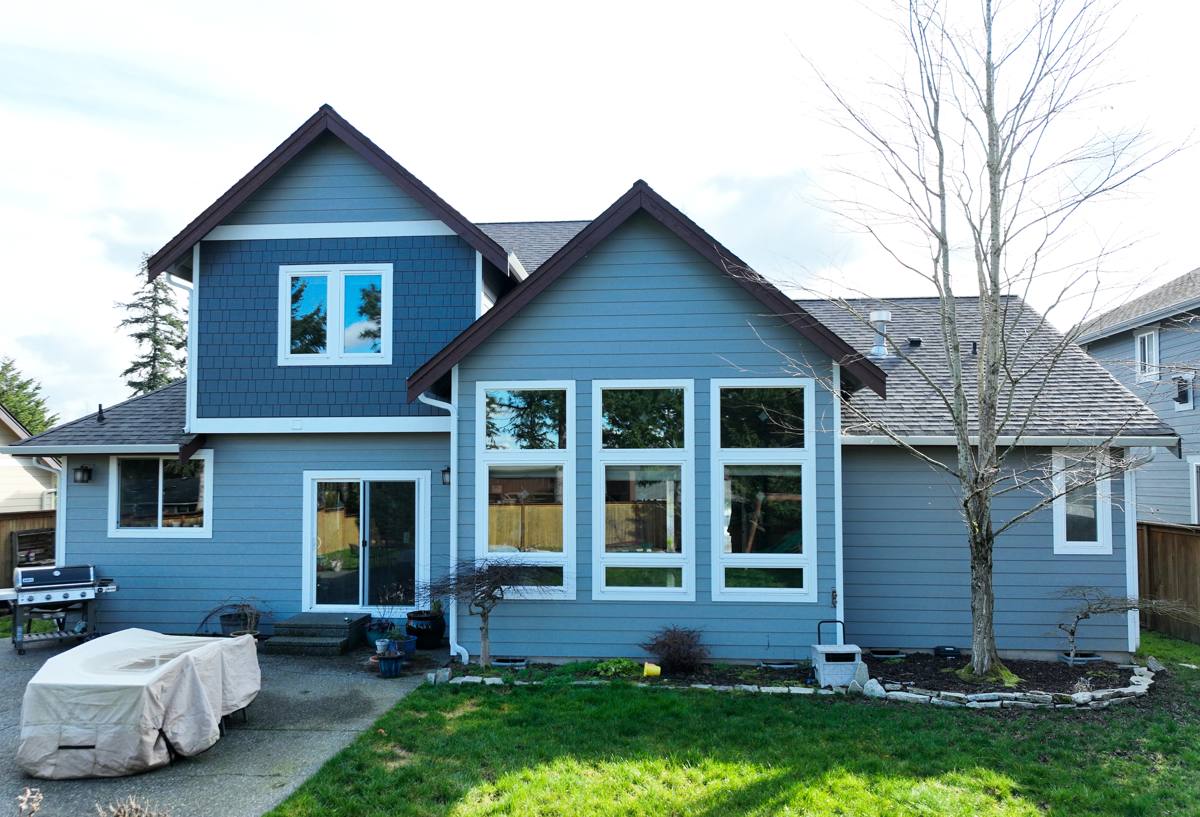
Signs Your Siding Has Reached the End of Its Service Life
Not every siding problem means a full replacement — sometimes it's a repair, a re-caulk, or a paint job. But there are signs that tell us the assembly itself is compromised and patching won't hold:
- Soft, spongy, or crumbling spots when you press on the siding, especially near the bottom courses
- Persistent moss or dark streaking that comes back within a season of cleaning
- Paint that's bubbling, peeling, or won't hold a new coat for more than a couple of years
- Visible gaps, warping, or cupping at panel edges and seams
- Interior signs — musty smells, discoloration, or soft drywall near exterior walls
- Siding that's original to a home built more than 20-25 years ago, particularly wood-based or older composite products
If you're seeing more than one of these, it's worth having someone look at the wall assembly itself, not just the surface — because in a wet climate like this one, surface damage is often the last symptom, not the first.
What a Correct Siding Replacement Actually Involves
A siding replacement done right is a weather-management project, not a cosmetic one. On a coastal Whatcom County home, that means paying close attention to the parts you won't see once the job is finished:
Tear-off and inspection
Once the old siding comes off, we inspect the sheathing and framing underneath. This is the moment that tells the real story — whether previous flashing was done correctly, whether there's rot that needs to be cut out and replaced, and whether the house wrap or building paper actually did its job. Skipping this step and just installing over questionable sheathing is how homeowners end up paying for the same problem twice.
Water-resistive barrier and flashing
In a region with as much driving rain as this one gets, the drainage plane behind the siding matters as much as the siding itself. That means a properly lapped weather-resistive barrier, correctly integrated flashing at every window, door, and roofline intersection, and attention to how water is meant to exit the wall assembly rather than get trapped in it.
Rainscreen and ventilation
Where conditions call for it, a ventilated rainscreen gap behind the siding lets any moisture that does get past the cladding dry out instead of sitting against the sheathing. This is one of the details that separates a siding job built for a wet coastal climate from one that was installed the same way you'd install it somewhere dry.
Fastening and joint detailing
Butt joints, corners, and trim intersections are where most siding failures start. Correct fastener placement, proper caulking at the right joints (and none at joints that should be left to drain), and manufacturer-spec clearances from grade, decks, and roof lines all affect how long the job lasts.
Why We Install Only James Hardie Fiber Cement
We standardized on James Hardie fiber cement siding for every project, including replacements in Bellingham and Birch Bay, and we're upfront about why. Fiber cement is non-combustible, it doesn't feed moss and mildew the way wood-based or organic-core products can, and it holds its shape in freeze-thaw and wet-dry cycling far better than materials that expand, contract, or absorb moisture over time. James Hardie's ColorPlus factory-applied finish is baked on and warranted separately from the substrate, which matters in an area where UV and salt air are hard on field-applied paint. Hardie also engineers specific formulations — including HZ5 and HZ10 product lines — for different climate zones, so what goes on a house here isn't the same formulation you'd use in the desert Southwest.
We don't install vinyl, LP SmartSide, Cemplank, Allura, or primed wood species like spruce or cedar. That's not a knock on every homeowner who has one of those products — plenty of them perform fine in the right conditions and with diligent upkeep. Our decision comes down to what we're willing to warranty our labor on in this specific climate: vinyl can warp and fade faster under coastal sun and doesn't offer the fire resistance of fiber cement; engineered wood products depend heavily on caulking and paint maintenance staying ahead of moisture, which is a hard standard to keep up with in a region that sees as much rain as Whatcom County does; and less-established fiber cement competitors don't carry the same track record or manufacturer support in the Pacific Northwest that James Hardie does. Given the climate we install in, Hardie is the product we're confident will still be doing its job in twenty years.
Our Process, Start to Finish
| Step | What Happens |
|---|---|
| Estimate & inspection | We walk the exterior, check for moisture damage, and give you a written scope and price — no pressure, no obligation. |
| Tear-off | Old siding is removed and hauled away; sheathing is inspected before anything new goes on. |
| Repairs as needed | Any rotted sheathing, framing, or damaged flashing is addressed before the wall is closed back up. |
| Weather barrier & flashing | Water-resistive barrier, flashing, and rainscreen detailing (where applicable) are installed to manage moisture correctly. |
| Hardie siding installation | Panels, trim, and accessories are installed to James Hardie's fastening and clearance specifications. |
| Final walkthrough | We review the finished work with you and address any punch-list items before calling it done. |
What Drives Cost on a Bellingham or Birch Bay Replacement
Every home is different, and we're not going to quote a number without seeing the house, but these are the factors that most often move the price:
| Factor | Why It Matters Here |
|---|---|
| Extent of sheathing/rot repair | Coastal moisture exposure means hidden damage is more common than in drier regions — it's not always visible until tear-off. |
| Home size and wall complexity | More corners, dormers, and roof intersections mean more flashing and trim detail work. |
| Siding profile and trim package | Lap siding, shingle-style panels, and board-and-batten all price differently, as does the trim and accent detailing you choose. |
| Accessibility | Steep sites, limited driveway access, or multi-story sections common in this area can affect labor and equipment needs. |
| Existing moisture damage | Homes that have gone years without maintenance in this climate often need more structural repair than the siding swap alone. |
Why Hiring a Crew That Works This Area Matters
Siding installation isn't identical everywhere in Washington, and a crew that mostly works drier inland regions will make different assumptions than one that installs siding week in and week out along the Salish Sea. A contractor familiar with Bellingham and Birch Bay conditions knows to check for the moisture patterns specific to shaded, wind-driven, and salt-exposed walls, knows which flashing details actually hold up here, and isn't guessing at how much rainscreen ventilation a given elevation needs. That familiarity shows up in fewer callbacks and a longer-lasting job — not in anything flashy, just in the boring, correct details that keep water out.
When you're vetting a siding contractor for a coastal Whatcom County home, it's reasonable to ask directly about their experience with wet-climate installation, how they handle sheathing repair when it's found mid-project, and what their warranty actually covers — both on materials and on labor.
Caring for Your New Siding After Installation
James Hardie fiber cement is low-maintenance compared to wood or engineered-wood alternatives, but "low-maintenance" isn't "no-maintenance," especially in a climate that grows moss on almost anything left alone long enough. A short annual routine keeps it looking and performing the way it should:
- Rinse the siding with a garden hose once or twice a year to clear salt residue, pollen, and grime
- Keep gutters clear so overflow doesn't run down the siding face repeatedly
- Trim back vegetation and tree cover that keeps siding shaded and damp longer than necessary
- Check caulking at trim and joints annually and have any cracked sections resealed
- Address any moss or algae early with a gentle wash rather than letting it establish
- Watch for any soft spots or damage after storms and have them looked at promptly
If you're weighing whether to repair or replace, or you just want an honest read on what your current siding is telling you, we're happy to take a look. We offer free, no-pressure estimates for Bellingham and Birch Bay homeowners — use the form below to get started.