 Birch Bay
 Decks on Lummi Island Take a Different Kind of Beating
Lummi Island sits right in the path of everything Whatcom County's marine climate can throw at a deck: salt-laden air off the water, driving rain that comes in sideways during winter storms, and a moss season that seems to stretch longer every year. A deck built to a generic spec — the kind of deck you'd see inland or in a drier climate — tends to show its age fast out here. Fasteners corrode sooner, boards cup and hold water, and anything shaded by trees or the house itself grows a green film that turns slick the moment it rains.
When we talk about deck replacement in Lummi Island, we're not just talking about tearing off old boards and nailing down new ones. We're talking about rebuilding a structure so it can actually handle the environment it lives in — ledger flashing that keeps water out of the house framing, fasteners rated for coastal exposure, and a board choice and drainage plan that account for how much shade and moisture the deck sees. Get those decisions wrong and you're looking at a deck that needs attention again in five or six years instead of twenty-plus.
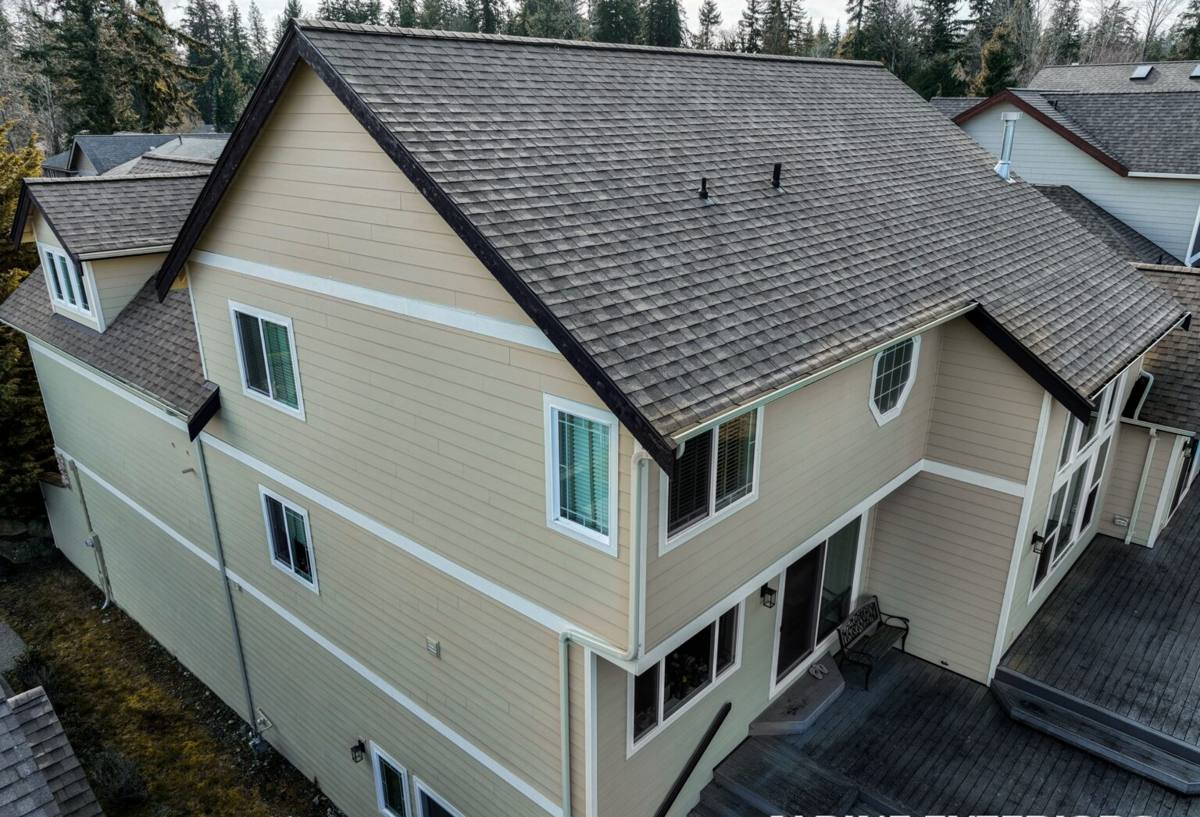
Why Salt Air, Rain, and Moss Matter More Than People Think
Salt Air and Metal Fatigue
Salt air accelerates corrosion on anything metal — screws, joist hangers, structural connectors, railing hardware. On a deck close to the water, standard zinc-coated fasteners can start showing rust streaks and pitting years before they would inland. Once a fastener starts corroding, it loses holding strength, and that's a structural issue, not a cosmetic one. This is why the fastener and hardware spec matters as much as the decking material itself.
Driving Rain and Water Intrusion
Storms here don't always come straight down. Wind-driven rain gets pushed sideways and upward under railings, around ledger boards, and into any gap where flashing wasn't done right. A deck attached to the house needs proper ledger flashing that directs water away from the band joist and foundation — this is one of the most common failure points we find when we tear off an old deck, and it's usually invisible from the surface until the wood underneath is already soft.
Moss and Slip Hazard
Whatcom County's long wet season means moss and algae get a real foothold on any deck surface that doesn't drain and dry quickly — north-facing decks, shaded areas under trees, and low spots where water pools are the usual culprits. Beyond looking bad, a mossy deck surface is a slip hazard, especially on stairs. Board spacing, airflow underneath the deck, and surface texture all affect how fast moss takes hold and how easy it is to keep off.
What a Correct Deck Replacement Involves
A proper deck replacement on Lummi Island isn't just swapping decking boards. Here's what we look at on every job:
- Structural inspection first — checking posts, beams, and joists for rot before deciding what actually needs to be replaced versus what's still sound
- Ledger board and flashing — proper flashing at the house connection is the single biggest factor in whether a deck stays dry where it meets the structure
- Footings and posts — verifying footings are set below frost depth and posts are properly connected, not just resting on old concrete pads
- Joist hardware rated for exposure — using connectors and fasteners suited to coastal, high-moisture conditions rather than standard interior-grade hardware
- Decking material selection — matched to the home's sun and shade exposure, maintenance expectations, and budget
- Drainage and airflow underneath — grading and joist spacing that let air move and water drain instead of pooling under the deck
- Railings and stairs built to current code — height, baluster spacing, and stair geometry brought up to standard, since older decks were often built under looser rules
Choosing Decking Material for This Climate
There's no single "best" decking material — the right choice depends on how much sun the deck gets, how much maintenance the homeowner wants to do, and the budget. Here's how the common options stack up for a moisture-heavy, salt-air environment like Lummi Island:
| Material | Moisture & Moss Resistance | Maintenance | Typical Lifespan |
|---|---|---|---|
| Pressure-treated wood | Fair — needs sealing to perform well | Annual cleaning and periodic re-sealing | 10-15 years with upkeep |
| Cedar | Good natural rot resistance, still needs care in shade | Regular sealing or staining | 15-20 years with upkeep |
| Composite decking | Very good — doesn't absorb water like wood | Periodic washing, no sealing needed | 25-30 years |
| PVC/capped decking | Excellent — fully sealed surface | Occasional washing | 25-30+ years |
Composite and capped PVC products have become popular for coastal Washington homes precisely because they don't soak up moisture the way wood does, which means less swelling, less warping, and a lot less moss buildup over time. Wood decking can still be the right call for homeowners who want that specific look and are willing to keep up with sealing — we'll walk through the honest trade-offs for your specific deck rather than push one product line.
How Our Process Works for Lummi Island Projects
Because Lummi Island properties sometimes mean ferry scheduling and tighter delivery windows than mainland Birch Bay jobs, we plan material staging and crew time around that up front rather than discovering it mid-project. Here's the general sequence:
- On-site assessment — we inspect the existing deck structure, ledger connection, footings, and framing to determine what's salvageable
- Written estimate — a clear scope covering demo, structural repair, material choice, and railings/stairs, with no vague allowances
- Material staging — ordering and scheduling delivery to account for ferry logistics so the crew isn't waiting on materials mid-job
- Tear-off and structural repair — removing old decking and addressing any rot or hardware issues found underneath
- Rebuild — new framing hardware, ledger flashing, decking, railings, and stairs installed to current code
- Final walkthrough — going over the finished deck together before we consider the job done
What to Check Before You Hire
- Do they carry current Washington contractor licensing and insurance, and will they show you proof without hesitation?
- Do they inspect the ledger flashing and structural framing, or just quote based on square footage?
- Can they explain why they're recommending a specific decking material for your deck's sun/shade exposure, not just what they have on hand?
- Do they have experience getting materials and crews to island properties, including ferry scheduling?
- Is the estimate detailed enough that you know what's included — demo, hardware, railings, stairs — or is it a single vague number?
Why Local Experience on Lummi Island Matters
A deck replacement on Lummi Island has logistical realities that a mainland-only crew doesn't always plan for — ferry schedules affect when materials and crew can get on and off the island, and that has to be built into the project timeline from the start, not discovered halfway through. Beyond logistics, a crew that's worked coastal Whatcom County properties before knows which fastener grades hold up, where flashing tends to fail on homes exposed to wind off the water, and how much airflow a deck actually needs underneath to keep moss from taking over a shaded section.
None of that is exotic knowledge, but it's the difference between a deck that looks fine on installation day and one that still looks and performs well five winters from now.
Signs Your Deck Needs Replacing, Not Just Repairing
Not every deck problem means a full replacement. But a few signs usually point that direction rather than a patch job:
- Soft or spongy spots in the decking boards, especially near the house connection
- Visible rot or rust at joist hangers and structural connectors
- Persistent moss or algae that comes back within weeks of cleaning
- Railings that feel loose or wobbly when pushed
- Water pooling on the deck surface instead of draining off
- A ledger board connection that shows staining or soft wood on the house siding above or below it
If you're seeing one or two of these, a repair might still make sense. If you're seeing several, or the deck is over 15-20 years old, replacement is usually the more cost-effective path — patching a structure with widespread issues just means paying for the same repairs again in a couple of years.
If you're weighing a deck replacement on Lummi Island, we're happy to come take a look and give you a straight, no-pressure estimate — just fill out the form below to get started.