 Birch Bay
 Building a Deck That Actually Belongs on the Whatcom County Coast
A deck in Bellingham or Birch Bay lives a different life than one built fifty miles inland. The salt-tinged air off the bay, the long stretches of driving rain from fall through spring, and the low winter sun angles that let moss and algae camp out on wood surfaces for months at a time all put extra demands on the structure, the fasteners, and the finish. A deck built to a generic national spec will often look fine the first summer and start showing problems by year three: soft spots at the ledger board, streaking and green film across the boards, rust bleeding from screw heads. Building for this area means designing and detailing the deck differently from day one, not just picking "good" lumber and hoping for the best.
This page focuses specifically on custom deck construction for homes in and around Bellingham and Birch Bay — what the climate actually does to a deck, what correct construction looks like here, and how we approach the work from estimate to final walkthrough.
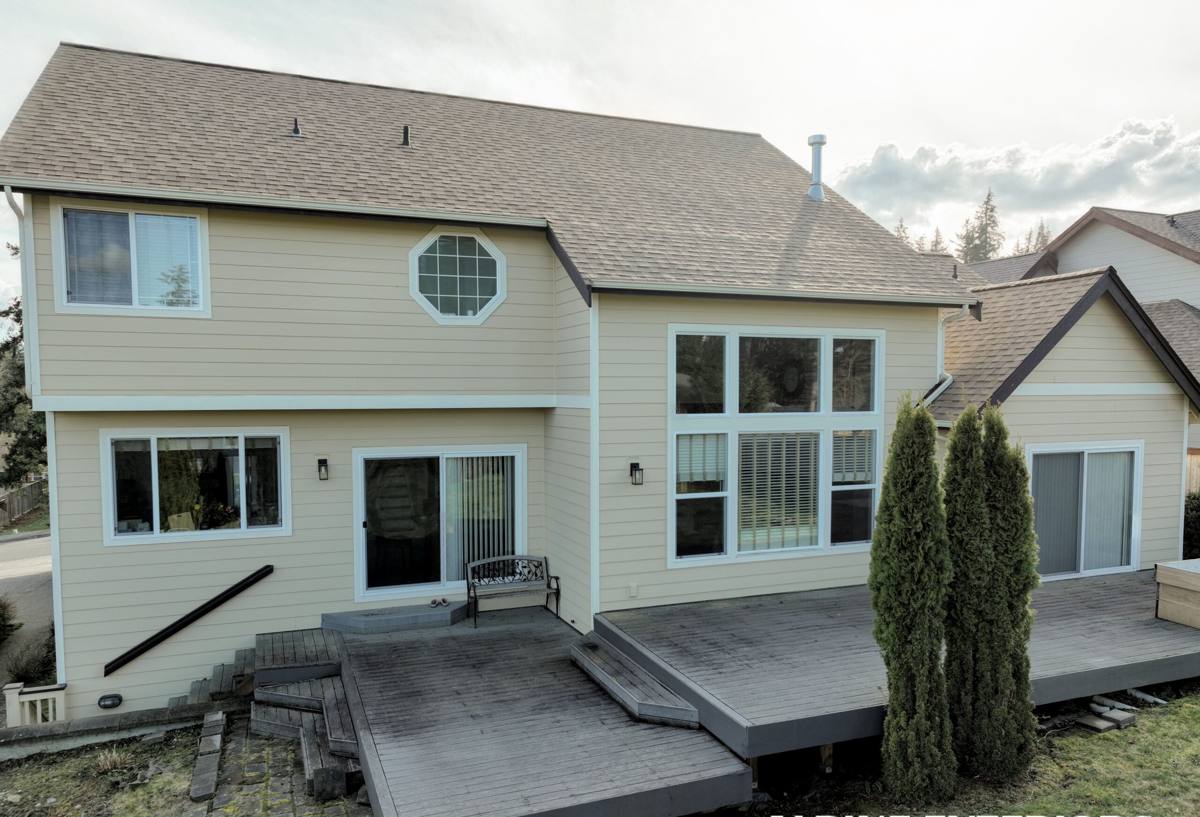
What This Climate Does to a Deck Over Time
Whatcom County's coastal exposure brings three things together that are individually manageable but genuinely tough in combination: persistent moisture, salt-laden air near the water, and shaded, slow-drying surfaces during the region's long wet season. A deck doesn't fail because of one storm — it fails because it never fully dries out between storms.
Moisture that never really leaves
Bellingham and Birch Bay see extended stretches of overcast, damp weather rather than short, hard downpours. That means deck boards, joists, and ledger connections stay wet longer than in drier climates, which is exactly the condition wood-decay fungus and algae need to establish themselves.
Salt air and metal fasteners
Proximity to the bay means airborne salt reaches decks that aren't even waterfront properties. Standard zinc-coated screws and nails can start showing surface corrosion within a few seasons in exposed coastal locations, which leads to unsightly rust streaks and, eventually, weakened fastening.
Moss and algae season
Because Whatcom County's wet season runs long and the sun sits low for much of the year, shaded deck areas — under roof overhangs, next to fences, on the north side of the house — can stay damp almost continuously. That's the recipe for moss and algae growth, which isn't just cosmetic. Moss holds moisture against the wood surface and makes boards dangerously slick.
Choosing the Right Decking Material for This Area
There's no single "best" decking material — the right choice depends on how much maintenance a homeowner wants to do, budget, and how exposed the deck is to weather. What matters most in this climate is picking a material and finish combination honestly, with eyes open about the trade-offs.
| Material | How it handles this climate | Maintenance | Typical lifespan here |
|---|---|---|---|
| Pressure-treated wood | Affordable and strong, but needs consistent sealing to resist the wet season and slows moss growth only if maintained | Annual cleaning and re-sealing recommended | 15-20 years with upkeep |
| Cedar | Naturally more rot-resistant than pine, still needs finish maintenance to fight graying and moss in shaded areas | Cleaning and finish renewal every 1-2 years | 15-20 years with upkeep |
| Composite decking | Doesn't absorb water like wood, resists rot, but can still grow surface algae/moss film in shaded, damp spots and needs periodic washing | Occasional washing, no sealing/staining | 25-30+ years |
| PVC decking | Fully synthetic, handles moisture and salt air very well, least prone to moss taking hold | Occasional washing | 25-30+ years |
For homes with a lot of shade or close proximity to the water, we generally steer conversations toward composite or PVC decking specifically because they remove the ongoing sealing/staining burden that this climate makes a real chore. For homeowners who want the look and feel of real wood and are willing to maintain it, cedar is a solid choice as long as the maintenance schedule actually happens — a wood deck that gets sealed once every four or five years instead of every year or two will age faster here than the same deck in a drier region.
What Happens Underneath the Decking Matters More Than the Decking Itself
Homeowners naturally focus on the decking material because it's what they see and walk on, but the structure underneath is what determines whether a deck lasts. In this climate, a handful of details separate a deck that holds up for decades from one that develops hidden rot within a few years.
Ledger board flashing
The ledger board — where the deck attaches to the house — is the single most common failure point on any deck, and it's a bigger risk here because of how long moisture sits against the house wall during the wet season. Proper flashing that sheds water away from the house sheathing, rather than trapping it against the ledger, is non-negotiable.
Joist protection
Joist tape or a comparable protective barrier over the top of each joist keeps standing water from soaking into the wood every time it rains, which in a region with our rainfall totals adds years to the frame's life.
Footings below frost depth and on stable soil
Whatcom County soils vary block to block — some are well-draining, some hold water. Footings need to be sized and set correctly for the specific soil conditions and local frost depth, not just poured to a generic minimum.
Airflow underneath
Decks built low to the ground or enclosed with skirting need enough ventilation underneath to let the frame dry out between storms. Without it, low decks in shaded yards are exactly the spots where we see moss and soft wood develop first.
Fasteners and Hardware That Hold Up Near the Bay
This is one of the areas where cutting corners doesn't show up for a year or two — and then shows up everywhere at once, as rust streaking down every board. For decks in Birch Bay and Bellingham, we treat fastener and hardware selection as a climate decision, not just a cost line.
- Stainless steel or high-grade coated fasteners rated for coastal/salt-air exposure, not standard interior-grade hardware
- Structural connectors (joist hangers, post bases) matched to the fastener material to avoid corrosion between dissimilar metals
- Post bases that hold the post above the decking surface so the end grain isn't sitting in standing water
- Railing hardware rated for exterior, high-moisture use — especially on any deck with a view of the water where salt exposure is higher
Railings, Guardrails, and Code Requirements
Any deck surface more than 30 inches above grade needs a code-compliant guardrail, and the specific height, baluster spacing, and load requirements are set by the building code adopted in Whatcom County. Beyond the legal minimum, railing choice matters for this climate too — wood railings need the same maintenance commitment as wood decking, while metal or composite railing systems hold up with less upkeep against the same moisture and salt exposure that affects the deck itself.
Setbacks, deck height, and whether a permit is required also depend on the specific property and its zoning within Bellingham or unincorporated Whatcom County near Birch Bay. We handle the permit process as part of the project rather than leaving homeowners to sort it out with the county on their own.
How We Approach a Custom Deck Project
- On-site assessment. We look at sun/shade exposure, drainage on the lot, proximity to the water, and how the deck will attach to the house before recommending materials.
- Design and material selection. We walk through the trade-offs above in plain terms — what each material and finish choice actually means for maintenance and lifespan in this specific location.
- Permitting. We handle the applicable permit submission and inspections so the deck is built to code from the start.
- Framing built for the climate. Correct ledger flashing, joist protection, footings sized for the soil and frost depth, and adequate airflow underneath.
- Decking and railing installation. Installed with fasteners and hardware rated for coastal exposure, with attention to drainage gaps and board spacing that account for our wet season.
- Final walkthrough. We go over the maintenance schedule appropriate to the material chosen, so there are no surprises down the road.
Keeping a New Deck Ahead of Moss and Algae
Even a well-built deck needs some seasonal attention in this climate, especially in shaded corners of Bellingham and Birch Bay yards. A short, honest maintenance routine goes a long way toward protecting the investment.
- Sweep debris (leaves, needles, seed pods) off the deck regularly — trapped organic matter holds moisture and feeds moss growth
- Rinse or wash the surface at least once or twice a year, more often in shaded areas, to remove the algae film before it takes hold
- Check and clear gaps between boards so water and debris aren't trapped against the joists
- For wood decks, re-seal or re-stain on the schedule appropriate to the product — skipping a cycle in this climate shows up faster than it would inland
- Inspect fastener heads and hardware annually for early signs of corrosion, especially on decks closer to the water
- Trim back overhanging vegetation where practical to let more light and airflow reach shaded sections of the deck
Why Local Experience Matters for This Job
Deck building looks similar everywhere on the surface, but the details that make a deck last in Whatcom County are specific to this coastline: the flashing details that account for our wet season, the fastener grade that accounts for salt air, and the material recommendations that account for how much shade and moisture a specific Bellingham or Birch Bay yard actually gets. A crew that builds decks regionally, without adjusting for this coast, tends to make the same generic choices everywhere — and those choices are exactly what shows up as rot and rust here first. Working in this area regularly means we've seen which details matter and which corners genuinely can't be cut.
If you're planning a new deck or replacing one that's showing its age, we're happy to take a look and put together a straightforward, no-pressure estimate. Use the form below to get started.